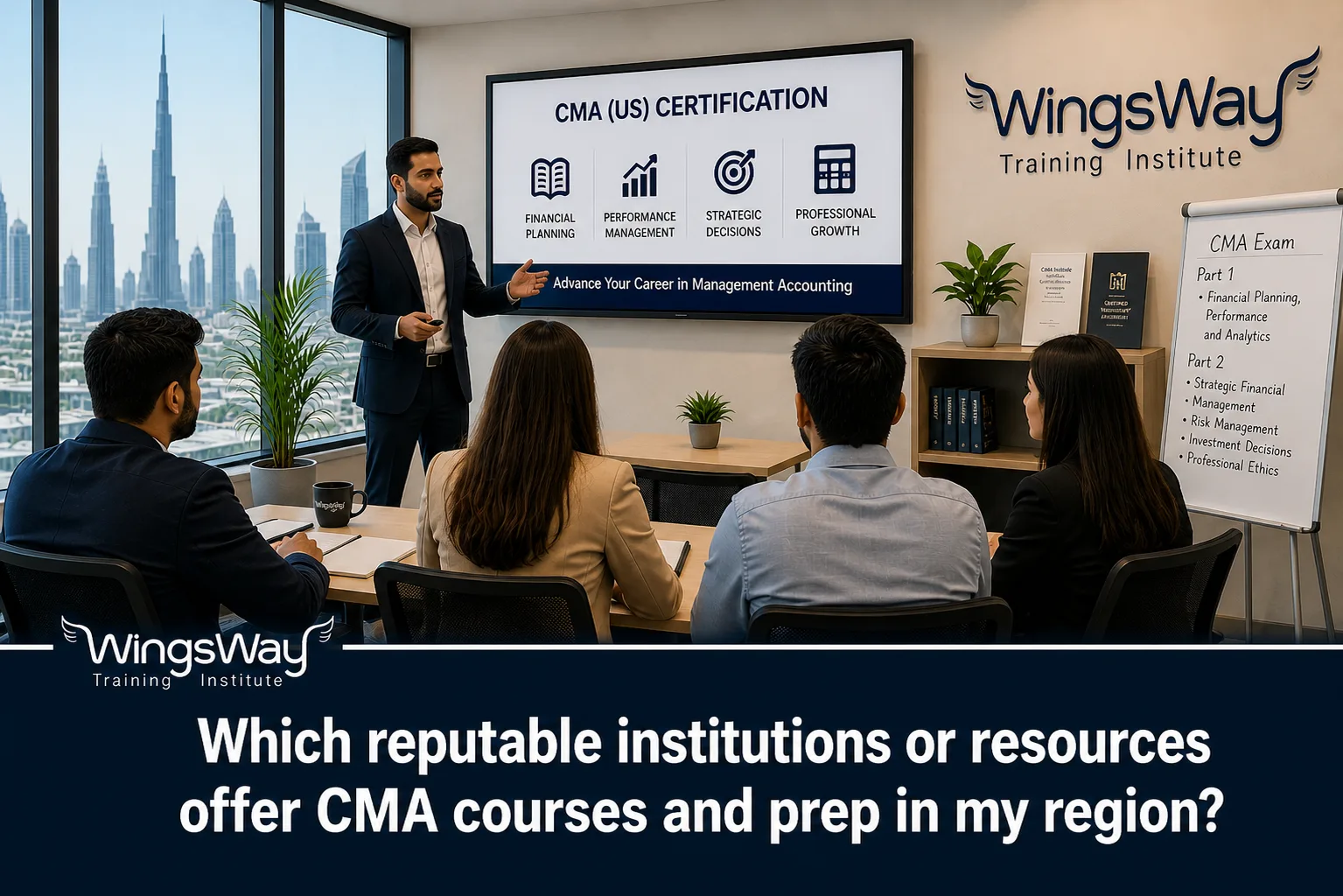
Which reputable institutions or resources offer CMA courses and prep in my region?
Quick Answer: CMA courses are offered by globally accredited training institutes approved by the Institute of Management Accountants (IMA), USA. In the UAE, reputable providers must hold KHDA approval and ideally CPD (UK) or ISO 9001:2015 accreditation. Internationally, candidates can access CMA certification prep through IMA-recognised centres across India, the GCC, and beyond, with content often aligned to globally trusted review systems such as HOCK International.
Which reputable institutions or resources offer CMA courses and prep in my region?
Choosing the right provider for CMA courses is one of the most important decisions a finance professional can make. The Certified Management Accountant (CMA) credential, awarded by the Institute of Management Accountants (IMA) in the United States, is recognised across more than 150 countries. Its global reputation means that the quality of your training provider directly influences your exam readiness, career prospects, and professional credibility.
Whether you are based in Dubai, Sharjah, Abu Dhabi, India, or anywhere in the GCC, access to high-quality CMA certification prep has improved significantly. Today, candidates can choose from classroom-based institutes, online platforms, hybrid programmes, and self-study systems. However, not all providers carry the same level of accreditation or instructional quality. Understanding what separates a reputable institution from a generic training centre is essential before enrolling.
This guide explains what to look for in a CMA course provider, how to evaluate institutional credibility, which accreditation markers matter most, and what resources are available across key regions including the UAE, India, and the broader GCC.
Why the Choice of CMA Course Provider Matters
Finance is one of the most regulated and competitive professional fields globally. The CMA certification signals to employers that a professional possesses verified competency in financial planning, analysis, control, decision support, and professional ethics. But the credential alone is not enough. The preparation path matters enormously.
A credible CMA course provider ensures candidates receive structured instruction aligned with the official CMA exam syllabus, access to quality practice questions and mock tests, and guidance from experienced trainers who understand the exam format. Beyond exam preparation, reputable institutions often carry regulatory approvals that add value to the certificate of completion they issue.
In the UAE specifically, CMA courses offered by KHDA-approved institutes carry formal recognition from the Knowledge and Human Development Authority. This distinction is relevant for professionals who want their continuing education credentials to be formally verifiable in the UAE system.
In India, the US CMA qualification is distinct from the Indian CMA (offered by ICMAI). Candidates must choose providers who clearly prepare for the IMA-administered US CMA exam, rather than the domestic Indian variant.
Key Takeaways
- CMA courses leading to the CMA US certification are overseen by the Institute of Management Accountants (IMA), USA, and the exam is administered by Prometric.
- In Dubai and the UAE, look for training providers approved by the KHDA, accredited by CPD (UK), and holding ISO 9001:2015 certification for quality assurance.
- The IMA maintains an official directory of approved training partners globally. Enrolling through a listed provider adds an extra layer of credibility.
- HOCK International is one of the most respected CMA review content providers worldwide. Training institutes that partner with or use HOCK-aligned materials offer candidates access to premium, globally benchmarked study resources.
- The CMA exam is divided into two parts: Part 1 covers Financial Planning, Performance, and Analytics; Part 2 covers Strategic Financial Management.
- Candidates typically require six to twelve months of preparation, though this varies based on prior knowledge, study hours per week, and the quality of the training programme.
Recognised Bodies and Their Role in CMA Certification
Understanding which organisations govern, accredit, or endorse CMA training helps candidates make informed decisions about where to study.
Institute of Management Accountants (IMA, USA)
The IMA is the sole governing body that awards the Certified Management Accountant credential. It sets the syllabus, manages exam registration, and maintains a directory of approved training providers globally. Any candidate pursuing the US CMA qualification must be an IMA member. The IMA’s Middle East chapter is particularly active, recognising training institutions across the UAE, Saudi Arabia, Bahrain, and Jordan.
HOCK International
HOCK International is one of the most reputable CMA exam prep content providers in the world. Institutions that partner with HOCK, or align their course materials to HOCK’s review system, provide candidates with high-quality question banks, study texts, video lectures, and mock examinations. This content alignment matters because the depth and accuracy of study materials significantly affect pass rates. Candidates should ask potential training providers whether their content is developed in partnership with or benchmarked against internationally recognised review systems such as HOCK.
KHDA – Knowledge and Human Development Authority (UAE)
The KHDA is the regulatory authority responsible for the growth, direction, and quality of private education in Dubai. Any training institute operating in Dubai must be licensed by KHDA. For CMA course candidates in the UAE, enrolling at a KHDA-approved institute means the provider has met formal regulatory standards for private education delivery. This is an important due diligence check before committing to a programme.
CPD – Continuing Professional Development Standards Office (UK)
The CPD Standards Office in the United Kingdom accredits learning activities, training programmes, and educational providers. When a CMA training institute holds CPD accreditation, it means their course delivery meets internationally recognised standards for structured professional learning. CPD accreditation is particularly valued by professionals who need to demonstrate formal continuing education for career or regulatory purposes.
ISO 9001:2015 Certification
ISO 9001:2015 is an international quality management standard. Training institutes that are ISO certified have been independently audited and verified to maintain consistent, high-quality service delivery. While ISO certification alone does not guarantee exam success, it signals a provider’s commitment to operational excellence, quality infrastructure, and systematic improvement.
Market Demand for CMA Professionals: UAE, India, and GCC
The demand for CMA-certified professionals across the Middle East and South Asia has grown substantially over the past decade. Several structural factors are driving this.
In the UAE, Vision 2030-aligned economic diversification programmes have expanded the role of finance professionals beyond traditional bookkeeping into strategic advisory, FP&A, corporate governance, and risk management. Multinational corporations, government-linked entities, sovereign wealth funds, and large family conglomerates all actively recruit professionals with globally recognised credentials such as the CMA certification.
In India, the US CMA is increasingly popular among finance graduates and mid-career professionals looking to differentiate themselves in a competitive job market. Unlike some domestic certifications, the CMA credential opens doors to multinational employers, GCC postings, and global finance roles.
Across the broader GCC — Saudi Arabia, Bahrain, Kuwait, Oman, and Qatar — the expansion of financial services sectors and government-led privatisation programmes is creating sustained demand for qualified management accountants.
Salary benchmarks reflect this demand. In the UAE, entry-level CMA-certified professionals earn approximately AED 9,000 to AED 14,000 per month. Mid-level roles such as Finance Manager or Senior Accountant typically command AED 16,000 to AED 25,000 per month. Senior positions including Financial Controller and CFO-level roles can reach AED 30,000 to AED 40,000 or higher.
What Are CMA Courses?
CMA courses are structured training programmes that prepare candidates for the Certified Management Accountant examination administered by the IMA. These programmes cover the full syllabus across both exam parts, provide study materials, conduct mock examinations, and guide candidates through registration and exam scheduling.
A CMA course is not the same as the CMA certification itself. The certification is earned by passing both parts of the CMA exam and fulfilling IMA’s experience and membership requirements. The course is the preparatory vehicle that enables a candidate to reach that outcome.
CMA courses vary in format and duration. Classroom-based programmes offer structured, instructor-led sessions. Online live programmes provide similar instruction via virtual platforms. Self-paced programmes give candidates access to recorded lectures and question banks at their own convenience. Hybrid models combine live instruction with self-paced revision tools.
The two parts of the CMA exam are:
- Part 1 – Financial Planning, Performance, and Analytics: Covers external financial reporting decisions, planning and budgeting, performance management, cost management, and internal controls.
- Part 2 – Strategic Financial Management: Covers financial statement analysis, corporate finance, decision analysis, risk management, investment decisions, and professional ethics.
Reputable Institutions and Resources for CMA Courses by Region
The following sections outline how to identify reputable providers and what types of institutions operate in key regions. This is an educational overview to help candidates make informed comparisons.
What Makes a CMA Training Provider Reputable?
Before reviewing specific regions, it is useful to understand the markers of institutional credibility:
- IMA-listed or approved status: The IMA maintains a directory of recommended CMA course providers. While IMA does not exclusively endorse one provider, listing on their directory indicates recognition by the certifying body itself.
- Regulatory approval in the home country: In the UAE, this means KHDA approval. In India, recognition from state or central educational authorities applies.
- International accreditation: CPD (UK) accreditation and ISO 9001:2015 certification are internationally recognised quality markers for training providers.
- Content partnerships: Providers that use premium review systems — such as HOCK International — offer candidates access to the same calibre of materials used by top-performing candidates globally.
- Experienced faculty: Instructors who hold active CMA, CPA, or ACCA credentials and have real-world finance experience bring practical relevance to classroom instruction.
- Track record and pass rates: Institutions that publish or make available their student pass rates provide a meaningful indicator of training quality.
UAE and Dubai: What to Look for in a CMA Course Provider
Dubai has emerged as a significant hub for professional finance training in the Middle East. The concentration of multinational corporations, free zone businesses, and government entities creates consistent demand for CMA-certified professionals.
When evaluating a CMA course in Dubai, candidates should verify:
- KHDA licensing: The provider must be licensed by the Knowledge and Human Development Authority to operate legally as a private training institute in Dubai.
- CPD accreditation: Holding CPD (UK) accreditation confirms the programme meets structured professional development standards recognised internationally.
- ISO 9001:2015 certification: This standard confirms quality management processes are in place and independently audited.
- IMA membership guidance: A reputable provider should assist candidates with IMA membership registration, exam scheduling at Prometric centres, and eligibility verification.
- Flexible formats: Given that most candidates are working professionals, reputable institutes typically offer weekday, weekend, evening, and online learning options.
The IMA Middle East chapter, based in Dubai, serves as an important resource for candidates seeking to verify approved training providers in the region. Their website lists institutions that have been recognised for CMA exam preparation.
India: Navigating the US CMA vs. Indian CMA Distinction
India has a unique complication in the CMA landscape. The Institute of Cost Accountants of India (ICMAI) offers its own CMA qualification, which is distinct from the US CMA issued by the IMA. Candidates pursuing the international credential must be careful to enrol specifically in programmes that prepare for the IMA-administered exam.
Reputable providers for the US CMA in India typically operate in major financial centres including Mumbai, Delhi, Bangalore, Hyderabad, and Chennai. Many also offer online programmes accessible to candidates across smaller cities. When evaluating providers in India, look for:
- Explicit focus on the IMA US CMA exam, not the ICMAI domestic qualification
- IMA recognition or listing as a recommended training partner
- Access to international review materials aligned to current exam standards
- Faculty with CMA (USA) credentials and international corporate experience
GCC Region: Saudi Arabia, Bahrain, Kuwait, and Beyond
Across the GCC, several established training groups operate certified management accountant programmes. Providers with regional offices or affiliate networks across Saudi Arabia, Bahrain, Kuwait, Oman, and Qatar offer candidates the convenience of local instruction combined with internationally aligned content.
In these markets, IMA’s Middle East chapter provides an important resource. The chapter actively promotes CMA certification and maintains relationships with approved training providers across the region. Candidates in GCC countries outside the UAE should consult the IMA Middle East website or contact the chapter directly to obtain a current list of endorsed providers in their specific country.
Online and Self-Paced CMA Prep Resources
Beyond institution-based programmes, several globally recognised self-study and online platforms offer CMA preparation:
- HOCK International: One of the most respected independent CMA review providers. Offers comprehensive study texts, video lectures, and a question bank covering both exam parts. Widely used by candidates who prefer structured self-study.
- Gleim CMA Review: Another well-established global CMA prep provider offering adaptive learning technology and extensive question banks.
- Wiley CMAexcel: Offers official IMA-licensed study materials. Widely considered a strong option for candidates who want materials directly aligned with IMA’s exam approach.
- UWorld CMA Review: Gaining recognition for its high-quality practice questions and detailed answer explanations, used by several training institutes as a supplementary resource.
Self-paced resources are particularly useful for candidates who are unable to attend regular classes due to work commitments, travel, or geographic constraints. Many training institutes now integrate these platforms into their hybrid programmes, giving candidates the best of both worlds.
CMA Exam Structure at a Glance
| CMA Part 1 | CMA Part 2 |
|---|---|
| Financial Planning, Performance, and Analytics | Strategic Financial Management |
| External Financial Reporting | Financial Statement Analysis |
| Planning, Budgeting, and Forecasting | Corporate Finance |
| Performance Management | Decision Analysis |
| Cost Management | Risk Management |
| Internal Controls | Investment Decisions |
| Technology and Analytics | Professional Ethics |
Career Outcomes for CMA-Certified Professionals
The CMA certification is designed to prepare professionals for strategic financial leadership roles. It is not solely an accounting qualification — it emphasises decision-making, analysis, and business strategy.
Typical roles held by CMA-certified professionals include:
- Financial Analyst: Responsible for budgeting, forecasting, variance analysis, and management reporting.
- Finance Manager: Oversees financial planning processes, manages reporting functions, and contributes to strategic business decisions.
- Financial Controller: Manages the accounting operations of an organisation, ensures compliance with reporting standards, and leads internal audit functions.
- Chief Financial Officer (CFO): The most senior finance role in an organisation, responsible for overall financial strategy, risk management, and investor relations.
- FP&A Manager (Financial Planning and Analysis): Specialises in forward-looking financial modelling and performance analytics, a growing role in modern corporations.
- Cost Accountant: Focuses on cost management, profitability analysis, and manufacturing or service efficiency metrics.
The CMA credential is particularly valued in industries with complex financial management needs: banking and financial services, oil and gas, manufacturing, real estate, technology, healthcare, and government entities. In the UAE and GCC, multinational companies, sovereign wealth funds, and large family groups specifically list CMA as a preferred or required qualification for senior finance roles.
How to Start Your CMA Journey: A Step-by-Step Overview
The following process outlines the key steps involved in enrolling in and completing CMA courses and earning the certification. This is a general educational overview; specific requirements may vary.
- Verify eligibility: Candidates typically need a bachelor’s degree from an accredited institution. Alternatively, certain professional accounting certifications (CA, CPA, ACCA) may satisfy the educational requirement. Two years of relevant professional experience in management accounting or financial management is also required — though this can be completed after passing the exams.
- Become an IMA member: IMA membership is a prerequisite for CMA certification. Membership options include professional and student categories, each with different annual fees. Membership provides access to study resources, networking, and exam registration.
- Enrol in a reputable CMA course: Choose a training provider based on the criteria outlined in this guide — regulatory approval, accreditation status, faculty credentials, and content quality.
- Register for the CMA exam: After joining IMA and paying the CMA entrance fee, candidates register for each part of the exam. The CMA exam is offered during three testing windows per year: January–February, May–June, and September–October.
- Prepare systematically: Use structured study plans provided by your training institute. Allocate adequate time for revision, practice questions, and mock exams. Most candidates study six to twelve months for each part.
- Sit the exam at a Prometric centre: The CMA exam is administered at Prometric testing centres globally. Candidates in Dubai, Abu Dhabi, Riyadh, Mumbai, and other major cities have convenient access to nearby centres.
- Meet the experience requirement and apply for certification: After passing both parts, submit documentation confirming two years of qualifying professional experience. The IMA then awards the CMA certificate.
Frequently Asked Questions About CMA Courses
Q1. What is the difference between CMA courses and the CMA certification?
CMA courses are preparatory training programmes designed to help candidates pass the CMA exam. The CMA certification, officially called the Certified Management Accountant designation, is awarded by the Institute of Management Accountants (IMA) upon passing both exam parts and meeting experience requirements. Completing a CMA course does not itself award the certification — it equips candidates to earn it.
Q2. How do I find an IMA-approved CMA course provider in my region?
The IMA maintains a directory of recommended training providers on its official website at imanet.org. The IMA Middle East chapter also lists regionally approved providers. Candidates should cross-reference IMA’s directory with local regulatory approvals such as KHDA approval for UAE-based institutes.
Q3. What accreditations should a reputable CMA course provider hold in Dubai?
A reputable CMA course provider in Dubai should hold KHDA (Knowledge and Human Development Authority) approval as the primary regulatory requirement. Additional international quality markers include CPD accreditation from the CPD Standards Office (UK) and ISO 9001:2015 certification. These accreditations collectively confirm that the provider meets both local regulatory standards and international quality benchmarks.
Q4. Is the US CMA the same as the CMA offered in India?
No. The US CMA is issued by the Institute of Management Accountants (IMA), USA, and is a globally recognised credential. The Indian CMA is issued by the Institute of Cost Accountants of India (ICMAI) and is a domestic qualification. They have different syllabi, examination bodies, and career relevance outside India. Candidates should confirm which credential a training programme is preparing them for before enrolling.
Q5. How long does it take to complete CMA exam preparation?
Most candidates take between six and twelve months to prepare for each part of the CMA exam, depending on their prior background in accounting and finance, the number of study hours they can commit each week, and the quality of the CMA course they follow. Some candidates with strong accounting backgrounds complete preparation in four to six months; others may need more time.
Q6. Are online CMA courses as effective as classroom-based programmes?
Online CMA courses, when delivered by credentialled instructors and paired with quality review materials, are considered comparably effective to classroom programmes for many candidates. Hybrid formats — combining live online instruction with access to recorded sessions and practice tools — offer flexibility without compromising structured learning. The key factors are instructor quality, content rigour, and the candidate’s own commitment to the study schedule.
Q7. What is HOCK International and why is it relevant to CMA preparation?
HOCK International is one of the most respected providers of CMA exam review content in the world. Training institutes that incorporate or partner with HOCK International provide candidates access to premium study materials that are closely aligned with the actual exam format and difficulty level. For candidates evaluating CMA courses, asking whether the programme uses or aligns with HOCK, Gleim, Wiley, or UWorld materials can help assess content quality.
Understanding Accreditation and Quality Standards for CMA Training
When evaluating CMA courses, particularly in markets with many competing providers, accreditation serves as an objective, third-party verification of quality. The following explains the significance of key accreditations commonly cited by reputable training institutes.
KHDA – Knowledge and Human Development Authority
KHDA is the government authority that oversees private education in the Emirate of Dubai. Any private training institute offering courses in Dubai must hold KHDA approval to operate legally. For CMA candidates, KHDA approval confirms that the provider has passed regulatory inspections for quality of instruction, qualifications of staff, and adequacy of educational infrastructure. This is the minimum standard to check for any Dubai-based CMA training programme.
CPD – Continuing Professional Development Standards Office (UK)
The CPD Standards Office provides accreditation to training providers and individual learning programmes that meet internationally recognised standards for structured professional development. A CPD-accredited CMA course confirms that the programme has been independently reviewed and meets benchmarks for learning quality. This accreditation is increasingly recognised by employers internationally as a mark of educational credibility.
ISO 9001:2015
ISO 9001:2015 is the internationally recognised standard for quality management systems. An institute holding this certification has been audited by an independent body affiliated with the International Accreditation Forum (IAF) and certified to maintain consistent processes, customer focus, and continuous improvement in its service delivery. For a training institute, ISO 9001:2015 provides assurance that quality is not a marketing claim but a verified operational standard.
Conclusion
CMA courses represent a structured pathway to one of the most respected certifications in global finance and management accounting. The choice of training provider directly influences exam readiness and the long-term value of the learning experience.
Candidates in the UAE should prioritise KHDA-approved institutes that also carry CPD (UK) accreditation and ISO 9001:2015 certification. Globally, alignment with trusted review content providers such as HOCK International offers a practical benchmark for assessing the quality of study materials offered by any institution.
The IMA’s own directory of approved training partners is the most authoritative starting point for candidates worldwide. Cross-referencing IMA listings with local regulatory approvals and independent accreditations provides a comprehensive framework for evaluating any CMA course provider.
The CMA certification pathway requires commitment — typically one to two years of preparation, professional experience, and continued IMA membership. Choosing the right institution at the outset significantly increases the probability of a successful outcome and the broader career benefits the credential enables.
Need More Details About This Course?
Connect with our team directly on WhatsApp for course details, fees, schedules, and guidance.