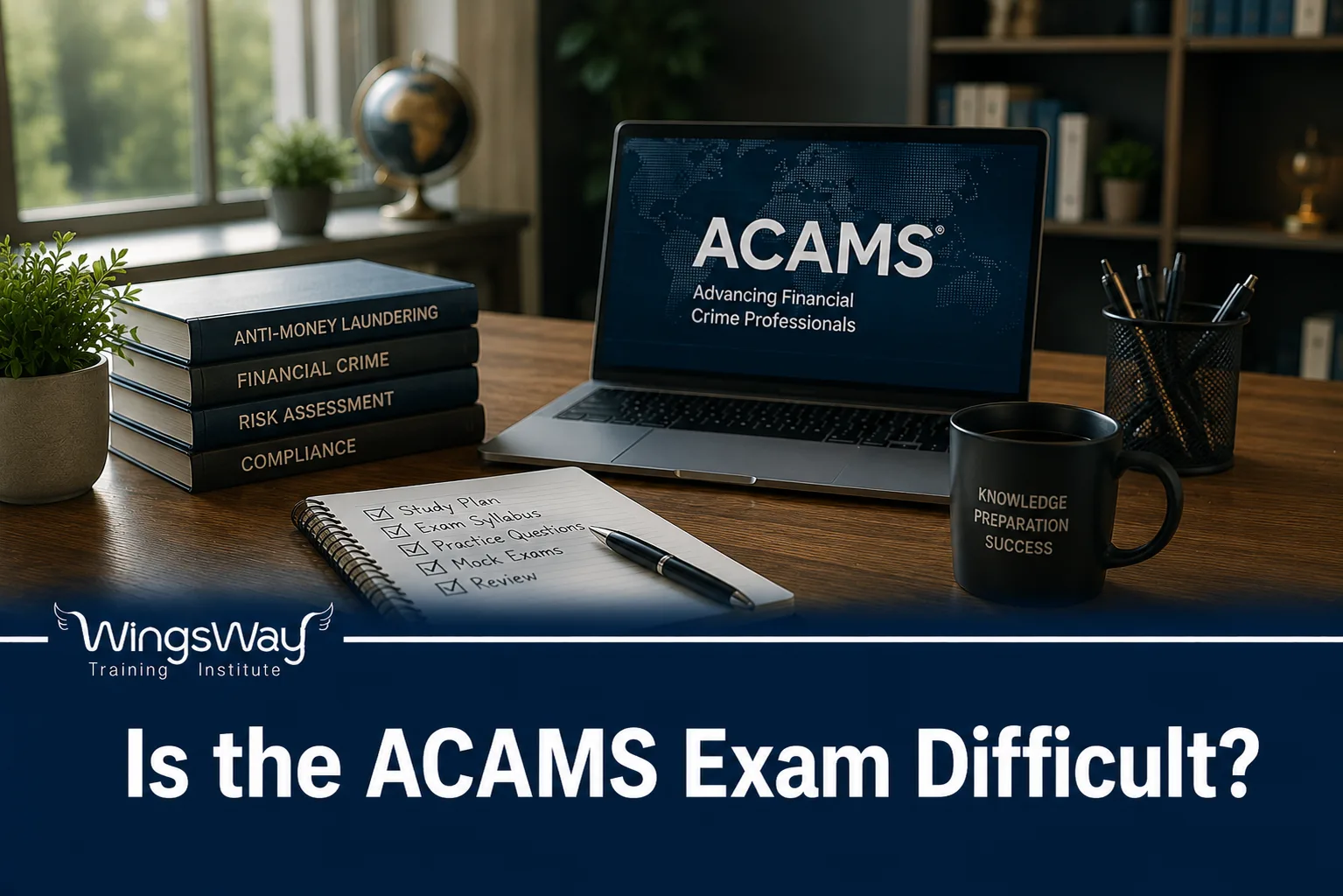
Is the ACAMS Exam Difficult?
Quick Answer: The ACAMS exam — specifically the CAMS (Certified Anti-Money Laundering Specialist) certification — is moderately to highly challenging. It consists of 120 multiple-choice questions in 3.5 hours and tests deep knowledge of AML regulations, financial crime typologies, and compliance frameworks. Professionals already working in AML or finance courses in Dubai and the UAE generally find the exam manageable with 8–12 weeks of focused preparation.
Introduction
The ACAMS exam is one of the most respected professional credentials in the world of anti-money laundering (AML) and financial crime compliance. It awards candidates the globally recognized CAMS designation — Certified Anti-Money Laundering Specialist.
But the first question most candidates ask is simple: how hard is it?
The honest answer depends on your background. If you already work in compliance, banking, or finance, you will find the ACAMS exam challenging but very manageable. If you are new to the field, it requires solid preparation and dedicated study time.
This blog breaks down everything you need to know about the ACAMS exam — its structure, difficulty, topics, preparation tips, and why it matters for professionals in Dubai, the UAE, and the wider GCC region.
Why the ACAMS Exam Matters
The ACAMS certification is not just an exam. It is a career milestone. Here is why it matters — especially for professionals in the UAE and GCC region:
- The UAE has strengthened its AML laws significantly in recent years. Financial institutions now require certified professionals.
- Dubai is a global financial hub. Compliance roles in banking, real estate, and fintech demand qualified AML specialists.
- Government and regulatory bodies in the GCC, including the UAE Central Bank and CBUAE, are raising compliance standards.
- Professionals with the CAMS credential earn higher salaries and access more senior roles.
- For those exploring finance courses in Dubai, the ACAMS certification is among the most recognized and career-relevant credentials available.
- The certification aligns with global Financial Action Task Force (FATF) standards, making it relevant across 180+ countries.
Key Takeaways
- The ACAMS exam has 120 multiple-choice questions and lasts 3.5 hours.
- A minimum score of 75 out of 120 is required to pass.
- Recommended study time is 8 to 12 weeks, dedicating at least 1 to 2 hours per day.
- Candidates must earn 40 eligibility credits before they can sit the exam.
- The CAMS certification must be renewed every 3 years through continuing professional development.
- Dubai and the UAE are seeing strong demand for ACAMS-certified professionals across banking, compliance, and financial crime units.
Recognized Bodies and Their Role in AML and Finance Education
Understanding who governs and validates professional certifications helps candidates and employers make informed decisions. Several globally respected organizations are relevant to the AML and finance education landscape.
ACAMS — Association of Certified Anti-Money Laundering Specialists
ACAMS is the world’s largest international membership organization dedicated to AML, CFT (countering the financing of terrorism), and financial crime prevention. It issues the CAMS certification, which is recognized by regulators, governments, and financial institutions in over 180 countries. ACAMS regularly updates its curriculum to reflect evolving threats, including cryptocurrency risks and AI-related compliance challenges.
CILT — Chartered Institute of Logistics and Transport (UK)
CILT is a globally recognized professional body that governs qualifications in logistics, transport, and supply chain management. Though not directly linked to AML, CILT-certified professionals working in trade finance and logistics increasingly need to understand AML frameworks given the sector’s exposure to financial crime risks.
CPD — Continuing Professional Development Standards Office (UK)
The CPD Standards Office in the UK provides accreditation to training programs that meet rigorous standards for professional learning. CPD-accredited AML and finance courses in Dubai ensure that the education provided is recognized internationally and contributes toward ongoing professional development requirements. Professionals pursuing finance courses in Dubai should look for CPD-accredited programs to ensure global recognition.
CIPS — Chartered Institute of Procurement and Supply
CIPS is a globally recognized body for procurement and supply chain professionals. As financial crime increasingly affects supply chains — through trade-based money laundering — CIPS professionals benefit from understanding AML principles alongside their procurement expertise.
CompTIA
CompTIA is a globally respected IT certification body. While its focus is on technology, CompTIA-certified professionals in cybersecurity play an important supporting role in financial crime detection, particularly in areas like transaction monitoring systems and digital forensics.
Market Demand for ACAMS-Certified Professionals in the UAE
The demand for ACAMS-certified professionals has grown rapidly across the GCC. Here is what the market looks like today:
| Factor | Detail | Impact |
|---|---|---|
| UAE Regulation | AML Law No. 20 of 2018 | Mandatory AML compliance across sectors |
| Sectors Hiring | Banking, fintech, real estate, insurance | High demand for certified AML officers |
| Salary Premium | 20–40% higher for CAMS holders | Strong ROI on certification investment |
| FATF Compliance | UAE actively aligned with FATF standards | CAMS seen as benchmark credential |
| GCC Expansion | Saudi Arabia, Qatar, Bahrain growing | Regional demand increasing steadily |
Professionals pursuing AML courses in Dubai or those interested in ACAMS certification in Dubai are entering one of the region’s most in-demand career paths. Finance courses in Dubai that include AML modules have seen a notable increase in enrolment as regulations tighten.
What Is the ACAMS Exam?
The ACAMS exam tests a candidate’s knowledge and competency in anti-money laundering. It leads to the CAMS designation — widely considered the gold standard in AML certification globally.
Here is a clear breakdown of the exam structure:
| Element | Detail |
|---|---|
| Format | 120 multiple-choice questions |
| Duration | 3.5 hours (210 minutes) |
| Passing Score | 75 out of 120 correct answers |
| Delivery | In-person (Pearson VUE) or online proctored |
| Eligibility | 40 ACAMS credits + active ACAMS membership |
| Renewal | Every 3 years (continuing education required) |
| Study Guide | Official ACAMS Study Guide (~600 pages) |
Need More Details About This Course?
Connect with our team directly on WhatsApp for course details, fees, schedules, and guidance.
Is the ACAMS Exam Difficult? A Detailed Breakdown
Overall Difficulty Level
The ACAMS exam is considered moderately to highly challenging. It is not the hardest professional exam in the world — but it is far from easy. Most candidates describe it as rigorous, particularly because of:
- The volume of study material (approximately 600 pages of the official guide plus additional readings)
- Complex scenario-based questions that require applied thinking, not just memorization
- Tricky wording that can mislead even experienced compliance professionals
- Coverage of fast-evolving topics like cryptocurrency, RegTech, and AI in financial crime
How Difficulty Varies by Background
Your professional background significantly affects how hard the ACAMS exam will feel:
- AML / Compliance Professionals: Generally find it manageable. Much of the content aligns with their daily work. Recommended study time is 6–8 weeks.
- Banking and Finance Professionals: Familiar with regulatory concepts but may need to deepen AML-specific knowledge. Study time of 8–10 weeks is common.
- Job Seekers and Career Changers: The exam requires more structured preparation. 12 weeks or more is advisable, alongside a good AML course in Dubai or a structured prep programme.
- Beginners: Possible to pass, but requires significant commitment. Starting with foundational AML courses before attempting the exam is strongly recommended.
The Four Exam Domains
The ACAMS exam is structured around four core content areas:
- Risks and Methods of Money Laundering and Terrorism Financing (26% of exam)
- Compliance Standards for AML and CFT (25% of exam)
- AML, CFT and Sanctions Compliance Programs (28% of exam)
- Conducting and Supporting the Investigation Process (21% of exam)
Understanding all four domains thoroughly is essential. The largest section — AML Compliance Programs — covers how financial institutions build, implement, and maintain internal AML controls.
New Topics Added in the 2025 Curriculum Update
The ACAMS exam content was updated in 2025 to reflect emerging challenges. Candidates must now understand:
- Virtual Asset Service Providers (VASPs) and cryptocurrency money laundering risks
- Non-Fungible Tokens (NFTs), stablecoins, and their AML implications
- Artificial Intelligence (AI) in transaction monitoring and sanctions screening
- RegTech tools and their role in modern compliance programs
- Updated FATF recommendations and global regulatory frameworks
This evolution makes using current, up-to-date study materials critically important. Relying on older editions can lead to exam failure.
Comparing ACAMS to Other Professional Exams
| Exam | Difficulty | Study Hours | Focus |
|---|---|---|---|
| ACAMS (CAMS) | Moderate-High | 150–200 hrs | AML & Compliance |
| CMA Exam | High | 300–400 hrs | Management Accounting |
| CFA Level 1 | Very High | 300+ hrs | Investment Analysis |
| CPA | High | 400+ hrs | Accounting & Audit |
Compared to the CMA exam or the CFA, the ACAMS exam requires significantly fewer study hours. However, it demands practical understanding rather than purely theoretical knowledge.
What Makes Candidates Fail the ACAMS Exam?
Common reasons for failing the ACAMS exam include:
- Using outdated study materials that do not reflect the latest curriculum
- Insufficient practice with scenario-based questions
- Poor time management during the exam (120 questions in 3.5 hours)
- Underestimating the complexity of questions — many require elimination of multiple plausible answers
- Not building enough familiarity with global AML regulatory frameworks (FATF, EU Directives, US BSA, PATRIOT Act)
Career Outcomes After the ACAMS Exam
Passing the ACAMS exam opens doors to a wide range of compliance and financial crime roles. Here is what professionals can expect:
Common Job Roles for CAMS-Certified Professionals
- AML Analyst — Entry to mid-level role focusing on transaction monitoring and suspicious activity reporting
- Compliance Officer — Ensuring the organization meets all regulatory requirements
- Risk Manager — Identifying and mitigating financial crime risks
- MLRO (Money Laundering Reporting Officer) — Senior compliance leadership role
- KYC (Know Your Customer) Specialist — Customer due diligence and identity verification
- Internal Auditor — Reviewing AML controls and identifying gaps
- Head of Compliance — Senior strategic role overseeing all compliance functions
Salary Expectations in the UAE
Salaries for CAMS-certified professionals in the UAE are competitive. Entry-level AML analysts typically earn between AED 8,000 to AED 15,000 per month. Senior compliance officers and MLROs can earn AED 25,000 to AED 60,000 or more depending on the sector and institution.
Industries Hiring in Dubai and the GCC
- Commercial and investment banks
- Fintech and digital payment companies
- Insurance and wealth management firms
- Real estate and property management companies
- Regulatory authorities and government bodies
- Law firms and consultancies specializing in financial regulation
How to Prepare for the ACAMS Exam: Step-by-Step
A structured approach significantly increases your chance of passing the ACAMS exam on the first attempt.
Step 1: Check Your Eligibility
Before registering, ensure you meet the eligibility requirements:
- Active ACAMS membership (required to sit the exam)
- 40 ACAMS eligibility credits — earned through work experience, academic qualifications, and professional certifications
- Three professional references
Credits are accumulated as follows: one year of AML-related work experience = 10 credits; a bachelor’s degree = 20 credits; a master’s degree = 30 credits; relevant professional certifications add additional credits.
Step 2: Obtain the Official ACAMS Study Guide
The ACAMS study guide is approximately 600 pages long and covers all four exam domains. This is your primary study resource. Supplement it with the additional readings recommended by ACAMS.
Step 3: Build a Study Schedule
Plan for 8 to 12 weeks of preparation:
- Weeks 1–3: Cover exam domains 1 and 2 (money laundering risks and global compliance standards)
- Weeks 4–7: Study domains 3 and 4 (AML programs and investigations)
- Weeks 8–10: Practice questions, case studies, and mock exams
- Weeks 11–12: Review weak areas, final revision, and exam readiness
Step 4: Take an AML Course or Exam Prep Programme
Structured training helps you learn more efficiently. AML courses in Dubai and ACAMS certification preparation classes provide instructor-led learning, case studies, and guided exam practice. This is particularly valuable for those who are new to the compliance field.
Step 5: Practice Scenario-Based Questions
The ACAMS exam emphasizes applied knowledge. Practice questions that present realistic scenarios — not just definitions. Time yourself to build speed and accuracy.
Step 6: Sit the Exam
The exam is available at Pearson VUE test centres globally, including in Dubai and the UAE. It is also available online with proctoring. On exam day: read each question carefully, flag uncertain questions for review, manage your time (aim for no more than 1.5 minutes per question), and trust your preparation.
Frequently Asked Questions About the ACAMS Exam
1. How difficult is the ACAMS exam compared to the CMA exam?
The ACAMS exam is generally considered less difficult than the CMA exam in terms of required study hours and technical depth. The CMA certification in UAE and globally typically requires 300 to 400 hours of study compared to 150 to 200 hours for the ACAMS exam. However, the ACAMS exam is more scenario-focused and requires strong applied knowledge of AML regulations, which can make it tricky for those without a compliance background.
2. What is the passing score for the ACAMS exam?
The passing score for the ACAMS exam is 75 out of 120 questions answered correctly. There is no negative marking. The exam is 3.5 hours long. Candidates who do not pass on the first attempt may retake the exam, though additional fees apply.
3. How long should I study for the ACAMS exam?
ACAMS recommends approximately 150 hours of study time. For working professionals, this typically means 8 to 12 weeks of preparation at 1 to 2 hours per day. If you are new to AML or taking an AML course in Dubai alongside your exam prep, allow 12 to 16 weeks.
4. Is the ACAMS certification recognized in Dubai and the UAE?
Yes. The ACAMS certification is fully recognized in Dubai, across the UAE, and throughout the GCC. It is respected by the UAE Central Bank, financial regulatory authorities, and major banking institutions operating in the region. Professionals seeking ACAMS certification in Dubai will find strong market demand for this credential.
5. What topics does the ACAMS exam cover?
The ACAMS exam covers four main domains: risks and methods of money laundering and terrorism financing; global AML and CFT compliance standards; AML program design and implementation; and conducting financial crime investigations. The 2025 update also includes cryptocurrency risks, RegTech, and AI-related compliance topics.
6. Can a beginner pass the ACAMS exam?
Yes, but it requires dedicated preparation. Beginners should start with foundational AML knowledge before tackling the full ACAMS study guide. Enrolling in an AML course in Dubai or an ACAMS exam preparation programme significantly increases the chance of passing on the first attempt.
7. How does the ACAMS certification relate to other finance courses in Dubai?
The ACAMS certification is one of several recognized finance certifications available in Dubai. While finance courses in Dubai cover areas such as accounting, investment, and corporate finance, the ACAMS exam specifically focuses on financial crime prevention. Professionals working in banking or compliance often hold both the ACAMS certification and other finance credentials such as the CMA certification in UAE or CIPS qualifications.
Trust, Accreditation, and Why It Matters
When choosing where to prepare for the ACAMS exam or pursue related finance courses in Dubai, the accreditation of the training provider matters significantly.
KHDA — Knowledge and Human Development Authority
KHDA is the regulatory authority overseeing private education and training in Dubai. Training providers registered with KHDA are monitored for quality, curriculum standards, and trainer qualifications. Choosing a KHDA-approved institute for your AML exam preparation ensures your training meets Dubai government standards.
CPD — Continuing Professional Development (UK)
CPD accreditation from the UK’s CPD Standards Office indicates that a training programme has been reviewed and meets internationally recognised standards for professional learning. CPD-accredited finance and AML courses in Dubai are widely recognised by employers across the GCC, Europe, and globally. The ACAMS certification itself qualifies as CPD activity.
ISO Standards
ISO certification for training institutes (particularly ISO 9001 for quality management systems) demonstrates that the organisation follows internationally benchmarked processes for delivering education and training. When selecting a finance course in Dubai or an AML prep programme, ISO certification at the institute level adds an additional layer of quality assurance.
ACAMS Authorised Training Providers
ACAMS designates authorised training providers globally who are qualified to deliver official CAMS exam preparation courses. These providers have demonstrated alignment with ACAMS standards and curriculum requirements. Candidates are advised to verify whether their chosen training provider holds this designation when preparing for the ACAMS exam.
Related Learning Pathways:
Professionals in the UAE exploring the ACAMS exam often also consider the CMA certification (UAE and global), CIPS qualifications in procurement and supply chain, CILT programmes in logistics and transport, and a broad range of finance courses in Dubai covering accounting, risk, and financial analysis. Building a portfolio of certifications strengthens career prospects across the region.
Conclusion
The ACAMS exam is a credible, globally respected certification that tests real-world knowledge of anti-money laundering principles, compliance frameworks, and financial crime investigation. It is moderately to highly challenging — particularly because of its applied, scenario-based question style and its evolving curriculum that now includes cryptocurrency risks and AI-related compliance topics.
For professionals already working in compliance or banking, the exam is very achievable with 8 to 12 weeks of focused study. For beginners, starting with foundational AML knowledge and enrolling in a structured preparation course can make a significant difference.
In the UAE and across the GCC, demand for ACAMS-certified professionals continues to grow as regulators tighten AML requirements and financial institutions invest in stronger compliance programmes. The CAMS designation offers measurable career advantages — higher salaries, greater professional credibility, and access to senior roles in financial crime prevention.
Understanding the exam structure, the topics covered, and the preparation required puts you in a much stronger position to succeed — whether you are approaching this certification as a career move, a professional development milestone, or a regulatory requirement.
Message From the Author
At WingsWay Training Institute, we help learners build practical skills for anti-money laundering (AML), compliance, and financial crime prevention careers in Dubai and across the GCC.
Our AML and finance certification courses combine KHDA-approved training, internationally recognised certifications, and flexible learning options designed for working professionals, banking employees, compliance officers, and fresh graduates.
To learn more about our ACAMS certification training in Dubai, contact us for a enquiry at information@wingsway.org or via WhatsApp or call on +971 50 906 3371.
Reviewed by WingsWay Training Institute Admission Team
This guide is based on current ACAMS certification requirements, AML compliance standards, KHDA training regulations, and globally recognised financial crime prevention certification pathways relevant to professionals in Dubai and the UAE
Also Read
- Why a Finance Course for Kids Is the Best Investment in Their Future
- How to Pass the CMA Exam: Complete 2026 Guide
- What is a Certified Management Accountant (CMA): Its Benefits, Expected Salary, and More.
- Which reputable institutions or resources offer CMA courses and prep in my region?
- Top 10 KHDA-approved Training Institutes in Dubai
Need More Details About This Course?
Connect with our team directly on WhatsApp for course details, fees, schedules, and guidance.
Tag:ACAMS Certification, ACAMS certification cost in UAE, acams certification dubai, ACAMS course in dubai, ACAMS study material, AML Career, Anti money laundering certificate, Anti money laundering course, Anti money laundering training courses, cams AML, cams certification, cams certification cost, Cams Certification courses, CAMS certification details (UAE), Cams Course in Dubai, CAMS Exam, CAMS Prep Exam, CBUAE, compliance career, DFSA, UAE