
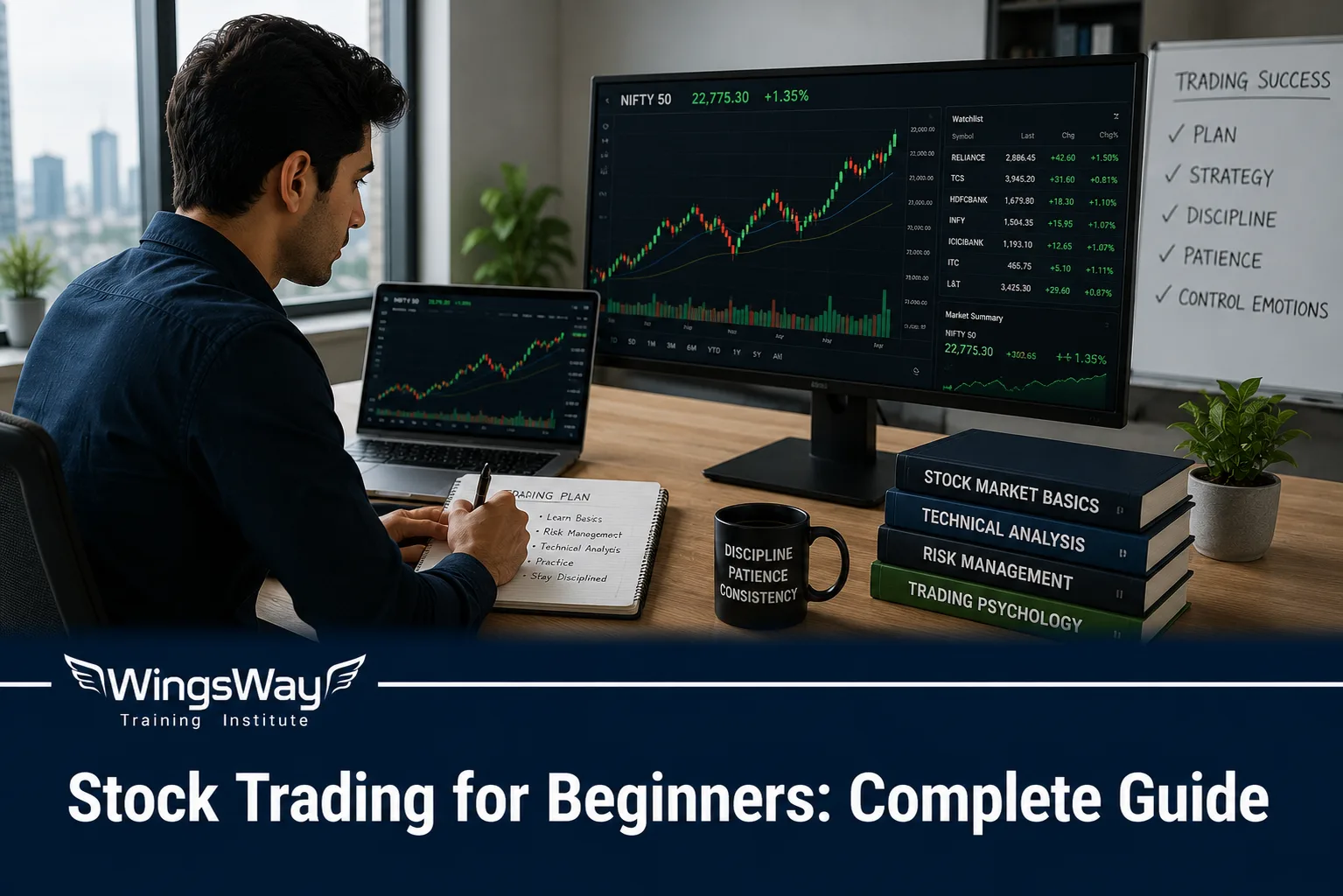
Stock Trading for Beginners: Complete Guide
Quick Answer: Stock trading for beginners involves buying and selling shares of publicly listed companies to generate profit. To start, you need to understand basic market concepts, open a brokerage account, learn a simple strategy, and manage your risk carefully. In the UAE and GCC, beginners can start trading with as little as a few hundred dirhams through regulated platforms.
The stock market is one of the most powerful wealth-building tools available to working professionals and fresh graduates in Dubai, the UAE, and across the GCC. Yet, many people hesitate to start because they do not know where to begin.
This guide is designed to walk you through everything you need to know about stock trading, from understanding what a stock is to building your first trading plan. Whether you are a complete beginner or someone looking to sharpen your knowledge, this resource covers the essential steps.
For those in the UAE who want structured learning, enrolling in a recognised stock market trading course can significantly accelerate your progress and help you trade with confidence.
Key Takeaways
- Stock trading consists of purchasing and selling shares of companies to gain profits from fluctuations in their prices.
- Beginners should start with a clear plan, a regulated broker, and a small capital amount.
- Fundamental and technical analysis are the two core methods used to evaluate stocks.
- Risk management, including stop-loss orders and position sizing, is essential for every trader.
- Day trading is high-risk and generally not recommended for absolute beginners.
- A structured stock trading course can help beginners in the UAE learn faster and avoid costly mistakes.
- KHDA-approved training providers in Dubai offer internationally recognised qualifications for finance professionals.
What Is Stock Trading?
Direct Answer: Stock trading is the process of buying and selling shares of publicly listed companies with the goal of making a profit from price changes.
When you buy a stock, you own a small percentage of that company. If the company grows and its share price rises, your investment gains value. If the price falls, your investment loses value.
Stocks are traded on exchanges such as:
- New York Stock Exchange (NYSE)
- NASDAQ
- London Stock Exchange (LSE)
- Dubai Financial Market (DFM)
- Abu Dhabi Securities Exchange (ADX)
In the UAE and GCC, both local and international stock exchanges are accessible through online trading platforms regulated by the Securities and Commodities Authority (SCA).
How Does Stock Trading Work?
Direct Answer: When you place a trade, you are either buying shares from or selling shares to other market participants through a broker connected to a stock exchange.
Here is a simple breakdown of how it works:
- You open a brokerage account with a regulated broker.
- You deposit funds into your trading account.
- You select a stock and decide to buy or sell.
- Your broker executes the order on the stock exchange.
- The trade is settled, typically within two business days (T+2).
Prices change constantly based on supply and demand, company performance, economic data, and market sentiment. Your job as a trader is to anticipate these movements and act accordingly.
Stock Trading vs Stock Investing: What Is the Difference?
Direct Answer: Trading focuses on short-term price movements to generate quick profits, while investing focuses on long-term wealth accumulation by holding stocks for months or years.
Understanding the difference helps you decide which approach fits your goals:
| Feature | Stock Trading | Stock Investing |
|---|---|---|
| Time Horizon | Days to months | Months to years |
| Goal | Profit from price swings | Long-term capital growth |
| Analysis Used | Technical analysis | Fundamental analysis |
| Risk Level | Higher | Moderate to lower |
| Activity Level | Active, frequent monitoring | Passive, periodic review |
| Best For | Those seeking active income | Those building wealth slowly |
Many beginners in the UAE start with investing, then gradually learn trading techniques as their knowledge grows.
Is Stock Trading Good for Beginners?
Direct Answer: Stock trading can be rewarding for beginners who approach it with proper education, a clear plan, and realistic expectations. Without preparation, the risks are high.
Stock trading is suitable for beginners if they:
- Take time to learn the basics before risking real money
- Start with a small capital and a simple strategy
- Use a demo account to practise before going live
- Set clear stop-loss levels to protect their capital
- Commit to ongoing learning through courses and market study
Many working professionals and fresh graduates in Dubai and the wider GCC are successfully learning to trade by combining self-study with structured training programmes.
How Much Money Do You Need to Start Stock Trading?
Direct Answer: In the UAE, you can technically start stock trading with as little as AED 500 to AED 1,000 through international online platforms. However, AED 5,000 to AED 10,000 gives you more flexibility.
Here is a general guide to starting capital:
| Capital Level | Approx. Amount (AED) | Suitable For |
|---|---|---|
| Entry Level | 500 – 2,000 | Demo-to-live transition |
| Beginner | 5,000 – 10,000 | Learning while trading live |
| Intermediate | 15,000 – 50,000 | Diversified stock portfolio |
| Advanced | 50,000+ | Active day or swing trading |
Keep in mind that you should never trade with money you cannot afford to lose. Start small, build your skills, and scale your capital gradually.
Stock Market Terms Every Beginner Should Know
Direct Answer: Understanding the fundamental terms of the stock market is vital before you begin trading.
Here are the most essential ones for beginners.
- Bull Market: A market where prices are rising or expected to rise.
- Bear Market: A market where prices are falling, typically by 20% or more.
- Bid Price: The highest price a buyer is willing to pay for a stock.
- Ask Price: The lowest price a seller is willing to accept.
- Spread: The difference between the bid and ask price.
- Volume: The number of shares traded in a given period.
- Market Capitalisation: The total market value of a company’s shares.
- Dividend: A portion of company profits paid to shareholders.
- Portfolio: Your collection of all owned investments.
- Liquidity: How quickly and easily a stock can be bought or sold.
- Volatility refers to the extent of price changes in a stock or market.
- Stop-Loss Order: An instruction to sell a stock if it reaches a certain price to limit losses.
- IPO (Initial Public Offering): When a company first lists its shares on a stock exchange.
What Is a Brokerage Account?
Direct Answer: A brokerage account is an account you open with a licensed broker that allows you to buy, sell, and hold stocks and other financial instruments.
A brokerage account works like a bank account for trading. You deposit funds, place trades, and the broker executes those orders on your behalf through a stock exchange.
Key features of a brokerage account include:
- Access to local and international stock markets
- Real-time price quotes and trading tools
- Order management and execution
- Portfolio tracking and reporting
In the UAE, brokerage accounts must be opened with brokers regulated by the Securities and Commodities Authority (SCA) for local markets, or with internationally regulated brokers for global markets such as NYSE and NASDAQ.
How to Choose a Stockbroker or Trading Platform
Direct Answer: Choose a regulated broker with low fees, a user-friendly platform, access to your target markets, and reliable customer support.
When selecting a broker, consider the following factors:
- Regulation: Ensure the broker is regulated by SCA, FCA, SEC, or another recognised authority.
- Fees: Look at commission per trade, spreads, and any account maintenance fees.
- Platform: Choose a platform that is easy to use and offers the tools you need.
- Market Access: Confirm the broker provides access to the markets you want to trade.
- Customer Support: Look for responsive support, ideally with Arabic or English language options.
- Educational Resources: Some brokers offer beginner tutorials, webinars, and demo accounts.
For UAE-based traders, well-known platforms include eToro, Saxo Bank, Interactive Brokers, and locally regulated brokers through Dubai Financial Market (DFM) and Abu Dhabi Securities Exchange (ADX).
Types of Stock Market Orders Beginners Should Understand
Direct Answer: A market order executes immediately at the current price, while a limit order only executes at a price you set. Understanding order types helps you control how and when your trades are filled.
Here are the most important order types for beginners:
- Market Order: Buys or sells immediately at the current market price.
- Limit Order: Executes purchases or sales exclusively at a designated price or more favorable.
- Stop-Loss Order: Automatically sells a stock when it reaches a set price to limit your loss.
- Stop-Limit Order: Combines a stop trigger with a limit price for more precise control.
- Trailing Stop Order: Adjusts automatically as the price moves in your favour.
Using stop-loss orders is strongly recommended for all beginners. It protects you from large, unexpected losses when the market moves against your position.
Step-by-Step Guide to Start Stock Trading
Direct Answer: Follow these steps to begin stock trading as a beginner in the UAE or GCC.
- Learn the Basics: Study stock market fundamentals, key terms, and how markets work.
- Set Your Goals: Decide why you want to trade, how much risk you can tolerate, and what returns you expect.
- Choose a Regulated Broker: Open an account with an SCA-regulated or internationally licensed broker.
- Fund Your Account: Deposit a starting amount you are comfortable risking.
- Practise on a Demo Account: Use virtual money to test your strategies before going live.
- Research Your First Stock: Use fundamental and technical analysis to identify a stock.
- Place Your First Trade: Start small. Buy a few shares and observe how the trade behaves.
- Set a Stop-Loss: Protect your capital from unexpected downturns.
- Review and Learn: Analyse your trades, identify mistakes, and improve your approach.
- Invest in Education: Consider enrolling in a structured stock market trading course.
How to Research a Stock Before Buying
Direct Answer: Researching a stock means evaluating the company’s financial health, growth potential, competitive position, and price trend before investing your money.
Good stock research combines two approaches:
- Fundamental Analysis: Examines the company’s financials, business model, and industry position.
- Technical Analysis: Studies price charts and trading patterns to identify entry and exit points.
Before buying any stock, ask these key questions:
- Does the company have strong and consistent revenue growth?
- Is the company profitable, and is that profit growing?
- Does the company have low or manageable debt?
- How does the stock’s valuation measure up against its peers?
- What is the current price trend on the chart?
Fundamental Analysis for Beginners
Direct Answer: Fundamental analysis involves evaluating a company’s financial statements, earnings, growth prospects, and market position to determine whether its stock is fairly valued.
Key metrics used in fundamental analysis include:
- Revenue and Earnings per Share (EPS): Indicates how much profit the company generates per share.
- Price-to-Earnings Ratio (P/E): Compares the stock price to its earnings. A lower P/E may indicate better value.
- Debt-to-Equity Ratio: Shows how much debt the company carries compared to its equity.
- Return on Equity (ROE): Measures how effectively the company uses shareholder equity to generate profit.
- Free Cash Flow: Indicates how much cash the company generates after expenses.
- Dividend Yield: For income-focused investors, this shows the annual dividend as a percentage of the stock price.
Fundamental analysis is most suitable for those who want to invest in quality companies over the medium to long term.
Technical Analysis for Beginners
Direct Answer: Technical analysis is the study of historical price charts and trading volume to identify patterns and predict future price movements.
Common technical analysis tools and indicators include:
- Candlestick Charts: Show the open, high, low, and close price for each time period.
- Support and Resistance Levels: Price zones where stocks tend to stop and reverse.
- Moving Averages (MA): Smooth out price data to identify the overall trend direction.
- Relative Strength Index (RSI): Measures whether a stock is overbought or oversold.
- MACD (Moving Average Convergence Divergence): Identifies changes in momentum and trend direction.
- Bollinger Bands: Show price volatility and potential breakout points.
- Volume Analysis: High volume confirms the strength of a price move.
Technical analysis is widely used by short-term traders who focus on price patterns rather than company financials.
Fundamental Analysis vs Technical Analysis
Direct Answer: Fundamental analysis assesses which assets to purchase; technical analysis determines the optimal timing for those purchases. Many experienced traders use both together.
| Factor | Fundamental Analysis | Technical Analysis |
|---|---|---|
| Focus | Company financials and value | Price charts and patterns |
| Time Horizon | Long-term | Short to medium-term |
| Best For | Investors, value traders | Day traders, swing traders |
| Tools Used | Financial statements, ratios | Indicators, chart patterns |
| Data Source | Company reports, earnings | Historical price and volume data |
Common Stock Trading Strategies for Beginners
Direct Answer: A trading strategy defines your rules for entering and exiting trades. Without a strategy, you are guessing, which leads to inconsistent results.
Here are the most popular beginner-friendly strategies:
- Trend Following: Identify a stock in a clear upward or downward trend and trade in that direction.
- Breakout Trading: Enter a trade when a stock breaks above a resistance level or below a support level with strong volume.
- Buy and Hold: Purchase quality stocks and hold them over the long term to benefit from compound growth.
- Swing Trading: Hold stocks for a few days to a few weeks, capturing medium-sized price moves.
- Moving Average Crossover: Buy when a short-term moving average crosses above a long-term moving average, and sell when it crosses below.
Beginners are advised to master one strategy before exploring others. Consistency and discipline in applying one strategy will produce better results than switching between several.
What Is Risk Management in Stock Trading?
Direct Answer: Risk management is the process of identifying, assessing, and controlling the amount of money you are willing to lose on each trade in order to protect your overall capital.
Core risk management principles every beginner should apply:
- Risk Only 1-2% Per Trade: Never risk more than 1 to 2 percent of your total capital on a single trade.
- Always Use a Stop-Loss: Set a stop-loss order on every trade to cap your potential loss.
- Position Sizing: Calculate how many shares to buy based on your risk tolerance and stop-loss distance.
- Diversify Your Portfolio: Avoid putting all your capital into one stock or sector.
- Avoid Overleveraging: Do not use excessive borrowed funds that amplify both gains and losses.
- Keep a Trading Journal: Record every trade, including your reasoning and the outcome.
Effective risk management distinguishes successful traders from those who incur losses.
You can have a winning strategy and still fail if you do not manage your risk properly.
What Is Volatility in the Stock Market?
Direct Answer: Volatility refers to how much and how quickly the price of a stock or market rises or falls. High volatility means larger and faster price swings.
Why volatility matters for beginners:
- High volatility creates more trading opportunities but also more risk.
- Low volatility stocks tend to move more slowly and are often better for beginners.
- Global events such as economic data releases, geopolitical news, and earnings reports increase volatility.
- The VIX (Volatility Index) is a common measure of expected market volatility, often called the fear index.
As a beginner, consider starting with lower-volatility stocks or sectors until you become more comfortable managing price swings.
What Are the Main Risks of Stock Trading?
Direct Answer: Stock trading carries real financial risks. Beginners must understand these risks clearly before committing real money to the market.
The main risks include:
- Market Risk: The overall market can fall, taking most stocks down with it.
- Company Risk: A specific company can underperform or fail, causing its stock to collapse.
- Liquidity Risk: Some stocks are thinly traded, making it difficult to buy or sell at the desired price.
- Emotional Risk: Fear and greed often lead traders to make impulsive decisions that result in losses.
- Leverage Risk: Trading with borrowed money amplifies losses and can wipe out your account quickly.
- Information Risk: Acting on incomplete or incorrect information can lead to poor trade decisions.
None of these risks can be completely eliminated, but they can be managed with education, planning, and discipline.
Day Trading vs Swing Trading vs Long-Term Investing
Direct Answer: Day trading involves entering and exiting trades within the same day. Swing trading holds positions for days to weeks. Long-term investing holds stocks for months to years.
| Factor | Day Trading | Swing Trading | Long-Term Investing |
|---|---|---|---|
| Holding Period | Minutes to hours | Days to weeks | Months to years |
| Time Required | Full-time | Part-time | Minimal |
| Risk Level | Very high | Moderate to high | Moderate |
| Best For | Experienced traders | Beginners with time | Patient beginners |
| Analysis Used | Technical only | Technical + some FA | Fundamental mainly |
For most beginners in the UAE and GCC, swing trading or long-term investing is the most appropriate starting point. Day trading requires significant experience, capital, and emotional discipline.
Should Beginners Trade Penny Stocks?
Direct Answer: No. Penny stocks are generally not suitable for beginners. They are highly speculative, often illiquid, and frequently subject to manipulation.
Penny stocks are shares that trade at very low prices, often below USD 5. While they appear affordable, they carry significant risks:
- Lack of transparency and limited financial reporting from the companies.
- Very low trading volume makes it difficult to exit positions at desired prices.
- They are frequently targeted by pump-and-dump schemes.
- Prices can collapse very quickly with little warning.
Beginners are better served by focusing on established, liquid companies listed on major exchanges such as NYSE, NASDAQ, or the Dubai Financial Market.
Should Beginners Use Margin or Leverage?
Direct Answer: No. Beginners should avoid using margin or leverage until they have consistent profitability and a thorough understanding of risk management.Margin trading allows you to borrow money from your broker to buy more shares than you could with your own capital. While this amplifies potential gains, it equally amplifies potential losses.
Key risks of leverage for beginners:
- A 10% adverse move on a 10x leveraged position wipes out 100% of your capital.
- Brokers issue margin calls if your account falls below the minimum required balance.
- Emotional decision-making increases significantly when borrowed money is at risk.
Build confidence and consistency first. Leverage is a tool for experienced traders, not a shortcut for beginners.
Common Stock Trading Mistakes Beginners Make
Direct Answer: Most beginner losses are caused by avoidable mistakes. Understanding them in advance can save you significant time and money.
The most common stock trading mistakes beginners make:
- Trading Without a Plan: Entering trades without clear entry, exit, and risk rules.
- Overtrading: Taking too many trades out of excitement or the need to be active.
- Chasing Losses: Increasing position size after a loss in an attempt to recover quickly.
- Ignoring Stop-Losses: Removing stop-loss orders and hoping prices will recover.
- Following Tips Blindly: Acting on social media advice or WhatsApp tips without personal research.
- FOMO Trading: Buying a stock because it has already risen sharply, often entering at the top.
- Neglecting Risk Management: Risking too much on a single trade.
- Overcomplicating Analysis: Using too many indicators simultaneously instead of mastering a few.
- Not Keeping a Journal: Failing to record and review trades makes improvement very difficult.
How to Create a Beginner Stock Trading Plan
Direct Answer: A trading plan is a written set of rules that defines your strategy, risk tolerance, entry and exit criteria, and trading goals.Your beginner trading plan should include the following elements:
- Your Trading Goals: What do you want to achieve, and over what timeframe?
- Capital Allocation: How much money will you trade with, and how much can you afford to lose?
- Markets and Instruments: Which stock exchanges or sectors will you focus on?
- Strategy: What is your specific entry and exit strategy?
- Risk Rules: Maximum loss per trade, maximum daily loss, and maximum weekly loss limits.
- Record Keeping: How will you track and review your trades?
- Review Schedule: When will you review your performance and refine your plan?
- A written plan keeps you accountable and helps you avoid impulsive decisions during volatile market conditions.
How Long Does It Take to Learn Stock Trading?
Direct Answer: Most beginners take 6 to 18 months of consistent study and practice before they develop a reliable trading approach. Some reach proficiency sooner with structured education.
The timeline depends on several factors:
- How much time you dedicate to learning and practising each week.
- Whether you study on your own or through a structured stock trading course.
- How quickly you apply lessons from both wins and losses.
- The quality of your educational resources and mentors.
In the UAE and GCC, many professionals accelerate their learning by enrolling in recognised stock market training programmes that combine theory, practical exercises, and mentorship.
Can You Make Money Through Stock Trading?
Direct Answer: Yes, it is possible to make consistent money from stock trading, but it requires education, discipline, and realistic expectations. Most beginners do not profit in their first year.
Key facts about profitability in stock trading:
- Studies suggest that the majority of active retail traders underperform the market over time.
- Those who succeed typically have a well-tested strategy, strong discipline, and effective risk management.
- Consistent small gains compound over time to produce meaningful returns.
- Trading for regular income is realistic but requires significantly more capital and skill than part-time trading.
The most important mindset shift for beginners is to focus on learning and process quality before focusing on profit. Sustainable profits follow consistent execution.
Should You Take a Stock Trading Course?
Direct Answer: Yes. A structured stock trading course significantly shortens the learning curve, reduces costly beginner mistakes, and provides a clear framework for consistent trading.
A quality stock market trading course in the UAE will provide:
- A structured learning pathway from basic to advanced concepts.
- Practical exercises and real-market case studies.
- Guidance from experienced instructors with live market knowledge.
- A recognised certification that adds credibility to your professional profile.
- Peer learning in a classroom or online environment.
Self-learning is possible, but it takes significantly longer and exposes you to more avoidable losses. Structured training offers a more efficient and reliable path to trading competency.
WingsWay Training Institute offers – for working professionals, fresh graduates, and career changers across Dubai and the GCC.
Why Choose WingsWay for Stock Market Trading Training?
Direct Answer: WingsWay Training Institute is a KHDA-approved training provider in Dubai offering internationally recognised stock market trading programmes designed for beginners and working professionals.
Here is why learners across Dubai and the GCC choose WingsWay:
- KHDA-Approved Training: All programmes are approved by the Knowledge and Human Development Authority (KHDA), ensuring quality and compliance with UAE education standards.
- CPD-Accredited Certifications: Courses are aligned with CPD UK (Continuing Professional Development) standards, recognised globally.
- Practical Curriculum: Training covers real-world trading scenarios, live market analysis, and hands-on exercises.
- Flexible Learning Options: Choose from classroom, online, and blended learning formats suited to working schedules.
- Expert Instructors: Learn from finance professionals with hands-on trading and investment experience.
- Career Support: WingsWay supports learners with career guidance and professional development resources.
- GCC-Wide Reach: Serving learners not only in Dubai but across the wider GCC region including Abu Dhabi, Sharjah, Riyadh, and Doha.
Explore our full range of Stock Market Trading Courses in UAE to find the programme that best suits your goals and schedule.
Final Verdict: How Should a Beginner Start Stock Trading?
Direct Answer: Start with education. Learn the basics, practise on a demo account, set a clear plan, and begin with a small capital amount. Never skip risk management.
Here is your recommended action plan:
- Invest in learning first. Read books, follow reputable market analysts, and consider a structured course.
- Open a demo account and practise your strategy for at least 60 to 90 days.
- Select a regulated broker that suits your budget and trading style.
- Start live trading with a small amount of capital that you can afford to lose.
- Apply strict risk management on every trade, including stop-loss orders.
- Review your performance regularly and refine your approach based on data.
- Stay patient. Proficiency takes time and consistent effort.
Stock trading is a skill that rewards those who invest in proper education and approach the market with discipline. In the UAE and GCC, there are excellent training resources available to help you build that foundation.
Stock Trading for Beginners: FAQs
Q: What is stock trading?
Stock trading is the buying and selling of shares in publicly listed companies with the goal of making a profit from price changes. Traders can buy shares expecting the price to rise or, in some platforms, sell short expecting prices to fall. In the UAE, stock trading is accessible through regulated online brokers connected to both local and international markets.
Q: How does stock trading work?
You open a brokerage account, deposit funds, select a stock, and place a buy or sell order. Your broker executes the trade on a stock exchange. Prices are determined by supply and demand. Trades are typically settled within two business days, referred to as T+2 settlement.
Q: Is stock trading good for beginners?
Stock trading can be suitable for beginners who take time to learn before risking real money. Starting with a demo account, a small capital amount, and a structured strategy helps manage the learning curve. Without proper education, beginners are exposed to significant financial risk.
Q: How much money is needed to start trading in the UAE?
In the UAE, you can technically start stock trading with as little as AED 500 on some international platforms. However, AED 5,000 to AED 10,000 is a more practical starting range for beginners who want enough flexibility to diversify and manage risk appropriately.
Q: Is stock trading risky?
Yes, stock trading carries inherent risk, including market risk, company risk, and emotional risk. However, risk can be managed through stop-loss orders, proper position sizing, diversification, and strict adherence to a trading plan. Education significantly reduces the likelihood of avoidable losses.
Q: Should beginners use stop-loss orders?
Yes, absolutely. Stop-loss orders are one of the most important risk management tools for beginners. They automatically close your position when the price reaches a predefined level, protecting your capital from excessive losses when the market moves against you.
Q: Should I take a stock trading course?
Yes. A structured stock market trading course shortens the learning curve, reduces beginner mistakes, and provides a clear framework for consistent trading. In the UAE, KHDA-approved courses from providers like WingsWay Training Institute offer internationally recognised certifications that add professional credibility to your profile.
Message From the Author
At WingsWay Training Institute, we help learners build practical skills for finance and trading careers in Dubai and across the GCC. Our stock market trading training combines KHDA-approved instruction, internationally recognised certifications, and flexible learning options designed for working professionals, job seekers, and fresh graduates.
To learn more about our Stock Market Trading Courses in UAE, contact us for a blog enquiry at information@wingsway.org, or connect with us via WhatsApp or call on +971 50 906 3371.
Reviewed by WingsWay Training Institute Admission Team
This guide is based on current stock market trading requirements, KHDA training standards, and internationally recognised certification pathways relevant to professionals in Dubai and the UAE. The information in this article reflects the learning frameworks and career outcomes associated with WingsWay Training Institute’s stock market trading for beginners programmes.
Need More Details About This Course?
Connect with our team directly on WhatsApp for course details, fees, schedules, and guidance.
Tag:beginner stock trading strategies, day trading for beginners, Dubai Financial Market, fundamental analysis for beginners, how to start stock trading, regulated stock brokers in UAE, risk management in stock trading, stock market terms for beginners, stock market trading course in UAE, stock trading course in Dubai, stock trading for beginners, stock trading in UAE, stock trading plan, swing trading for beginners, technical analysis for beginners