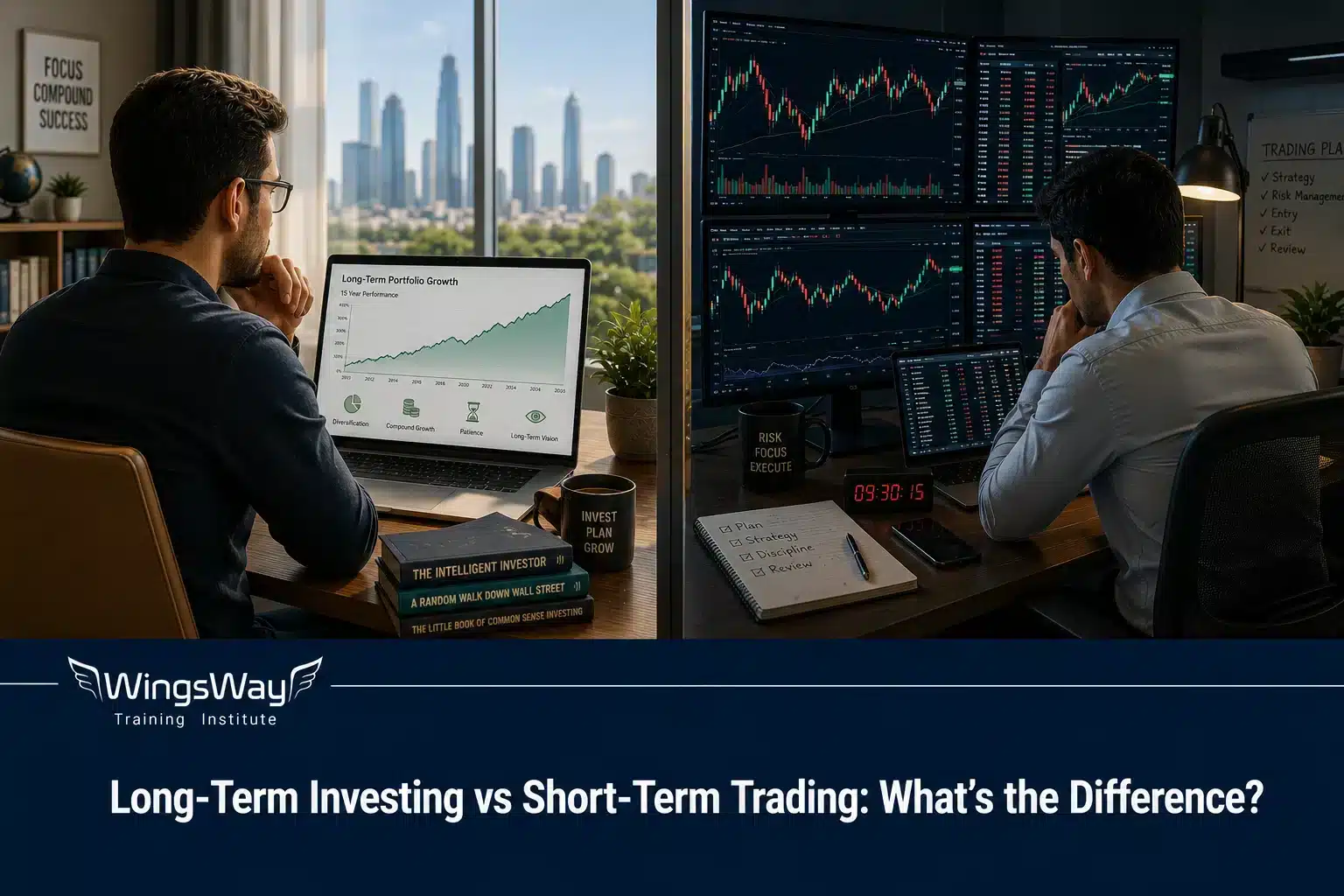
Long-Term Investing vs Short-Term Trading: What’s the Difference?
Quick Answer: Long-term investing vs short-term trading comes down to time horizon and approach: long-term investing means holding stocks, ETFs, or bonds for years to grow wealth through compounding, while short-term trading involves buying and selling assets within days or weeks to profit from price swings. Long-term investing generally suits people focused on patient, goal-based wealth building, while short-term trading is more suited to those willing to devote more time to active market monitoring and risk management.
Introduction
For anyone entering the financial markets, one of the first decisions to make is a strategic one: long-term investing vs short-term trading. Both approaches involve putting capital into financial instruments with the goal of generating a return, but the timeframe, mindset, and skill set required for each are fundamentally different. Long-term investing is built around patience and compounding, while short-term trading is built around speed, price movement, and discipline. Understanding this distinction early helps a beginner choose an approach that fits their financial goals, risk tolerance, and available time, rather than adopting a strategy by accident.
This distinction matters because the two approaches call for different knowledge bases, different tools, and different emotional temperaments. A structured understanding of both prevents costly mistakes such as treating a long-term holding like a day trade, or trying to hold a highly volatile short-term position for years without a plan.
Why This Matters
Financial literacy around markets has become increasingly important as more individuals in the UAE and GCC participate directly in the stock market through online brokerage platforms. Choosing between long-term investing vs short-term trading is not just a technical decision, it shapes how much time a person needs to dedicate, how much risk they are exposed to, and how their tax and cost structure looks over time. As access to markets widens through mobile apps and regional brokers, understanding the fundamentals through structured Stock Market Trading education has become a practical necessity rather than an optional extra for new participants.
Key Takeaways
- Long-term investing typically means holding an asset for years or decades, while short-term trading involves positions held from seconds to a few weeks.
- Short-term traders often place greater emphasis on technical analysis, including charts and price patterns, while long-term investors more commonly focus on fundamental analysis involving company performance, valuation and broader economic factors.
- Long-term investing can benefit from compounding over time, while the tax treatment of investment gains varies by jurisdiction and should be checked separately.
- Short-term trading generally involves higher transaction costs and can expose participants to greater short-term volatility, particularly when trading frequently or using leverage.
- Neither approach is inherently better — the right choice depends on financial goals, available time, and risk appetite.
- Structured education, such as a Stock Market Trading Course, helps beginners build a foundation in both approaches before committing real capital.
Industry Standards and Recognised Bodies
Financial market education in the UAE operates within a framework shaped by recognised regulators and quality benchmarks. The Securities and Commodities Authority (SCA) and the Dubai Financial Services Authority (DFSA) oversee market conduct and investor protection in the UAE, setting the regulatory backdrop against which retail trading and investing take place. On the training side, course quality can be benchmarked against frameworks such as CPD (Continuing Professional Development) standards from the UK, which are widely used internationally to assess whether a course delivers structured, verifiable learning outcomes rather than informal tips. Referencing these standards helps learners evaluate whether a trading or investing course offers credible, structured content.
Market Demand and Insights
Interest in personal investing and trading has grown across the UAE and wider GCC region, supported by easier access to brokerage platforms and digital financial services. This has increased interest in Money Market Courses in Dubai that explain both investing and trading approaches clearly. Beginners often compare long-term investing and short-term trading before opening a brokerage account, because the choice can affect the tools, time commitment, risk management approach and educational resources they may need. Some participants eventually use a blended approach, combining longer-term holdings with shorter-term positions depending on their goals and risk tolerance.
What Do These Terms Actually Mean?
Short-term trading is the practice of buying and selling financial instruments over brief periods, ranging from seconds (scalping) to a few weeks (swing trading), with the goal of profiting from price movement rather than from long-term business growth. Long-term investing is the practice of purchasing assets such as shares, exchange-traded funds (ETFs), or bonds and holding them for years, with the goal of building wealth through capital appreciation, dividends, and compounding. The core difference in long-term investing vs short-term trading is time horizon, but that single difference cascades into nearly every other decision an investor or trader makes.
Long-Term Investing vs Short-Term Trading: A Detailed Comparison
The table below summarises how the two approaches differ across the factors that matter most to a beginner evaluating which path suits them.
| Factor | Short-Term Trading | Long-Term Investing |
|---|---|---|
| Typical holding period | Seconds to a few weeks | Several years to decades |
| Primary goal | Profit from price movement | Capital growth through compounding |
| Main analysis method | Technical analysis (charts, patterns) | Fundamental analysis (company/economy) |
| Time commitment | High – frequent monitoring | Low – periodic review |
| Typical instruments | Stocks, forex, CFDs, options | Stocks, ETFs, bonds, index funds |
| Risk exposure | Higher, amplified by frequency and leverage | Moderated by time and diversification |
| Emotional demand | High – requires strict discipline | Lower – fewer daily decisions |
| Costs | Higher – frequent spreads/commissions | Lower – fewer transactions |
Time Horizon
Short-term trading is measured in minutes, hours, days, or at most a few weeks. Long-term investing is measured in years, often five, ten, or more. This single variable determines almost everything else about how each approach is practised.
Analysis Method
Traders lean heavily on technical analysis — reading price charts, volume, and momentum indicators to anticipate short-term price direction. Investors lean on fundamental analysis — evaluating a company’s financial statements, competitive position, and growth prospects, or an economy’s broader trajectory for index-based investing.
Risk and Volatility Exposure
Short-term positions are more exposed to sudden volatility because there is less time for a price to recover from a downturn. Long-term positions can generally absorb short-term volatility, since the investor is not forced to react to every daily fluctuation.
Capital and Cost Structure
Frequent trading means more transactions, and each transaction typically carries a spread or commission, which adds up over time. Long-term investing usually involves fewer trades, which keeps transaction costs lower as a proportion of overall returns. Tax treatment of investment gains varies by jurisdiction, investor status and asset type, so investors should verify the rules that apply to them rather than assuming long-term holdings receive preferential treatment.
Psychological Demands
Short-term trading requires constant discipline, since decisions must often be made quickly and emotions such as fear or overconfidence can directly affect outcomes within the same day. Long-term investing requires patience and the ability to stay committed to a thesis even when short-term price action is unfavourable.
Tools and Platforms
Traders typically use advanced charting platforms, real-time data feeds and technical indicators. Investors typically rely on company reports, economic data and portfolio-tracking tools, with less emphasis on minute-by-minute price feeds. Beginners may benefit from practising in a simulated or demo environment before using real capital, particularly while learning platform functions, order types and basic risk-management processes. WingsWay’s Stock Options Trading Course in Dubai includes structured training relevant to more active market strategies.
Career Outcomes and Opportunities
Understanding both long-term investing and short-term trading can support further learning in areas such as personal portfolio management, market analysis, research, risk and compliance:
- Independent trader/investor: managing personal capital using either a trading or investing approach, or a blend of both.
- Portfolio and wealth management support roles: assisting with research, reporting and portfolio administration under the requirements of the relevant employer or regulated firm.
- Market analysis and research: producing technical or fundamental research used by trading desks, brokers, financial media or research teams.
- Risk and compliance-adjacent roles: supporting firms where understanding trading, investing and market behaviour is relevant to monitoring and control functions.
These areas generally require broader knowledge, role-specific skills and, in some cases, additional qualifications or regulatory requirements beyond basic market education.
How to Start: A Structured Learning Process
Rather than choosing a side before understanding either approach, most beginners benefit from a phased learning process:
- Learn market fundamentals — what the stock market is, how trades are executed, and key terminology.
- Study both analysis methods — technical analysis for short-term price action and fundamental analysis for long-term value.
- Practise in a simulated environment — test both styles without financial risk before committing real capital.
- Define personal goals and risk tolerance — decide how much time and volatility exposure is realistic.
- Choose an approach, or a blend — many participants allocate part of their capital to long-term holdings and part to shorter-term positions.
WingsWay’s Money Markets programme follows a similar progression, beginning with market structure, instruments and terminology before moving into technical analysis, risk management, trading psychology and simulated practice. The simulated environment allows learners to practise concepts and test different approaches before considering the use of real capital.
For beginners searching for Stock Trading for Beginners guidance or structured Stock Market Trading Course in Dubai, this kind of phased, practice-based approach reflects how the distinction between investing and trading is best learned: through structured concepts first, then supervised practice, rather than trial and error with live capital.
Frequently Asked Questions
Q1: Is long-term investing safer than short-term trading?
Long-term investing can reduce the impact of short-term price fluctuations because positions are held over a longer period, but it is not inherently risk-free or always safer. Risk depends on the assets chosen, diversification, valuation, market conditions and the investor’s overall strategy.
Q2: Which requires more time: trading or investing?
Short-term trading requires significantly more time, often several hours a day for active monitoring, while long-term investing typically requires periodic review, such as monthly or quarterly check-ins on portfolio performance.
Q3: Can a beginner do both long-term investing and short-term trading at the same time?
Yes. Many market participants allocate a portion of their capital to long-term holdings for stability and growth, and a smaller portion to short-term trades, provided they understand the different skill sets and risk profiles each approach demands.
Q4: What is the main skill difference between a trader and an investor?
A trader relies primarily on technical analysis and fast decision-making under time pressure, while an investor relies primarily on fundamental analysis and the discipline to hold a position through short-term volatility.
Q5: Do I need a large amount of capital to start trading or investing?
No. The amount of capital needed depends on the market, broker, instrument and strategy. Beginners may choose to practise in a demo or simulated environment before committing real funds, particularly while learning order types, platform functions, and basic risk management.
Q6: How long does it take to become proficient at trading or investing?
Foundational knowledge can be developed through consistent, structured learning and practice, but the time required to become proficient varies widely by the individual, strategy, market experience and level of discipline. Consistent profitability is not guaranteed and may take significantly longer, if achieved at all.
Q7: Where can I learn the basics of long-term investing vs short-term trading in Dubai?
Structured stock market trading courses in Dubai, such as those offered by training institutes with dedicated market-education programmes, typically cover both approaches, starting with foundational concepts before progressing into strategy-specific modules.
Why Choose WingsWay Training Institute?
WingsWay Training Institute is a KHDA-approved training provider based in Dubai, with its market-education programmes delivered under the WingsWay Money Markets brand. Learners studying Stock Market Trading Courses in Dubai at WingsWay have access to a structured, two-course pathway, from foundational market concepts through to advanced strategy and risk management, under a single provider. Institutional accreditations relevant to course quality include:
- KHDA approval — places the institute under Dubai’s regulated private training framework.
- ISO 9001:2015 certification — reflects an audited quality management system covering course delivery and continuous improvement.
- CPD (UK) accreditation — an independent review of course structure, delivery hours, and learning outcomes.
- Simulated trading environment — built into the course pathway so learners can test both long-term investing and short-term trading approaches before using real capital.
Trust and Accreditation Factors to Check
When comparing providers for stock market trading courses in Dubai, it is worth verifying these layers of credibility separately, since they are not interchangeable:
- KHDA approval — confirms the provider operates under Dubai’s regulated private training and education framework; this can be verified directly on the KHDA training provider directory.
- CPD (UK) accreditation — an independent review of course content, delivery hours, and learning outcomes, separate from any regulatory approval.
- ISO 9001:2015 — the international standard for quality management systems, covering a provider’s documented, audited operational processes rather than course content itself.
These markers do not guarantee investment outcomes, since markets carry inherent risk, but they indicate that a course has been built and independently reviewed against recognised benchmarks rather than assembled informally.
Conclusion
The choice between long-term investing vs short-term trading ultimately comes down to time horizon, risk tolerance, and the amount of active involvement a person is willing to commit. Long-term investing favours patience, lower transaction costs, and the power of compounding, while short-term trading favours active engagement, technical skill, and comfort with volatility. Neither approach is universally superior; the right path depends on individual financial goals and circumstances.
A structured, education-first approach — starting with market fundamentals and progressing into practice through simulation — can help beginners understand which style, or combination of styles, may suit their goals, risk tolerance and available time.
Author & Review Information
- Written by: WingsWay Training Institute Content Research Team
- Reviewed by: Senior Trading Instructor, WingsWay Money Markets
Course content and market-education material referenced in this article are developed and periodically reviewed by WingsWay’s subject-matter instructors to maintain factual accuracy and alignment with current market conditions.
This article is intended for general educational purposes and does not constitute financial advice. Trading and investing in financial markets carry risk, including the potential loss of capital. Readers should conduct their own research or consult a licensed financial advisor before making investment decisions.
Need More Details About Stock Market Trading Courses?
Connect with our team directly on WhatsApp for course details, fees, schedules, and guidance.