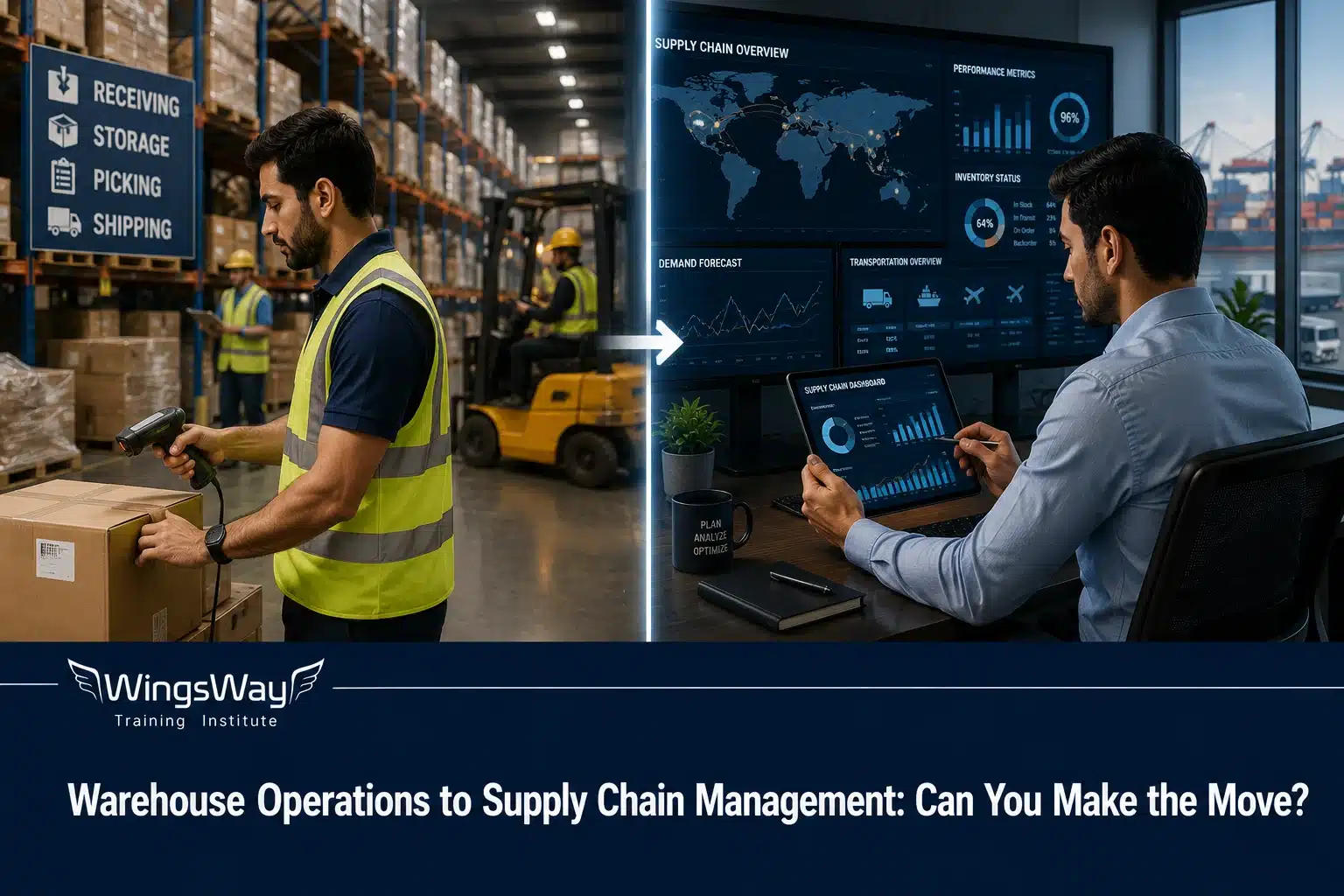
Warehouse Operations to Supply Chain Management: Can You Make the Move?
Quick Answer: Warehouse operations to supply chain management is a realistic career move for professionals who build on existing inventory, stock control, and logistics experience with structured knowledge of procurement, planning, and end-to-end coordination. With relevant training, warehouse assistants, supervisors, and inventory controllers can move into coordinator and management roles within a warehouse to supply chain career path.
Introduction
Warehouse operations to supply chain management is one of the most common career questions among professionals working in distribution centres, stores, and fulfilment warehouses across the UAE. Warehouse assistants, supervisors, and inventory controllers already handle receiving, put-away, picking, stock counts, and dispatch — all of which sit inside a wider supply chain. What is less clear is whether that hands-on experience is enough on its own to move into coordination, planning, or management roles, or whether it needs to be paired with structured knowledge of procurement, demand planning, and logistics systems.
This article sets out what actually separates warehouse operations from supply chain management, which skills transfer directly, which need to be developed, and what a realistic transition path looks like for warehouse professionals across the UAE, Saudi Arabia, and the wider GCC region.
Why This Career Move Makes Sense in the UAE
The UAE’s position as a regional trade and logistics hub means warehousing rarely operates as a stand-alone function. Goods moving through free zones such as JAFZA and DAFZA pass through procurement, inbound logistics, warehousing, and distribution as one connected chain — which is exactly why warehouse operations to supply chain management is a realistic move rather than a change of industry.
For warehouse professionals, this changes what career growth looks like. Instead of progressing only within the warehouse — from assistant to supervisor to warehouse manager — a warehouse to supply chain career opens a second, parallel path into planning, procurement support, logistics coordination, and inventory control roles positioned closer to the centre of the business.
Key Takeaways
- Warehousing is one function within supply chain management, not a separate field — the two are directly connected, not parallel tracks.
- Practical warehouse experience — inventory accuracy, stock movement, receiving and dispatch — gives a genuine head start into supply chain career path roles.
- Moving from warehouse operations to supply chain management usually means adding knowledge of procurement, demand planning, logistics coordination, and systems such as WMS and ERP.
- Common transition routes include warehouse to logistics coordinator and warehouse supervisor to supply chain manager, often supported by structured training.
- A university degree is not always mandatory for entry-level supply chain roles; relevant operational experience, practical skills and recognised certifications can also support progression.
- Reframing a CV — using supply chain terminology instead of task lists — is often what separates warehouse professionals who get shortlisted for coordinator roles from those who do not.
What Is Supply Chain Management?
Supply chain management is the coordination of everything involved in getting a product from raw material or origin to the end customer. This includes procurement (sourcing and buying), production or assembly, transportation, warehousing, inventory management, and distribution.
Warehouse operations sit inside this chain as the point where goods are received, stored, tracked, and prepared for onward movement. Warehouse operations to supply chain management, in this sense, is not a move from an unrelated field into a new one — it is a move from one link in the chain to a role that oversees or coordinates several links at once.
Warehouse Operations to Supply Chain Management: What Actually Changes?
Is Warehouse Part of Supply Chain Management?
Yes. Warehousing is one of the core functions of supply chain management, alongside procurement, transportation, demand planning, and distribution. A warehouse is where inventory is held, tracked, and prepared for the next stage of the chain, so warehouse activity directly affects supply chain performance — stock accuracy, order fulfilment speed, and cost all depend on how well a warehouse is run.
Which Warehouse Skills Transfer Directly to Supply Chain Roles?
- Inventory accuracy and stock counting — directly relevant to inventory control and planning roles.
- Understanding of goods flow (receiving, put-away, picking, dispatch) — useful for logistics coordination.
- Familiarity with warehouse management systems (WMS) — a foundation for working with broader ERP and supply chain software.
- KPI awareness (order accuracy, turnaround time, damage rates) — transferable to performance reporting in coordinator roles.
- Experience working with suppliers, transport providers, or dispatch teams — a starting point for procurement and logistics coordination.
What Skills Are Needed for Supply Chain Management?
Moving beyond the warehouse floor typically requires:
- Procurement basics — how sourcing, purchase orders, and supplier relationships work.
- Demand planning and forecasting — understanding how stock levels are planned against expected demand.
- Data and reporting skills — working with spreadsheets and WMS/ERP dashboards.
- Cross-functional coordination — communicating between suppliers, warehouse teams, transport providers, and procurement or sales teams.
- Regulatory and documentation knowledge — customs, import/export documentation, and compliance, which matter across UAE free zones.
These skills are typically what separate a warehouse to logistics coordinator move from a lateral move within the warehouse itself.
Warehouse Assistant to Supply Chain Coordinator: What Changes?
A warehouse assistant to supply chain coordinator move usually means shifting from executing tasks to coordinating them. Instead of picking and packing, the coordinator role involves scheduling shipments, liaising with suppliers or transport companies, monitoring stock levels against demand, and reporting on service levels. The daily tasks change, but the underlying knowledge of how a warehouse runs — gained on the floor — remains directly useful for understanding where delays or stock issues come from.
Warehouse Supervisor to Supply Chain Manager: What Changes?
A warehouse supervisor to supply chain manager move adds strategic and cross-departmental responsibility. A supervisor manages people and processes within the warehouse; a supply chain manager is typically responsible for aligning procurement, inventory, warehousing, and distribution against cost and service targets across the wider business. This move usually requires demonstrated experience managing a team, plus additional knowledge of procurement, planning, and supplier management — often built through structured courses or certifications rather than on-the-job exposure alone.
Career Outcomes After Warehouse Operations Experience
Warehouse professionals making this transition often move into roles such as:
- Inventory Controller — focused on stock accuracy, cycle counts, and reconciling physical stock against system records.
- Logistics Coordinator — responsible for scheduling shipments, coordinating with transport providers, and tracking orders.
- Supply Chain Coordinator / Planner — supporting demand planning, purchase order tracking, and supplier coordination.
- Warehouse Manager — an internal progression route that increasingly overlaps with supply chain responsibilities as warehouses become more integrated with planning and procurement.
- Supply Chain / Procurement Analyst — a more data-focused role, tracking KPIs, costs, and supplier performance.
From these roles, progression may continue into supply chain management, procurement or broader operations positions, depending on the professional’s experience and chosen specialisation.
How to Move from Warehouse Operations to Supply Chain Management
- Map your current experience against supply chain functions — Identify which parts of your current role already touch procurement, planning, or distribution, even informally.
- Learn the terminology and tools — Familiarise yourself with terms such as demand planning, lead time, and safety stock, and with ERP/WMS systems used beyond your current warehouse.
- Identify the specific role you are targeting — Coordinator, planner, and analyst roles have different skill emphases, so targeting a specific role focuses your preparation.
- Consider structured training — this is the point at which many warehouse professionals formalise their experience rather than relying on informal learning alone. The right choice depends on direction: professionals who want to stay close to warehouse operations can compare warehouse and inventory management training separately, while those aiming for broader coordinator or planning roles should prioritise logistics and supply chain training covering procurement, planning, inventory and cross-functional coordination. Structured training is one route used to bridge this gap — it is not the only route, but it is a common one.
- Update your CV and LinkedIn using supply chain language — Reframe warehouse tasks (for example, “maintained stock accuracy across a defined SKU range”) rather than listing duties, so recruiters and applicant tracking systems recognise the transferable value.
- Apply for hybrid or bridge roles first — Roles such as inventory controller or warehouse-based supply chain coordinator often accept warehouse experience directly, acting as a practical stepping stone rather than requiring an immediate jump into a full planning or procurement role.
How to Rewrite Your Warehouse CV for Supply Chain Roles
How to update CV from warehouse to supply chain comes down to one habit: describing outcomes and accuracy, not tasks. Recruiters and applicant tracking systems scanning for supply chain keywords are more likely to shortlist a CV that reads like the examples below.
| Warehouse Task | Supply Chain CV Version |
|---|---|
| Stock counting | Maintained inventory accuracy through regular cycle counts |
| Dispatch support | Coordinated outbound movement and delivery documentation |
| Picking and packing | Supported order fulfilment and stock movement processes |
| Warehouse reporting | Updated WMS/ERP records and supported inventory visibility |
| Supervising warehouse staff | Led a team responsible for meeting daily fulfilment and accuracy targets |
The pattern in each rewrite is the same: name the system or metric involved, and state the result rather than the activity. This is what turns a warehouse assistant to supply chain coordinator application from a lateral guess into a credible case.
Interview Questions for Moving from Warehouse to Supply Chain
Interviewers for coordinator, planner, and analyst roles typically probe two things: whether a candidate understands why the move makes sense, and whether they grasp supply chain concepts beyond the warehouse floor. Common questions include:
- Why do you want to move from warehouse operations to supply chain management?
- How does warehouse experience help in supply chain?
- What supply chain skills do you need to improve?
- How do you handle inventory errors or discrepancies?
- What is the difference between warehousing, logistics, and supply chain management?
Preparing short, specific answers — with real examples from warehouse work — is generally more effective than memorised definitions.
Which Certifications Can Support a Warehouse to Supply Chain Career Move?
Certifications can help warehouse professionals formalise their practical experience, though the right choice depends on the target role.
- CILT-aligned qualifications tend to suit logistics and transport-focused coordinator roles.
- CIPS-aligned qualifications tend to suit procurement-focused supply chain roles.
- Broader supply chain management qualifications, often referencing IFPSM standards, tend to suit coordinator or planning roles that span multiple functions.
These professional bodies are referenced again in the accreditation section below because their qualification, accreditation and affiliation frameworks can help learners evaluate the relevance and recognition of different training pathways.
Common Mistakes When Moving from Warehouse to Supply Chain
- Applying without reframing warehouse experience in supply chain terms — listing tasks instead of demonstrating measurable impact.
- Skipping the terminology gap — walking into interviews without knowing terms like lead time, demand planning, or safety stock.
- Targeting management roles too early — trying to move straight to supply chain manager without first taking a coordinator or analyst step.
- Underestimating systems and documentation knowledge — ERP/WMS familiarity and compliance documentation matter more outside the warehouse, not less.
- Treating a certificate as a shortcut — a certification supports a case for the move, but it does not replace the need to demonstrate practical, cross-functional understanding.
Frequently Asked Questions
Q1: Can warehouse experience help in supply chain?
Yes. Warehouse experience gives direct, practical exposure to inventory accuracy, stock movement, and the operational realities of order fulfilment — all of which supply chain roles rely on. It needs to be paired with knowledge of procurement, planning, and coordination to move into broader supply chain roles.
Q2: Is warehouse part of supply chain management?
Yes. Warehousing is one of the core functions of supply chain management, alongside procurement, transportation, and distribution. It is not a separate field.
Q3: What jobs can I get after warehouse operations?
Common next roles include inventory controller, logistics coordinator, supply chain coordinator or planner, warehouse manager, and procurement or supply chain analyst, depending on experience level and any additional training completed.
Q4: Can a warehouse supervisor become a supply chain manager?
Yes, this is a recognised progression route, though it typically requires demonstrated people-management experience plus additional knowledge of procurement, planning, and supplier management, often gained through structured training or certification.
Q5: Which course is best after warehouse experience?
There is no single “best” course — the right choice depends on the target role. Warehouse and inventory management courses build directly on existing warehouse skills, while broader supply chain management or logistics courses cover procurement, planning, and coordination for professionals aiming at coordinator or management roles.
Q6: Do I need a degree for supply chain jobs?
Not always. A university degree is not mandatory for every entry-level or coordinator-level supply chain role. Some employers consider relevant operational experience, practical skills and recognised certifications alongside formal education, while degree requirements are more common for senior management or strategic planning positions.
Q7: How do I move from warehouse to logistics?
A warehouse to logistics coordinator move typically involves building knowledge of shipment scheduling, transport coordination, and documentation, alongside existing warehouse experience. Structured training and exposure to logistics-specific systems and terminology usually support this move.
Why Choose WingsWay for Supply Chain Career Growth
When evaluating any course or programme related to this career move, it is worth checking who accredits it and what that accreditation actually means, since certification claims vary widely across training providers. This is relevant here specifically because CIPS, CILT and IFPSM — referenced above — each play different roles in procurement, logistics and supply-chain professional standards. Their approved-centre, accredited-partner or affiliation frameworks can help learners assess the relevance and recognition of a training provider’s programmes.
WingsWay Training Institute offers courses relevant to this transition, including warehouse and inventory management courses and broader supply chain and logistics courses, for professionals looking to formalise a warehouse to supply chain career move. Its accreditation profile includes:
- KHDA approval — licensed by the Knowledge and Human Development Authority, Dubai’s regulator for private training providers.
- ISO 9001:2015 certification — an internationally recognised quality management standard.
- CPD Standards Office (UK) accreditation — recognised continuing professional development credentials.
- CIPS Approved Study Centre and CIPS exam centre status — for procurement and supply qualifications benchmarked by the Chartered Institute of Procurement and Supply.
- IATA Authorised Training Centre status (AE-WWD-01-20-001) — for aviation and air transport-related training.
- CILT Accredited Training Partner (ATP) status — for logistics and transport qualifications aligned with the Chartered Institute of Logistics and Transport.
- IFPSM affiliation — reflecting participation in an international federation focused on purchasing and supply management professional standards and development.
These are stated for informational purposes as part of evaluating training providers for this career move, not as a promotional claim.
Conclusion
Warehouse operations to supply chain management is a realistic career move rather than a leap into an unrelated field, because warehousing already sits within the wider supply chain. Warehousing is already part of the supply chain, and the operational experience gained on a warehouse floor — inventory accuracy, stock flow, KPI awareness — carries real value in coordinator, planning, and management roles. What typically separates a successful transition from a stalled one is whether that experience is paired with procurement, planning, and coordination knowledge, and whether it is presented to employers in supply chain terms rather than warehouse task lists. For professionals across the UAE and wider GCC, this combination of practical background and structured knowledge is what turns warehouse experience into a genuine supply chain career path.
- Author: WingsWay Content Strategy Team
- Reviewed by: Senior Supply Chain & Procurement Training Lead, WingsWay Training Institute
- Last reviewed: August 2026
Are you Looking For Career Change?
Connect with our team directly on WhatsApp for course details, fees, schedules, and guidance.
Tag:logistics careers UAE, logistics coordinator UAE, Supply Chain Courses UAE, supply chain jobs UAE, supply chain management UAE, warehouse and inventory management, warehouse management UAE, warehouse operations to supply chain management, warehouse supervisor career growth, warehouse to supply chain career path