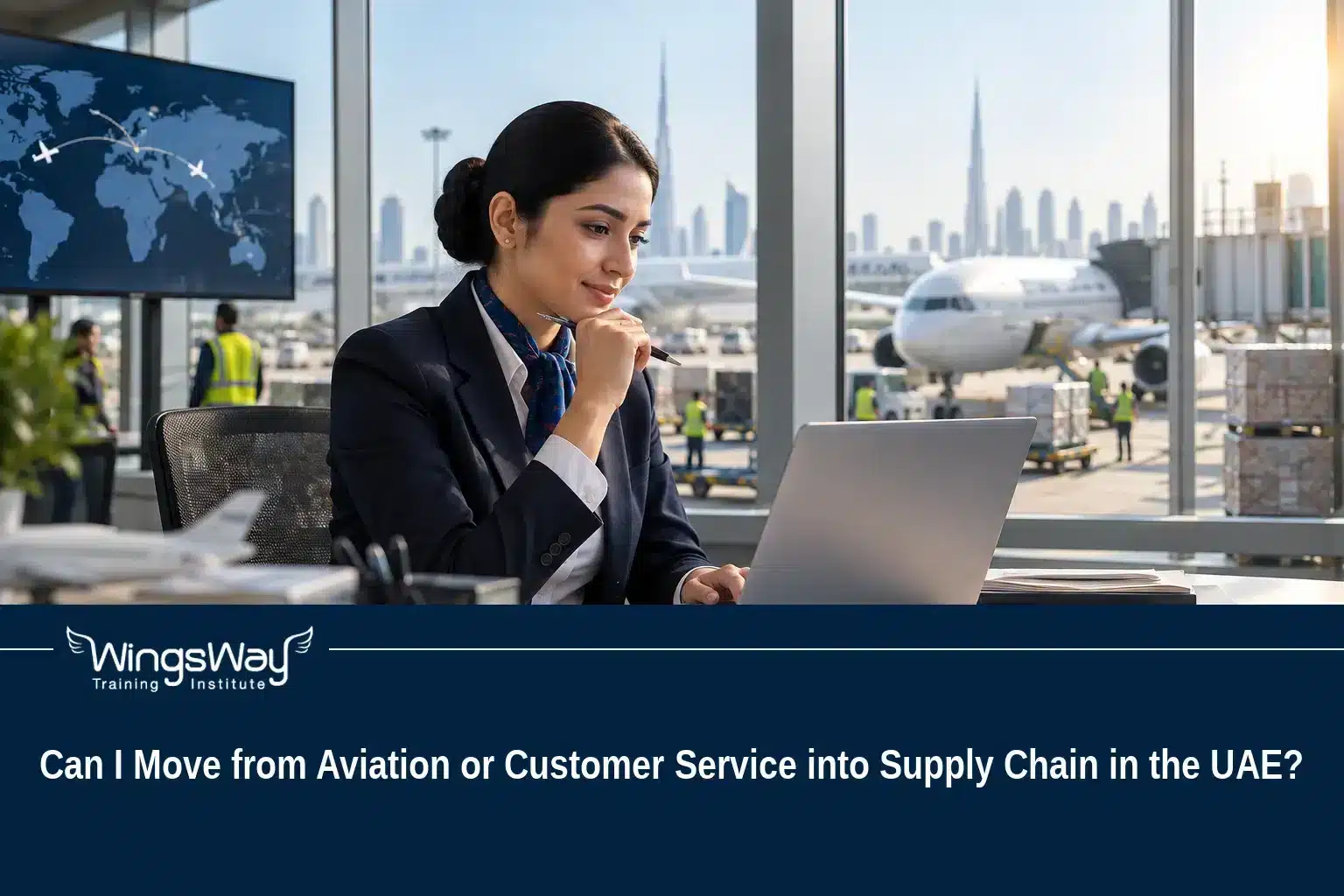
Can I Move from Aviation or Customer Service into Supply Chain in the UAE?
Quick Answer: Yes. Moving from aviation, airport operations, or airline customer service into a supply chain career in the UAE is realistic, since many daily tasks, such as compliance, documentation accuracy, and coordination under pressure, transfer directly. Structured training, such as a supply chain certification for professionals transitioning into supply chain, is one way to formalise that background, though it is not the only route in.
Many professionals working in UAE airports, ground handling companies, and airline customer-service roles ask us one recurring question: is moving from aviation to supply chain career in the UAE realistic, or is aviation experience seen as unrelated by logistics and procurement employers?
It’s a fair question. Aviation operations and supply chain management look different on the surface — one deals with passengers and flights, the other with goods, warehouses, and procurement cycles. But the underlying skills overlap more than most people expect.
This blog looks at that transition on its own merits. It covers which transferable aviation skills actually carry over, which knowledge areas typically need to be built through training, what roles are realistic first steps for both operations and customer-service backgrounds, and how UAE employers in logistics, procurement, and transport generally evaluate candidates coming from a non-traditional supply chain background.
Why This Matters
The UAE’s aviation and logistics sectors sit much closer together than they might appear. Dubai and Abu Dhabi are built around air-sea-land connectivity, and the same free zones, ports, and airport cities that handle passenger traffic also handle cargo, warehousing and distribution.
This close relationship can make aviation experience particularly relevant when exploring logistics and supply chain opportunities in the UAE.
For professionals, this matters because airport operations experience is not disconnected from supply chain thinking. Flight schedules, cargo handling, customs clearance, and ground coordination are all logistics functions in practice, even when the job title reads ‘customer service’ or ‘ground operations.’
Recognising this overlap is usually the first step in reframing an aviation background for a logistics career in the UAE.
Key Takeaways
- Many aviation operations tasks are logistics functions under a different name — cargo handling, customs documentation, and ground coordination all map onto recognised supply chain activities.
- A career change from aviation to supply chain does not necessarily mean starting from zero, although targeted training can help close technical knowledge gaps and translate existing experience into supply chain terminology.
- Entry-level and coordinator-level supply chain jobs in the UAE often give real weight to operational discipline and compliance experience, along with a prior supply chain job title.
- Transferable aviation skills such as SLA management, documentation accuracy, and multi-party coordination map closely onto procurement and logistics coordinator roles.
- Employers assessing a supply chain application typically look for evidence of process understanding, not just interest. A recognised certification is one way to provide that evidence, though not the only one.
- UAE’s free zone and airport-cargo infrastructure (Jebel Ali, Dubai World Central, airport cargo terminals) creates substantial operational overlap between the aviation and logistics sectors.
CIPS, CILT, and IATA: What They Mean for This Career Move
Three professional bodies are commonly referred to when UAE employers and training providers talk about supply chain and logistics credentials.
CIPS – Chartered Institute of Procurement and Supply, UK
CIPS is a professional body for procurement and supply chain qualifications. CIPS is referenced or preferred in some of the UAE procurement job postings, and CIPS study covers sourcing, contracts, and supplier-management knowledge that aviation operations roles do not typically include.
CILT – Chartered Institute of Logistics and Transport, UK
CILT is a professional body focused on logistics and transport. For someone coming from ground handling or airport operations, CILT’s transport and logistics fundamentals often map directly onto tasks already familiar with an aviation environment.
IATA – International Air Transport Association
IATA is primarily an aviation body, but it also delivers cargo and supply chain training, including a joint cargo supply chain management certificate developed with an academic partner.
This reflects how closely air cargo, logistics, and supply chain functions sit together in practice, which makes IATA a relevant reference point specifically for professionals moving from an airline or airport background into supply chain.
Market Demand for an Aviation to Supply Chain Career in the UAE
Demand for logistics and supply chain talent in the UAE is tied to the wider growth of the sector.
Dubai’s transport and storage sector alone contributed 13% of Dubai’s GDP in the first quarter of 2025, according to official Dubai GDP data — a sector that, by definition, covers air, land and sea transport, handling and storage activities.
Separately, industry forecasts (Technavio) project the wider UAE logistics market to grow at roughly 8.2% annually between 2025 and 2030 as trade, e-commerce, and industrial diversification continue.
This is relevant to anyone considering a logistics career in the UAE: a sector of this size is not staffed solely by candidates with a traditional supply chain degree, and operations-trained professionals, including from aviation, are a plausible talent pool for it, even though sector-wide hiring data broken down by previous industry is not publicly available.
What an Aviation to Supply Chain Career in the UAE Actually Means
In simple terms, this kind of transition means moving from an operational aviation role, such as ground handling, passenger services, cargo operations, or airline customer service, into a role that manages the flow of goods, materials, or services, such as logistics coordination, procurement, warehousing, or transport operations.
Supply chain management, defined simply, covers everything involved in getting a product or service from source to end user: sourcing (procurement), moving goods (logistics and transport), storing them (warehousing), and managing the process end-to-end (supply chain planning and operations).
Aviation operations roles already touch several of these functions — moving people and cargo on schedule, managing documentation, coordinating with multiple parties under time pressure. This is why this transition is generally considered achievable rather than a complete career restart.
How Aviation Experience Maps onto Supply Chain Roles
Transferable Skills from Aviation Operations
The following skills, built through day-to-day aviation operations work, are the ones most consistently relevant to UAE logistics and procurement roles:
- Compliance and documentation discipline: Aviation is one of the most heavily regulated operational environments, and this translates directly into customs, freight, and procurement documentation.
- Coordination across multiple parties: Managing ground handlers, caterers, fuel suppliers, and airline schedules is functionally similar to coordinating vendors, carriers, and internal stakeholders in a supply chain role.
- Performance against service-level agreements (SLAs): On-time-performance culture in aviation maps onto on-time-delivery (OTD), and KPI-driven logistics environments.
- Problem-solving under time pressure: Disruption management (delays, reroutes, irregular operations) is directly comparable to exception-handling in logistics and freight.
- Customer-facing communication: Particularly relevant for account coordination or customer-service roles within a procurement or logistics function.
| Aviation/airport operations task | Equivalent supply chain function |
|---|---|
| Ground handling coordination, flight turnaround timing | Logistics/warehouse coordination, on-time delivery (OTD) management |
| Cargo acceptance, documentation, customs paperwork | Freight forwarding, import-export documentation |
| Passenger/customer service, complaint resolution | Customer service or account coordination within a supply chain team |
| Flight disruption handling (delays, reroutes, irregular ops) | Logistics exception management |
| Passenger-service escalation handling | Logistics customer/account coordination |
| SLA and on-time performance monitoring | KPI tracking in logistics or procurement operations |
| Working with ground handlers, caterers, fuel suppliers | Working with vendors and suppliers (early procurement exposure) |
| Shift-based operational discipline, compliance procedures | Warehouse, inventory or compliance-driven logistics roles |
If You Work in Airline Customer Service Specifically
Having airline customer service experience does not automatically equal cargo or logistics experience, and it’s worth being clear-eyed about that.
It sits at more of a distance from warehouse or freight operations than a ground-handling or cargo role does.
That said, several competencies do transfer, particularly into coordination-facing rather than operations-facing supply chain roles:
| Airline customer-service experience | Possible supply chain/logistics application |
|---|---|
| Handling escalations | Logistics exception management |
| Customer communication | Logistics customer or account coordination |
| Booking and document accuracy | Order processing/document control |
| SLA handling | Service-performance (KPI) monitoring |
| Cross-team coordination | Internal or vendor coordination |
| Disruption handling | Delivery or order exception resolution |
In practice, this means a more realistic first move for a customer-service background is often a logistics customer-service or order-management coordinator role, with progression toward broader logistics coordination over time.
A direct move into procurement or buying is less immediate without some additional procurement-specific knowledge, since that function relies more on sourcing and supplier-negotiation skills that customer-service roles don’t typically build.
Skills Gaps that Typically Need Formal Training
Certain knowledge areas are specific to supply chain and procurement, and are not usually covered by aviation operations experience alone:
- Procurement and logistics skills — sourcing methodology, tendering, supplier evaluation, and contract terms.
- Inventory and warehouse management principles, including stock control and warehousing KPIs.
- Supply chain planning concepts, such as demand forecasting and supplier lead-time management.
- Logistics costing, Incoterms, and freight documentation specific to non-aviation cargo movement.
- Familiarity with ERP or procurement software commonly used in supply chain roles.
Formal training is one way to close these gaps, but it is not the only evidence employers look for. Practical signals, such as ERP or spreadsheet/data competence, exposure to KPI or process-improvement work, any internal project involving vendors, scheduling or documentation, and measurable operational achievements from an aviation role, can also demonstrate readiness, particularly when paired with a clear, well-framed CV.
Which Aviation Roles Transition Most Naturally
- Cargo and freight agents — typically one of the closest fits because air cargo handling is already a logistics function.
- Ground operations and ramp coordinators — existing coordination experience can align with warehouse or logistics operations roles.
- Airport operations supervisors — skills in compliance, shift management and operational coordination can transfer to logistics-supervisory roles.
- Airline customer-service staff — more typically move into customer service, account coordination, or order-management roles within a logistics or procurement team; see the dedicated section on this topic above.
Where Training Fits in
For professionals who do want to formalise their background, a supply chain certification for career changers functions largely as a translation layer. It converts operational experience into supply chain terminology and frameworks that can make the relevance of that experience clearer to recruiters and hiring managers.
Studying toward a CIPS or CILT qualification is a common route for this, though it sits alongside, rather than replaces, demonstrable operational experience.
Career Outcomes
Possible entry points from aviation to supply chain, depending on existing experience and the specific supply chain function being targeted, include:
- Logistics Coordinator
- Logistics Customer-Service / Order-Management Coordinator
- Supply Chain Coordinator
- Freight or Cargo Coordinator
- Warehouse Operations Coordinator
- Import-Export Coordinator
Procurement Assistant or Procurement Officer roles are also a possible entry point, though generally a more realistic fit for candidates with some sourcing, vendor or contract exposure than for a customer-service-only background.
With experience and further professional study (such as progressing through CIPS or CILT qualification levels), possible next steps include Buyer, Supply Chain Analyst, Senior Logistics Coordinator and, over a longer timeframe, Procurement Manager or Logistics/Supply Chain Manager roles.
How Aviation Professionals Can Make the Transition
- Audit your current aviation experience against supply chain functions. Identify which of your day-to-day tasks already resemble procurement, logistics, or warehouse activities.
- Decide which function you are targeting — procurement, logistics/transport, warehouse operations or a coordination-facing role — since each has a different skills emphasis and, often, a different professional body.
- Address the specific knowledge gap through structured training or targeted self-study, rather than trying to cover every area of supply chain at once.
- Reframe your CV and LinkedIn profile using supply chain and logistics terminology, mapping aviation achievements onto recognised KPIs (OTD, SLA adherence, documentation accuracy).
- Target entry points where an aviation background is a genuine advantage before broader logistics or procurement roles. Air cargo, ground-logistics providers and airport-adjacent freight companies.
- Build familiarity with relevant professional bodies such as CIPS and CILT, and understand which qualification pathway aligns with your target function.
For many professionals, this is also the stage at which structured training becomes relevant. Logistics and supply chain training in Dubai is one route used to formalise operational experience into qualifications that supply chain employers recognise.
It is not the only route you can take from aviation to supply chain, but it is a common one for professionals planning to change their careers and demonstrate procurement and logistics skills alongside their aviation background.
Frequently Asked Questions
Q1: Can I move from aviation or customer service operations into supply chain in the UAE?
Yes. An aviation to supply chain career move is achievable, particularly from ground handling, cargo, and airport operations roles, because these functions already involve logistics-related tasks. Customer-service backgrounds can also transition, typically into coordination-facing roles first. A structured certification can strengthen the transition by formalising that experience, though it isn’t the only possible route.
Q2: Do I need a supply chain degree to make this career change?
A supply chain degree is not always required. Requirements vary by employer and role, and a career change from aviation to supply chain is often made on the strength of relevant operational experience combined with a professional certification such as CIPS or CILT.
Q3: Which aviation roles transition most easily into supply chain jobs in the UAE?
Cargo and ground operations roles usually transition most directly, since they already involve logistics coordination. Passenger-facing customer-service roles more typically transition into coordinator or account management positions within logistics and procurement teams, rather than directly into warehouse or procurement roles.
Q4: What supply chain certification is best for professionals changing their careers from aviation?
There is no single ‘best’ option. CIPS is a common reference point for procurement-focused roles, while CILT is more closely aligned with logistics and transport operations. The right supply chain certification for career changers depends on which function — procurement or logistics — you are targeting.
Q5: How long does it take to move from aviation into a supply chain role?
There is no standard timeframe. It depends on your existing experience, the target role, the size of the skills gap, whether you pursue formal training, and hiring conditions at the time. Most professionals work through this alongside their current job rather than in a fixed window.
Q6: Is aviation experience valued by UAE logistics and procurement employers?
Relevant airport operations experience can be valuable, since it demonstrates compliance discipline, documentation accuracy, and the ability to work under operational pressure. These qualities are relevant to supply chain and logistics roles. How much weight it carries varies by employer and by how clearly that experience is presented on a CV.
Q7: What is the difference between logistics and supply chain management?
Logistics refers specifically to the movement and storage of goods, including transportation, warehousing, and distribution. Supply chain management is the broader function, covering sourcing, procurement, logistics, and planning end-to-end. Aviation operations experience tends to map most directly onto the logistics side of that broader function.
If You Decide to Pursue Training
Not all training ‘certificates’ carry the same recognition, so it’s worth checking a few credibility factors before enrolling: whether the provider holds KHDA permitting (a Dubai regulatory permission to deliver training, not itself a professional accreditation), an ISO 9001:2015 quality-management certification, CPD (UK) accreditation. For supply chain and procurement training — also check whether it is a CIPS Approved Study Centre or exam centre, holds CILT Approved Training Provider (ATP) status, is affiliated with IFPSM, or, for aviation-specific cargo and supply chain training, is an IATA Authorised Training Centre.
WingsWay Training Institute in Dubai is one example of a provider holding several of these — KHDA permitting, ISO 9001:2015 certification, CPD (UK) accreditation, CIPS Approved Study Centre and exam centre status, IATA Authorised Training Centre status (AE-WWD-01-20-001), CILT ATP status and IFPSM affiliation — noted here as a reference point against the factors above, not as a recommendation.
If you want to know the difference between a licensed training institute vs an accredited certification, read here.
Conclusion
Moving from aviation or airport-based customer service into supply chain, logistics or procurement can be a realistic career path in the UAE. The two sectors overlap more than they first appear to, particularly around cargo, ground operations and compliance-driven processes.
The most realistic route combines an honest audit of which aviation skills already transfer, targeted study to close specific knowledge gaps (typically in procurement, logistics planning or inventory management), and a clear-eyed choice of which supply chain function — procurement, logistics, warehouse operations or a coordination-facing role — best fits existing experience.
UAE’s logistics sector, and its close physical and economic ties to aviation infrastructure, make it one of the more accessible industries to move into with an aviation background.
Author & Review Information
Written by: Sadiq
Reviewed by: Manish K Dalal, MBA, MCIPS (UK), CMILT — Procurement, Supply Chain, and Logistics Instructor, WingsWay Training Institute
Last reviewed: September 2026
This page is reviewed periodically for factual accuracy, including accreditation details and role definitions, and updated as procurement practices or professional-body frameworks change.
This content is for educational and informational purposes only and does not constitute professional, career, or recruitment advice. Readers should verify current role requirements and accreditation details directly with employers or the relevant professional bodies.
Need More Details About This Course?
Connect with our team directly on WhatsApp for course details, fees, schedules, and guidance.