
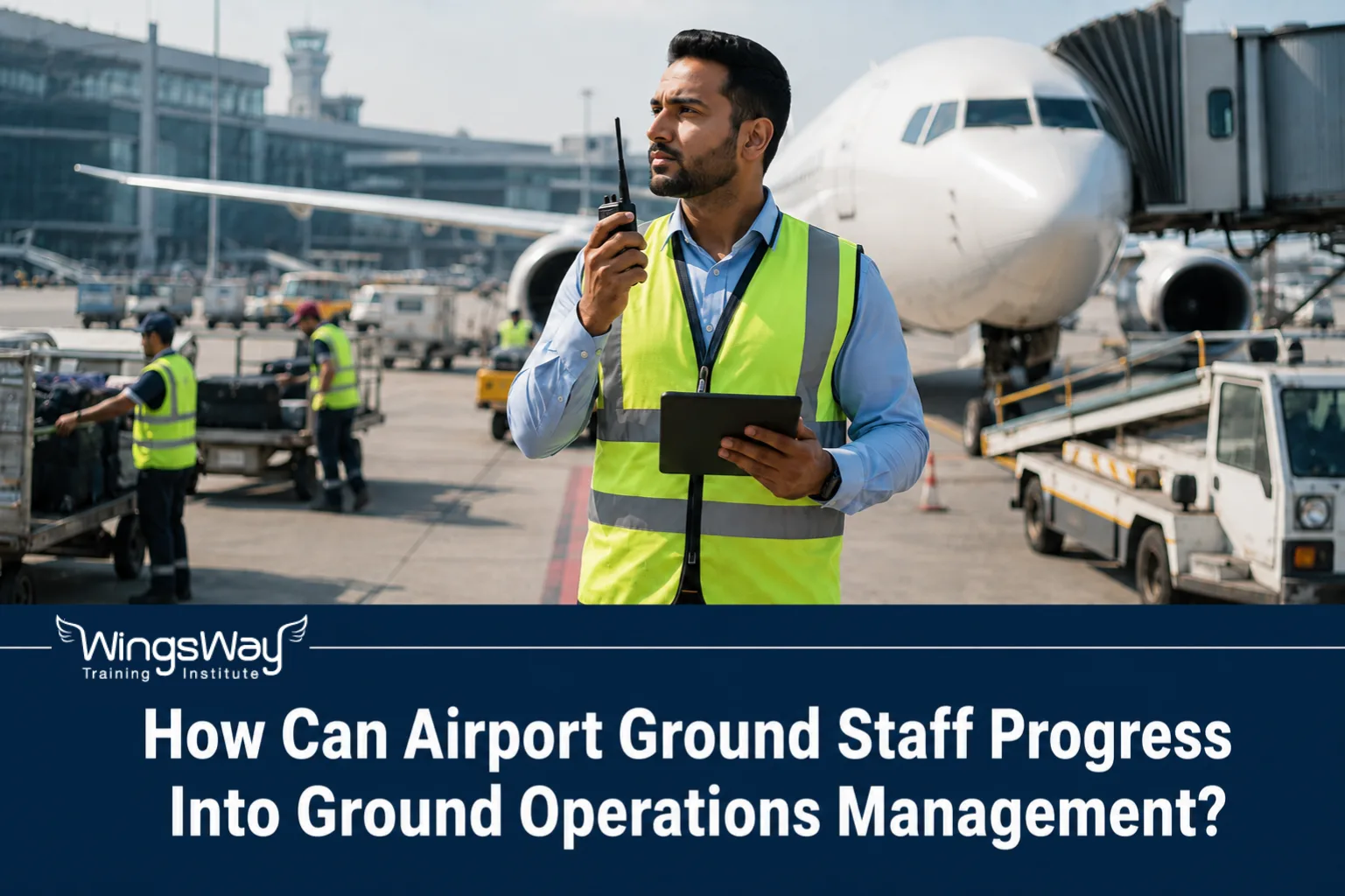
How Can Airport Ground Staff Progress Into Ground Operations Management?
Quick Answer: Airport ground operations career progression typically moves from entry-level roles such as ramp agent or passenger service agent, through team leader and supervisor positions, into station coordination, and eventually into ground operations management. Progression usually depends on operational experience, safety and compliance knowledge, leadership exposure, and structured aviation training.
Introduction
Airport ground staff form the backbone of daily flight operations, working across check-in, boarding, baggage handling, ramp services, and dispatch. Many begin their careers in an operational, hands-on role without a clear picture of what comes next. Understanding airport ground operations career progression helps staff identify the skills, experience, and qualifications that typically separate an entry-level position from a supervisory or management role.
This guide explains, in a structured and factual way, how ground staff commonly move from operational duties into ground operations management. It covers the typical stages of progression, the skills airports and ground handling companies look for, and the training routes professionals use to formalise their experience. The explanations here are informational and apply broadly across airports in the UAE, the wider GCC, and other markets with active ground handling operations.
Why This Matters
Ground operations sit at the centre of airport turnaround performance. Delays in baggage handling, ramp coordination, or passenger processing affect on-time performance across an entire airline network, which is why airports and ground handling companies invest heavily in developing internal talent.
For staff, this creates a genuine airport ground staff career path rather than a static entry-level job. Airlines and ground handlers generally prefer promoting experienced operational staff into supervisory and management roles because they already understand turnaround procedures, safety requirements, and passenger flow. Structured airport operations career progression also supports airport safety, since supervisors and managers with direct ground experience are better placed to identify operational risk before it affects a flight.
Key Takeaways
- Progression from ground staff to management usually follows recognisable stages: entry-level role, team leader or supervisor, coordinator, then manager.
- Both ramp and passenger service backgrounds can lead into ground operations management, though the skills emphasised differ slightly.
- Leadership exposure — shift-lead duties, incident reporting, roster coordination — is often what separates staff ready for promotion from long-serving operational staff.
- Structured training in ground operations, safety, and management strengthens a promotion case even without a university degree.
- Airports across the UAE and wider GCC have active demand for supervisory and management-level ground operations talent due to ongoing airport expansion.
- A degree is not always mandatory for ground operations management, though it can support progression into senior or regional roles.
The Airport Ground Operations Career Path, Step by Step
Entry-Level Ground Staff Roles
Most people enter airport ground operations through one of a small number of entry-level roles: ramp agent, passenger service agent, baggage handler, check-in agent, or boarding gate agent. These roles are operational and hands-on, focused on a single function within the wider turnaround process.
At this stage, staff typically work under direct supervision, follow standard operating procedures, and are assessed on accuracy, safety compliance, and reliability rather than leadership ability. The time spent at this stage varies significantly by employer, airport, vacancy availability, and individual performance.
Ramp Agent to Ground Operations Manager
For staff who begin on the ramp, ramp agent career progression usually follows a fairly consistent pattern. A ramp agent typically moves first into a ramp team leader or shift lead role, taking on responsibility for a small team during a shift, coordinating aircraft turnaround timing, and handling basic incident reporting.
From there, progression into a ramp supervisor or duty supervisor role adds responsibility for multiple turnarounds, staff rostering, and closer coordination with airlines and airport authorities. The move from airport ground staff to ground operations manager — specifically ramp agent to ground operations manager — typically requires this supervisory experience plus additional training in safety management, ground operations planning, and leadership, since a ground operations manager oversees ramp activity alongside several other ground functions rather than ramp duties alone. Staff at this stage sometimes look at Airport Ramp Services training to formalise ramp-side knowledge alongside their operational experience.
Passenger Service Agent to Airport Operations Supervisor
A passenger service agent career path usually moves through check-in, boarding, and customer service duties before progressing into team leader responsibilities — managing gate teams, handling escalated passenger issues, and coordinating with ramp and baggage teams during irregular operations.
The typical next step is a passenger service agent to airport operations supervisor move, where responsibility expands to cover shift-level performance across passenger-facing functions, staff scheduling, and reporting to station or duty managers. From a supervisor role, staff with broader operational exposure — including some ramp or baggage-side experience — are better positioned to move into a full ground operations management role, since the position requires oversight across passenger service and airside functions rather than passenger service alone. Staff at this stage sometimes look at Passenger Ground Services training to formalise this experience.
Team Leader and Duty Supervisor Roles
Team leader and duty supervisor roles are usually the first formal step into people management. Responsibilities at this stage typically include:
- Allocating staff across shifts and flights
- Monitoring turnaround timing and reporting delays
- Handling first-line incident reports and irregularities
- Acting as the point of contact for airline representatives during a shift
This stage is where staff usually begin building the operational and leadership evidence that supports later promotion into station or ground operations management roles.
Station Coordinator and Airport Operations Officer Roles
Above supervisor level, roles such as station coordinator or airport operations officer typically oversee an entire station’s ground handling performance for one or more airlines. Responsibilities usually include coordinating between ramp, passenger service, baggage, and dispatch teams, monitoring service-level agreements, and managing relationships with airline station managers and airport authorities.
This stage generally requires a broader understanding of ground operations as a whole system, rather than expertise in a single function, and is often where staff begin formal ground operations management training to fill knowledge gaps outside their original specialism.
Ground Operations Manager: The Senior Role
A ground operations manager typically holds full responsibility for a station’s or airport’s ground handling performance, including safety compliance, staff management across multiple functions, budget and resource planning, and coordination with airlines, airport authorities, and regulators. This role usually sits at the top of the airport ground staff career path before further progression into regional or airport operations director roles.
What Is Ground Operations Management?
Ground operations management is the function responsible for planning, coordinating, and overseeing all activities involved in preparing an aircraft, its passengers, and its cargo for departure and arrival. This includes ramp handling, baggage and cargo processing, passenger services, load control, dispatch, and coordination with airlines, ground handling agents, and airport authorities.
A ground operations manager is typically responsible for safety compliance, staff rostering, service-level performance, incident management, and coordination between multiple ground handling functions during aircraft turnaround. The role sits above day-to-day operational duties and requires a working understanding of every function it oversees — which is why most people who reach this role have direct ground handling or passenger service experience earlier in their career.
Skills Needed for Ground Operations Management
Skills needed for ground operations management typically combine operational knowledge with people management and compliance capability. Common skills include:
- Understanding of aircraft turnaround procedures and IATA ground handling standards
- Safety and regulatory compliance knowledge, including airside safety procedures
- Staff rostering and shift management
- Incident reporting and irregular operations (IROPS) handling
- Communication and coordination across multiple ground handling functions
- Basic performance reporting and service-level monitoring
- Leadership and conflict-resolution skills for managing frontline teams
Most of these skills are built through a combination of direct operational experience and structured training. Practical experience develops familiarity with day-to-day procedures, while formal courses cover safety regulations, ground operations planning, and management frameworks that are harder to learn purely on the job.
Ground Staff vs Management: How Responsibilities Change
The table below summarises how day-to-day responsibilities typically shift as staff move from an operational ground role toward ground operations management.
| Operational ground staff | Progression toward management |
|---|---|
| Performs assigned operational tasks | Coordinates multiple functions |
| Follows safety procedures | Monitors and reinforces compliance |
| Works within a shift team | Allocates and supervises staff |
| Reports incidents | Manages and escalates operational incidents |
| Understands one operational area | Understands station-wide operations |
| Handles individual flights or tasks | Monitors wider turnaround performance |
| Works to supervisor instruction | Makes or supports operational decisions |
Career Outcomes: Roles, Growth, and Opportunities
Career outcomes across the airport ground operations career path vary by airport size, airline contracts, and individual specialisation. Common outcomes include:
- Ramp Supervisor or Duty Manager — overseeing ramp and turnaround operations for a shift or station
- Passenger Services Supervisor — overseeing check-in, boarding, and gate operations
- Station Coordinator or Airport Operations Officer — overseeing multiple ground functions for one or more airlines
- Ground Operations Manager — overall responsibility for a station’s or airport’s ground handling performance
- Airport Operations Manager or Director — a senior role overseeing operations across multiple stations or an entire airport, typically reached after several years in ground operations management
Salary, scope, and reporting lines vary between airports and ground handling companies, so these outcomes should be treated as typical role progression rather than a guaranteed timeline.
How to Start: A Step-by-Step Process
Staff exploring how to become a ground operations manager generally follow a broadly similar process, even though timelines vary by airport and employer:
- Build operational experience — spend time in an entry-level ground role (ramp, passenger service, baggage, or dispatch) to understand day-to-day turnaround procedures.
- Take on shift-lead or team-leader responsibility to begin building leadership and reporting experience.
- Broaden operational exposure — where possible, gain familiarity with functions outside your original specialism, for example a passenger service agent gaining ramp-side exposure, or vice versa.
- Formalise knowledge through structured training. Ground operations management courses cover safety regulation, ground operations planning, staff management, and airline coordination in a structured way that complements on-the-job experience — one route professionals use to formalise operational experience into recognised, employer-facing training, alongside continuing to build hands-on exposure.
- Apply for coordinator or supervisory roles with broader scope. Station coordinator or airport operations officer positions are a common bridge between supervisor-level and full ground operations manager roles.
- Continue building compliance and leadership evidence. Safety record, incident handling, and staff management experience are typically weighed alongside qualifications when ground operations manager roles are filled.
How Structured Training Supports Career Progression
Practical experience remains the foundation of progression into ground operations management, but structured training is one route professionals use to formalise that experience into a recognised, employer-facing form. Formal aviation management training typically covers safety regulation, ground operations planning, staff supervision, and coordination frameworks in a structured way that is harder to piece together purely on the job.
This is most useful as a complement to operational experience rather than a substitute for it. Staff who combine hands-on ground handling exposure with structured operational training are typically better placed for supervisory and management-level roles than either alone.
Ground handling staff comparing options may want to review a Ground Operations Management training page, alongside relevant fundamentals such as Airport Operations Fundamentals training.
Industry Standards and Professional Development
A small number of industry bodies shape how ground operations training and standards are recognised internationally. The International Air Transport Association (IATA) sets widely used training standards for ground operations, ramp safety, and airside procedures, and many ground operations courses reference IATA’s syllabus structure because it reflects globally recognised airline and ground handling practice.
The Chartered Institute of Logistics and Transport UK (CILT) is relevant as an adjacent authority, since ground handling is itself a logistics function — moving baggage, cargo, passengers, and turnaround resources within tight time windows. The CPD Standards Office (UK) accredits Continuing Professional Development, relevant because ground operations management benefits from ongoing, structured learning rather than a single one-off qualification.
When evaluating aviation training generally, professionals should consider whether a provider has relevant regulatory approval, recognised industry relationships, and a curriculum aligned with current operational practice. These bodies do not certify individuals for a specific job title, but their standards inform how training providers structure ground operations curricula.
Airport Ground Operations Career Outlook in the UAE and GCC
Airport ground operations career progression is a practical route for staff based in the UAE and wider GCC region, where major carriers and ground handling companies operate high-frequency hub airports. Ongoing airport expansion in the UAE and across the GCC has added ground handling capacity, and ground handling companies typically prefer to promote from within, since internal candidates already understand turnaround procedures, safety protocols, and airline-specific requirements.
This makes an airport ground staff career path a realistic route into management for staff who build the right combination of experience and structured training. The stages described in this guide reflect a career model that is broadly applicable across international ground handling markets, not only the UAE and GCC.
WingsWay’s Aviation Training Expertise and Credentials
WingsWay Training Institute has direct subject-matter relevance to airport ground operations through its aviation training portfolio, which includes passenger services, ramp services, airport operations, and ground operations management.
WingsWay Training Institute is also an IATA Authorised Training Centre (AE-WWD-01-20-001) and holds:
- KHDA approval
- ISO 9001:2015 certification
- CPD (UK) accreditation
- CILT ATP status
These credentials provide institutional context for the career and training pathways discussed in this guide.
This article is also reviewed by a WingsWay aviation subject-matter instructor to help ensure that the operational terminology, progression stages, and training references reflect current airport ground-handling practice.
Frequently Asked Questions
Q1.Can airport ground staff become managers?
Yes. Ground operations management roles are typically filled by staff who have worked their way up through operational positions such as ramp agent, passenger service agent, or baggage handler, combined with supervisory experience and, in many cases, structured aviation training.
Q1.How do I move from ground staff to airport operations?
Moving from ground staff to airport operations generally involves taking on team leader or supervisor responsibility first, then broadening exposure across multiple ground functions before applying for coordinator or operations-level roles. Formal ground operations training can support this transition alongside practical experience.
Q2.Can a ramp agent become a supervisor?
Yes. A ramp agent can progress into a team leader or shift supervisor role after demonstrating strong safety performance, reliability, operational competence, and leadership potential. The timing varies considerably between employers and airports.
Q3.What is the career path in airport ground operations?
The airport ground operations career path usually moves from entry-level roles (ramp agent, passenger service agent, baggage handler) into team leader and supervisor positions, then into station coordinator or airport operations officer roles, and finally into ground operations management.
Q4.What skills are needed for ground operations management?
Ground operations management requires operational knowledge of aircraft turnaround and safety procedures, staff rostering and leadership skills, incident and irregular-operations handling, and the ability to coordinate across ramp, passenger service, baggage, and dispatch functions.
Q5.Can structured training help ground staff move into management?
Yes. Structured training can help experienced ground staff formalise knowledge in areas such as station operations, safety, compliance, staff supervision, and operational planning. Training is most useful when it complements practical airport experience rather than replacing it. Professionals preparing for supervisory or management responsibilities can then explore relevant Ground Operations Management training based on their existing role and experience.
Q6.Do I need a degree for airport operations management?
A degree is not always required for progression into ground operations management. Requirements vary by airline, airport, and ground handling company, and substantial operational and supervisory experience can be highly relevant. Formal aviation or management training can strengthen a candidate’s knowledge, while degree-level study may become more useful for some senior, regional, or corporate roles.
Conclusion
Airport ground operations career progression is rarely a single leap from ground staff to manager. It typically develops through a sequence of stages — operational role, team leadership, coordination, and finally management — supported by a combination of hands-on experience and structured training. Whether staff begins as a ramp agent or a passenger service agent, the skills that matter most are similar: operational reliability, safety awareness, leadership under pressure, and the ability to coordinate across ground handling functions. For staff evaluating their own airport ground staff career path, understanding these stages provides a realistic picture of what progression into ground operations management actually involves.
Author & Review Information
- Written by: WingsWay Training Institute Content Research Team
- Reviewed by: Senior Aviation Operations Instructor, WingsWay Training Institute
- Last reviewed: August 2026
Course content and industry-education materials referenced in this article are developed and periodically reviewed by WingsWay’s subject-matter instructors to maintain factual accuracy and alignment with current airport ground-handling practice.
This article is intended for general educational purposes and does not constitute career, employment, or professional advice. Role titles, promotion timelines, and entry requirements vary by airport, airline, and ground handling company. Readers should verify specific requirements with individual employers or training providers before making career decisions.
Need More Details About the Ground Operations Management course?
Connect with our team directly on WhatsApp for course details, fees, schedules, and guidance.
Tag:airport ground operations career progression, airport ground staff career path, airport operations jobs UAE, airport operations training Dubai, aviation careers Dubai, ground handling jobs UAE, ground operations management, IATA ground operations training, passenger service agent career path, ramp agent career progression