
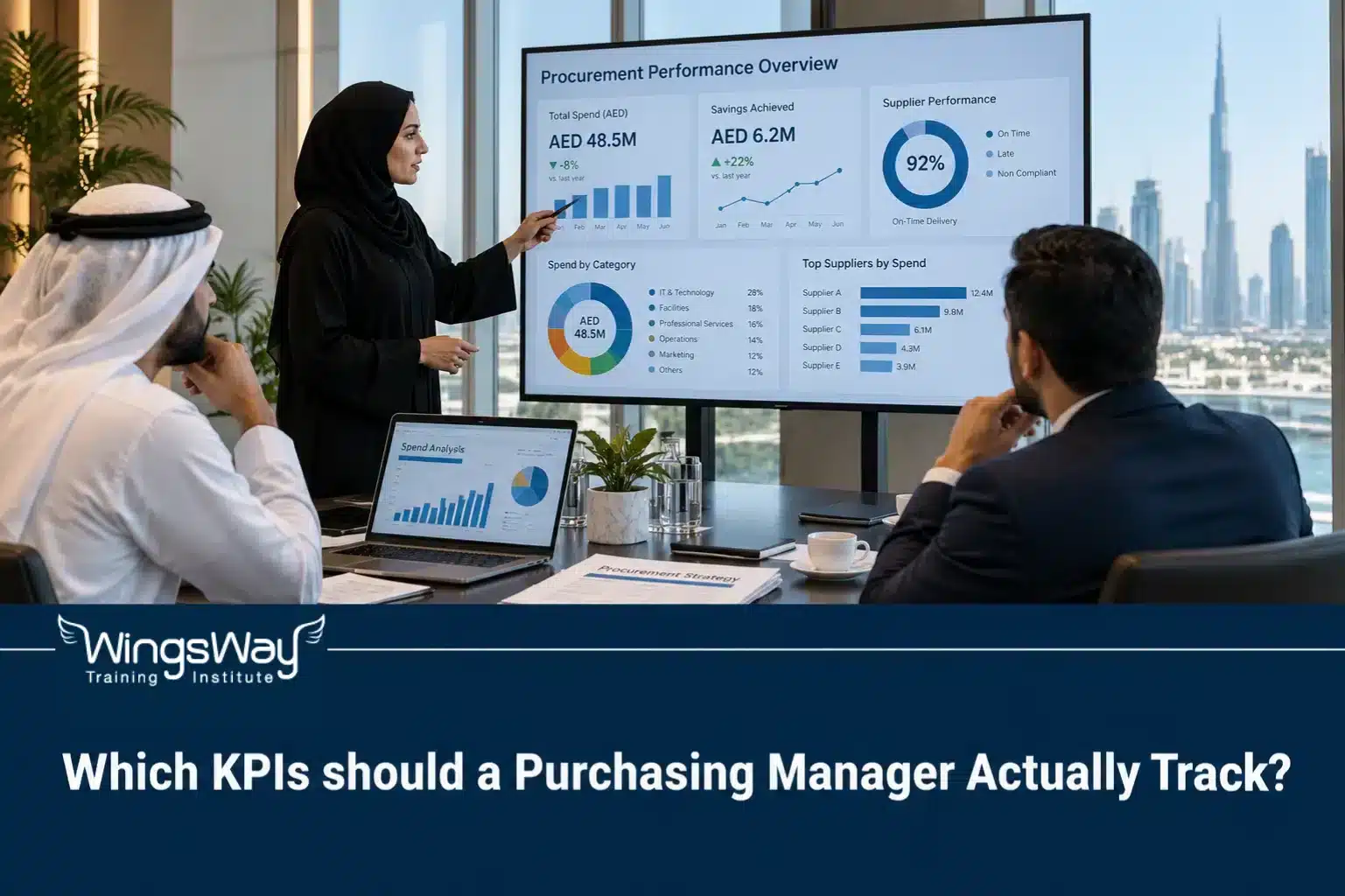
Which KPIs should a purchasing manager actually track?
Quick Answer: Purchasing manager KPIs measure whether procurement decisions create real value, not just how many orders get processed. The core set includes procurement cost savings vs cost avoidance, spend under management, supplier performance metrics in procurement, contract coverage, and purchase order cycle time. Together, these show whether purchasing activity supports business goals or simply keeps up with volume.
Introduction
Procurement teams generate a lot of data. Every purchase order, invoice, and supplier scorecard produces a number. But not every number is a good measure of performance. Purchasing manager KPIs exist to separate activity from outcome — to show whether a procurement function is creating value, or simply processing transactions faster.
This distinction matters more as procurement roles evolve. A purchasing manager today is expected to control cost, manage supplier risk, and support planning across finance and operations. Choosing the right KPIs — and interpreting them correctly — is central to that job. This page sets out the KPIs used most often in practice, what each one measures, and where they tend to be misread.
Why This Matters
Procurement is no longer judged only on whether goods and services are delivered on time. Finance teams want visibility into spend. Operations want reliable suppliers. Auditors want evidence that agreed contracts and policies are being followed. Purchasing manager KPIs give a shared language for these different demands.
Without agreed metrics, procurement performance is often described in general terms — “the team is doing well” — with no evidence behind it. Clear purchasing manager performance metrics change that. They let a purchasing manager show, with numbers, where spend is controlled, where suppliers are reliable, and where risk sits. This is particularly relevant across the UAE and the wider GCC, where procurement functions in aviation, logistics, retail, and government sectors are under growing pressure to demonstrate measurable value rather than transaction volume alone.
Key Takeaways
- Purchasing manager KPIs should measure value created, not just transactions processed.
- Cost savings and cost avoidance are different measures and should never be reported as a single combined figure.
- Spend under management shows how much of total company spend goes through structured procurement processes.
- Supplier performance metrics cover quality, delivery reliability, and responsiveness — not price alone.
- Contract coverage shows how much spend is protected by formal agreements versus ad hoc buying.
- A small, well-chosen set of KPIs, reviewed regularly, is more useful than a long list nobody revisits.
How Professional Procurement Bodies Approach Performance Measurement
Professional bodies have shaped how procurement performance is measured and reported. The Chartered Institute of Procurement and Supply (CIPS) sets globally recognised standards for procurement practice, including performance measurement, and its qualifications are widely referenced when organisations design KPI frameworks.
The International Federation of Purchasing and Supply Management (IFPSM) links national procurement associations and promotes consistent professional standards across markets — relevant for multinational procurement teams operating across the GCC. The American Purchasing Society (APS) has also published guidance on purchasing performance measurement and professional certification for buyers and purchasing managers.
None of these bodies mandates a single fixed KPI set. Each organisation still tailors its metrics to its own size, sector, and risk profile. But their frameworks are a common reference point for what a credible procurement measurement system looks like.
Market Demand and Industry Insights
Procurement and supply chain roles are a visible part of the wider job market across the UAE and the Gulf region, alongside continued expansion in aviation, logistics, retail, and manufacturing. As organisations formalise procurement processes, purchasing managers are increasingly expected to explain how to measure purchasing performance in terms that finance and operations teams can act on, rather than reporting order counts alone.
For professionals moving from aviation, ground handling, or airline customer service into procurement or supply chain roles, this shift is worth noting. What KPIs should a purchasing manager track is a question candidates for procurement roles can reasonably expect to be asked about, since employers generally look for an understanding of outcome-based measurement rather than process steps alone. Familiarity with cost, supplier, and compliance KPIs is a practical starting point for anyone entering the field.
A useful illustration of structured, policy-driven procurement in practice comes from elsewhere in the GCC. In Oman, the Oman Investment Authority has expanded its mandatory local-content procurement list from 103 to 384 products and services, and grown spend with SMEs from around RO 187 million in 2022 to RO 278 million in 2025. This does not represent a single published KPI figure, but it illustrates how a large organisation can deliberately shift spend from informal buying toward structured, policy-governed procurement — the same underlying principle that KPIs such as spend under management are designed to track, as reported by Oman Observer (September 2026).
What Is a Procurement KPI?
A KPI, or key performance indicator, is a measurable value that shows whether an activity is meeting its objective. In procurement, purchasing manager KPIs track how well the buying function manages cost, risk, supplier relationships, and policy compliance.
KPIs differ from simple activity counts. Counting purchase orders processed tells you how busy a team is. It does not tell you whether the organisation paid a fair price, whether suppliers delivered reliably, or whether spend was covered by an agreed contract. Useful KPIs connect day-to-day procurement activity to outcomes such as cost control, supply continuity, and reduced risk.
The Core Purchasing Manager KPIs, Explained
Purchase Order Volume KPI
Purchase order volume KPI measures the number of purchase orders raised over a set period, often broken down by department, supplier, or spend category. On its own, this figure says little about performance — a high volume could mean a genuinely busy team, or it could mean processes are fragmented, with staff raising many small orders instead of consolidating spend.
Formula: Total number of purchase orders raised in the period, typically segmented by department, supplier, or category.
Used well, the purchase order volume KPI is a diagnostic rather than a scorecard. A purchasing manager might use it to spot categories where spend is scattered across many suppliers and small orders — a sign that consolidation or a preferred supplier agreement could reduce cost and administrative effort. Tracking volume alongside average order value gives a clearer picture than volume alone.
Procurement Cost Savings vs Cost Avoidance
One of the most misunderstood areas in procurement reporting is procurement cost savings vs cost avoidance. These are two different measures, and treating them as interchangeable weakens the credibility of a KPI report.
Cost savings refer to a measurable reduction in what the organisation actually pays, compared with a previous price, budget, or agreed benchmark. If a contract renewal reduces the unit price paid for a component, that reduction is a savings figure that should be visible in the accounts.
Formula (cost savings): (Previous price − New price) × Volume purchased, over a defined period.
Cost avoidance refers to a cost that did not happen because of an action taken — for example, negotiating a price freeze when a supplier had planned an increase, or avoiding a penalty by managing a contract renewal on time. Cost avoidance is real value, but it does not reduce current spend, so it should not be added directly to cost savings totals.
Estimate (cost avoidance): Value of the increase, penalty, or cost that was prevented, calculated against a clearly documented baseline (for example, a supplier’s originally proposed price increase). Because this figure depends on a hypothetical baseline rather than an actual payment, it should carry a note on how the baseline was set.
A credible purchasing manager KPI framework reports these two figures separately, with the basis for each one documented. This keeps the numbers defensible when finance or internal audit review them.
Supplier Performance Metrics in Procurement
Supplier performance metrics in procurement assess how reliably a supplier meets agreed terms, not just how competitive their price is. Common measures include:
- On-time delivery rate — the percentage of orders delivered by the agreed date
- Quality or defect rate — the percentage of goods or services rejected or returned
- Responsiveness — how quickly a supplier resolves queries or issues
- Compliance — whether the supplier meets contractual, safety, or regulatory requirements
Formula (on-time delivery rate): (Orders delivered on or before the agreed date ÷ Total orders in the period) × 100.
Formula (defect/quality rate): (Units or orders rejected or returned ÷ Total units or orders received) × 100.
Tracking these metrics over time helps a purchasing manager identify suppliers that are becoming higher risk, even when their pricing still looks attractive. In sectors such as aviation and logistics, where delays and quality failures carry operational cost, supplier performance metrics in procurement often carry as much weight as price in formal supplier reviews.
Spend Under Management KPI
Spend under management KPI measures the percentage of total organisational spend that goes through structured procurement processes — sourcing, approvals, and contracts — rather than being bought informally outside those controls.
Formula: (Spend routed through approved procurement processes ÷ Total organisational spend) × 100.
A low spend under management KPI usually points to what is sometimes called “maverick spend”: purchases made without competitive sourcing or contract cover, often at higher prices and with less risk oversight. Increasing this percentage is a common procurement objective, because it extends the benefits of negotiated pricing, supplier vetting, and agreed contract terms across more of the organisation’s total spend.
Procurement Contract Coverage KPI
Procurement contract coverage KPI shows what proportion of spend is covered by a formal, agreed contract, rather than one-off purchase orders or informal arrangements. Higher contract coverage generally means clearer pricing terms, defined service levels, and stronger protection if something goes wrong.
Formula: (Spend covered by a formal, agreed contract ÷ Total spend in that category or overall) × 100.
This KPI overlaps with spend under management, but it specifically isolates contract cover rather than process compliance more broadly. A purchasing manager reviewing procurement contract coverage KPI typically looks at which categories have the lowest coverage, then assesses whether the value of that spend justifies negotiating a formal agreement.
Purchase Order Cycle Time
Purchase order cycle time measures how long it takes from raising a purchase requisition to the order being approved and issued to the supplier. Long cycle times can delay operations and push staff toward informal purchasing to avoid the process — which undermines spend under management. Short cycle times generally reflect clear approval limits and efficient systems, though a cycle time that is too short with no meaningful review can also point to weak controls.
Formula: Average number of days (or hours) between requisition submission and purchase order issuance, calculated across all orders in the period.
Purchase Order Accuracy and Policy Compliance Rate
Purchase order accuracy tracks how often orders are raised without errors — wrong quantities, incorrect pricing, or missing approvals — that require rework. Policy compliance rate tracks how often purchases follow the organisation’s procurement policy, such as using approved suppliers or obtaining the required number of competitive quotes. Both metrics point to process discipline, which affects cost and risk even when headline savings figures look strong.
Formula (PO accuracy): (Purchase orders issued without errors ÷ Total purchase orders issued) × 100.
Formula (policy compliance rate): (Purchases following the defined procurement policy ÷ Total purchases in the period) × 100.
KPI Summary Table
The table below brings these measures together for quick reference.
| KPI | What It Measures | Calculation | What a Poor Result May Indicate |
|---|---|---|---|
| PO Volume | Level of purchasing activity | Count of purchase orders raised in the period | Very high volume of small orders may signal fragmented, unconsolidated spend |
| Cost Savings | Actual reduction in price paid | (Previous price − New price) × Volume | Flat or negative savings across renewals may signal weak negotiation or benchmarking |
| Cost Avoidance | Cost prevented, not a reduction in current spend | Value of the increase/penalty avoided vs. a documented baseline | Reported without a clear baseline is a red flag for inflated figures |
| Supplier On-Time Delivery | Delivery reliability | (On-time orders ÷ Total orders) × 100 | A falling rate signals rising supply continuity risk |
| Spend Under Management | Share of spend under structured procurement control | (Spend under managed process ÷ Total spend) × 100 | A low or falling percentage signals growing maverick (off-process) spend |
| Contract Coverage | Share of spend protected by a formal contract | (Contracted spend ÷ Total spend) × 100 | Low coverage in high-value categories signals pricing and legal exposure |
| PO Cycle Time | Speed of the requisition-to-order process | Average days from requisition to PO issuance | Lengthening cycle times can push staff toward informal, off-process buying |
| PO Accuracy / Compliance Rate | Process discipline | (Error-free or policy-compliant orders ÷ Total orders) × 100 | A falling rate signals weakening controls, regardless of savings figures |
Career Outcomes
These KPIs apply, in some form, across several procurement-related roles:
- Procurement Officer / Buyer — day-to-day KPIs such as PO accuracy and cycle time
- Category Manager — cost savings vs. cost avoidance and supplier performance within a specific spend category
- Purchasing / Procurement Manager — owns the overall KPI framework and reports it to senior management
- Supply Chain or Operations Manager — uses spend and supplier data for inventory and logistics planning
Professionals moving from aviation, ground handling, or airline customer service bring transferable skills to this progression — process discipline, vendor or partner coordination, and structured reporting.
How to Start Building Procurement KPI Knowledge
Moving into a role where purchasing manager KPIs are part of daily work usually follows a similar path:
- Learn the core KPI categories — cost, supplier, compliance, and process — and how each is calculated
- Practise interpreting KPI data, not just collecting it — understand what a change in a number actually means for the business
- Get familiar with the procurement or ERP systems used to track spend, contracts, and supplier scorecards
- Build category-level knowledge, since KPI interpretation differs across services, goods, and capital purchases
- Consider structured training — procurement and purchasing courses in procurement or supply chain management provide a consistent framework for selecting and interpreting KPIs, which is useful for professionals moving from operational aviation or customer-facing roles into a procurement function
Frequently Asked Questions
Q1: What KPIs should a purchasing manager track?
At minimum, a purchasing manager should track cost savings vs. cost avoidance, spend under management, supplier performance metrics, contract coverage, and purchase order cycle time. These purchasing manager KPIs together show cost control, supplier reliability, and process compliance, rather than just order volume.
Q2: What is the difference between procurement cost savings and cost avoidance?
Cost savings indicate a tangible reduction in payments made, which is evident in the financial statements. Conversely, cost avoidance involves costs that were averted as a result of specific actions, such as preventing a proposed price increase. It is important to keep these two figures reported separately.
Q3: How do you measure purchasing performance?
Purchasing performance is measured using a small set of purchasing manager KPIs covering cost, supplier reliability, contract coverage, and process compliance — not by order volume alone. Comparing figures against prior periods or budget shows whether performance is improving.
Q4: What is spend under management?
Spend under management is the percentage of total organisational spend that goes through structured procurement processes, including sourcing, approvals, and contracts, rather than being bought informally.
Q5: What is a good purchase order cycle time?
There is no single universal benchmark, since cycle time depends on approval structure and category complexity. The more useful measure is the trend: whether cycle time is stable, improving, or lengthening compared with prior periods.
Q6: Why does procurement contract coverage matter?
Higher procurement contract coverage generally means more spend is protected by agreed pricing, service levels, and legal terms, which reduces both cost risk and supply risk compared with ad hoc buying.
Q7: What are supplier performance metrics in procurement?
Supplier performance metrics in procurement include on-time delivery rate, quality or defect rate, responsiveness, and compliance with contractual or regulatory requirements. They assess reliability, not price alone.
Trust and Training Standards
Purchasing manager KPIs are taught and referenced within structured procurement and supply chain training. For this subject area, the most directly relevant accreditations are CIPS and CILT:
- WingsWay Training Institute operates as a CIPS Approved Study Centre and CIPS exam centre.
- WingsWay holds CILT Approved Training Provider (ATP) status.
- KHDA-approved.
- ISO 9001:2015 certified.
- CPD (UK) accredited.
- An IATA Authorised Training Centre (AE-WWD-01-20-001).
- Affiliated with IFPSM.
These accreditations relate to training quality and delivery standards, not to a single “correct” KPI framework — procurement KPI selection still depends on each organisation’s size, sector, and objectives.
Professionals who want to develop broader purchasing-management skills alongside performance measurement can explore the Certified Professional Purchasing Manager (CPPM) programme, for professionals considering a structured route into procurement.
For anyone evaluating a training provider, checking accreditation directly against the awarding body’s own directory is a reasonable step, regardless of which institute is under consideration.
Conclusion
Purchasing manager KPIs work best as a focused set of measures that show value, not just volume. Cost savings and cost avoidance need separate reporting. Supplier performance metrics reveal reliability risk that price alone does not show. Spend under management and contract coverage indicate how much of total spend is actually under structured control. Together, these give a purchasing manager — and the people they report to — a realistic picture of procurement performance, rather than a count of transactions processed.
Author & Review Information
Written by: Sadiq
Reviewed by: Manish K Dalal, MBA, MCIPS (UK), CMILT — Procurement, Supply Chain, and Logistics Instructor, WingsWay Training Institute
Last reviewed: September 2026.
This page is reviewed periodically for factual accuracy, including KPI definitions, accreditation details, and role definitions, and updated as procurement practices or professional-body frameworks change.
This content is for educational and informational purposes only and does not constitute professional, financial, career, or recruitment advice. Readers should verify current role requirements, KPI methodologies, and accreditation details directly with employers or the relevant professional bodies.
Need More Details About This Course?
Connect with our team directly on WhatsApp for course details, fees, schedules, and guidance.