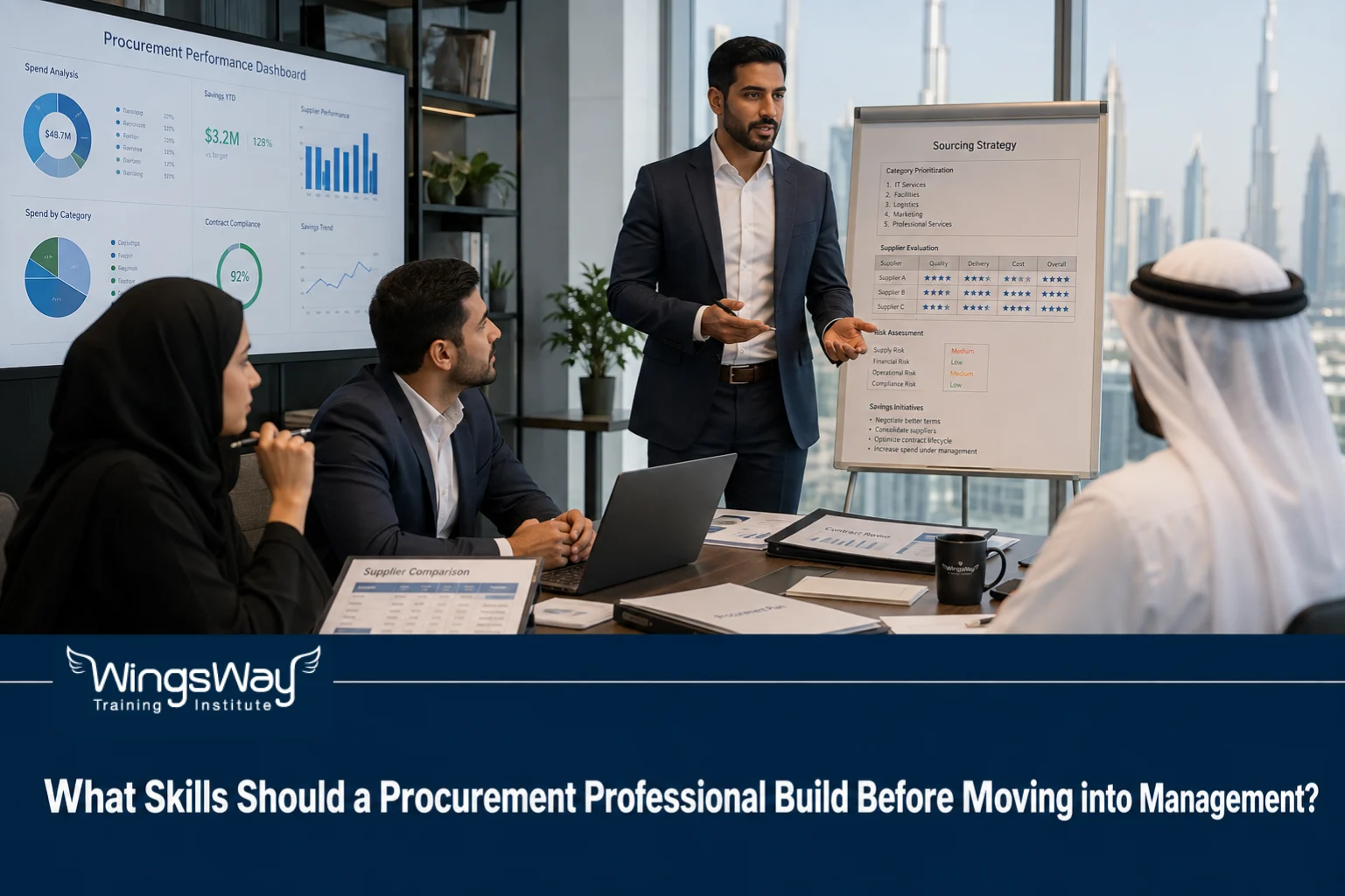
What Skills Should a Procurement Professional Build Before Moving into Management?
Quick answer: Procurement professional skills for a move into management typically start with supplier management skills and procurement negotiation skills, and grow to include contract management, risk oversight, and team leadership as their responsibility increases. Building these areas early helps a procurement professional prepare for the added scope of a manager-level role.
Introduction
Many procurement teams promote from within, moving an experienced buyer or procurement officer into a management role once technical competence is proven. But procurement professional skills used at the officer or executive level are not identical to the skills a procurement manager needs day-to-day.
A procurement manager typically carries budget accountability, supplier strategy ownership, and responsibility for a small team, in addition to sourcing and negotiation.
This page sets out procurement professional skills for career growth — what a procurement professional should build before stepping into management, why each one matters, and how the transition typically unfolds across the UAE and wider GCC procurement market.
Why This Matters
Procurement functions across the UAE, Saudi Arabia, and the wider GCC have grown more strategic in recent years. In a January 2026 statement, CIPS described procurement across the Middle East as shifting “from an operational function to a strategic enabler of growth, resilience and national development,” a change it linked to rising investment, regulatory activity, and sustainability priorities across the region (CIPS, January 2026).
This shift means procurement skills that were once optional, such as data analysis or structured supplier relationship management, are now expected at management level. A procurement officer who has only handled transactional buying may find the jump into management difficult without first developing procurement leadership skills and strategic procurement skills.
Employers assessing internal candidates for procurement manager roles typically look for evidence of these broader capabilities, not just sourcing experience.
Key Takeaways
- Procurement manager roles require skills beyond day-to-day purchasing skills, including budget ownership, team leadership, and supplier strategy.
- Procurement negotiation skills and contract management skills are core at both officer and manager level, but managers apply them to higher-value, higher-risk decisions.
- Supplier management skills shift from transactional supplier handling toward longer-term supplier relationship strategy.
- Procurement risk management becomes a formal responsibility, covering supply continuity, compliance, and contractual risk.
- Structured professional-level procurement training can help formalise capabilities already developed through practical sourcing, negotiation, and supplier experience.
- Procurement career progression is rarely instant; most professionals build these skills over several sourcing cycles before moving into a manager’s title.
Who Sets the Standards for Procurement Skills?
Several professional bodies define and benchmark procurement professional skills globally. The International Federation of Purchasing and Supply Management (IFPSM) represents national procurement associations and supports consistent professional standards across markets, including the Middle East, with competency frameworks covering sourcing, supplier relationship management, contract management, and negotiation.
Other bodies, including the Chartered Institute of Procurement and Supply (CIPS), publish comparable frameworks and are also widely referenced across the profession. These bodies are referenced here because their frameworks closely mirror the skill areas covered on this page, not because a single qualification is the only route into procurement management.
Typical Procurement Career Path
Procurement career progression generally follows a recognisable pattern, though titles and timelines vary by organisation and sector. Professionals researching how to become a procurement manager typically start by mapping where they sit against the stages below. Most professionals enter through a coordinator or assistant buyer role, and the core progression from that point runs through three stages:
- Buyer/procurement officer — supplier sourcing, quotation comparison, contract administration support
- Senior buyer/procurement executive — category ownership, negotiation on higher-value contracts, early supplier relationship management
- Procurement manager — team leadership, budget ownership, supplier strategy, cross-department stakeholder management
The skills gap between the senior buyer or procurement executive stage and the procurement manager stage is usually where professionals need to add capability deliberately, rather than assume it develops automatically with tenure. Beyond procurement manager, some professionals go on to head of procurement or director-level roles, though that stage sits outside the scope of this page.
What are Procurement Professional Skills?
Procurement professional skills are the combined technical, commercial, and interpersonal capabilities a person uses to source, negotiate, and manage the supply of goods and services on behalf of an organisation. At an officer or executive level, these skills are typically applied to individual purchases or categories.
At manager level, the same skill set is applied across a wider portfolio, often described as procurement manager skills once responsibility for a team, a budget, and higher-risk supplier relationships is added.
Purchasing skills, in this context, refer more narrowly to the operational side of buying, such as raising orders, comparing quotations, and managing purchase-to-pay processes, while procurement skills are the broader term covering strategy, negotiation, supplier management, and risk oversight.
Core Skills a Procurement Professional Should Build Before Management
1. Procurement Negotiation Skills
At officer level, negotiation is usually limited to price and delivery terms on individual purchases. Moving toward management requires broader procurement negotiation skills: preparing a negotiation strategy in advance, understanding total cost of ownership rather than unit price alone, knowing walk-away points, and running multi-supplier negotiations across a category.
Managers also negotiate internally, aligning stakeholders on requirements before a supplier discussion begins — which is why procurement negotiation skills for managers extend beyond price discussions with suppliers alone.
2. Contract Management Skills
Contract management skills extend beyond simply filing signed agreements. A procurement professional preparing for management should be comfortable reviewing terms and conditions, understanding service-level agreements and performance clauses, tracking renewal dates, and recognising contractual risk such as unfavourable liability or termination clauses. Managers are usually accountable for approving contract terms, not just administering them.
3. Supplier Management Skills
Supplier management skills for procurement professionals at officer level often mean day-to-day communication: chasing quotations, confirming delivery, and resolving basic issues.
At management level, supplier management skills shift toward supplier relationship management: segmenting suppliers by risk and value, running periodic performance reviews, and working with strategic suppliers on longer-term improvement rather than single transactions.
4. Procurement Risk Management
Procurement risk management becomes a formal responsibility at the manager level. This covers supply continuity risk, such as single-source dependency, logistics, or geopolitical disruption, and compliance or ethical sourcing risk.
A procurement officer typically flags issues upward; a procurement manager is expected to have a mitigation plan and, in many organisations, sign-off authority on risk decisions.
5. Procurement Leadership Skills
Procurement leadership skills cover people management: delegating work, mentoring junior buyers, giving performance feedback, and managing cross-department stakeholders such as finance, legal, or operations. Budget accountability also falls under this heading, along with the ability to make sourcing and risk decisions under time pressure without waiting for direction.
Building procurement leadership skills for career progression is generally more about consistent delegation and decision-making than about any single milestone.
6. Strategic Procurement Skills
Strategic procurement skills include category management, cost modelling, and market or spend analysis, which are used to align procurement activity with wider business objectives rather than react to individual purchase requests. A procurement professional building toward management should practice looking at spend and supplier data across a category, not just at the level of a single order.
7. Data, Reporting, and Digital Procurement Tools
Procurement managers are commonly expected to report on savings, supplier performance, and category spend using e-procurement platforms and spend-analytics dashboards. Familiarity with these tools, along with presenting procurement data to non-procurement stakeholders, is increasingly treated as a baseline skill rather than a specialisation.
Procurement Professional vs Procurement Manager: Skills Comparison
The table below summarises how the same skill areas typically change in scope between officer-level and manager-level roles.
| Skill Area | Procurement Professional (Officer / Buyer) | Procurement Manager |
|---|---|---|
| Negotiation | Negotiates individual purchase orders and standard contracts | Leads negotiation strategy across categories and handles escalations |
| Supplier management | Handles day-to-day supplier communication | Owns supplier relationship strategy and performance reviews |
| Contract management | Administers existing contracts and processes renewals | Reviews and approves contract terms and manages contract risk |
| Risk management | Flags supply issues to a manager | Owns risk mitigation planning and supply continuity decisions |
| Team involvement | Works as an individual contributor | Leads, mentors, and evaluates a team |
| Budget | Works within an allocated purchase budget | Owns and reports on a department or category budget |
| Strategy | Executes sourcing plans set by others | Sets category and sourcing strategy aligned to business goals |
Are You Ready to Move into Procurement Management?
The skill areas above translate into a practical readiness check. A procurement professional who can already do most of the following is typically closer to management-ready than one who can only handle individual transactions:
- Prepare a negotiation strategy in advance, rather than negotiating price purchase by purchase
- Assess total cost of ownership for a purchase or category, not just unit price
- Review a contract for basic risk, such as unfavourable liability, termination, or renewal terms
- Run a structured supplier performance review, rather than only reactive supplier communication
- Analyse spend across a category, not just track individual purchase orders
- Delegate a task to, or mentor a junior buyer or coordinator
This is a self-assessment guide, not a formal test.
Career Outcomes
Procurement professionals who build these skills typically move into the procurement manager role itself, or into closely related titles such as category manager, depending on organisational structure.
In the UAE and wider GCC, procurement skills for management roles are increasingly expected across sectors including construction, aviation, logistics, retail, oil and gas, and government-linked entities, reflecting how central procurement has become to cost control and supplier risk.
Career progression at this stage rarely follows a single fixed path; many professionals combine practical category or supplier ownership, cross-functional project exposure, and structured professional-level training to build the case for promotion.
How to Start Building These Skills
A procurement professional can begin preparing for management in a structured way:
- Assess current skill gaps against the manager-level skill areas above, through self-assessment or manager feedback.
- Take on category or supplier ownership within the current role, even informally, to build strategic exposure.
- Practice negotiation and contract review on lower-risk purchases before handling higher-value categories.
- Build supplier relationship management experience, not just supplier communication, by tracking supplier performance over time.
- Consider structured professional-level procurement training to formalise existing experience and fill specific knowledge gaps, such as formal negotiation frameworks or contract clauses not always covered through day-to-day work.
- Look for stretch assignments, such as leading a small sourcing project or mentoring a junior buyer, to demonstrate leadership readiness before applying for a management title.
How Professional-Level Training can Strengthen Procurement Capability
Structured training is one of several routes procurement professionals use to formalise practical experience before moving into management. Courses covering the procurement cycle, international sourcing, contract management, supplier ratings, and negotiation are commonly used to fill specific knowledge gaps, such as formal negotiation frameworks or contract-risk basics, that are not always covered through on-the-job experience alone.
Training is not the only route into procurement management — experience, mentoring, and demonstrated ownership of supplier or category responsibilities also weigh heavily in most promotion decisions — but it is one way professionals compress the learning curve for less familiar areas.
Professionals who want to formalise these capabilities can explore the Certified Global Procurement Professional (CGPP) course in Dubai, an IFPSM-recognised programme covering global sourcing, supplier ratings, contract management, and negotiation strategy at a professional level. It is aimed at buyers, procurement officers and professionals moving into supervisory or team-leader roles. A separate Certified Global Procurement Manager (CGPM) programme is available for those further along the same career path, where management-level responsibility is already in scope.
UAE and GCC Context for Procurement Professionals
Demand for procurement professionals with management-ready skills has been increasing across the UAE and wider GCC, linked to continued investment in construction, logistics, aviation, and government-linked infrastructure projects.
The CIPS/Hays Procurement & Supply Salary Guide 2026, based on responses from over 7,000 procurement and supply professionals across 11 regions, found that 57% of employers hiring procurement staff had struggled to find the right talent, and 59% named MCIPS, or progress towards it, as a recruitment preference.
While that data is global rather than GCC-specific, it reflects the same pattern reported by organisations in Saudi Arabia, Kuwait, Bahrain, Oman, and Qatar: procurement staff who can evidence supplier risk management, negotiation, and contract oversight skills, not just sourcing experience, are increasingly favoured for management-track hiring.
Training Credibility and Accreditation
When comparing training providers for procurement courses, professionals often look for verifiable accreditation rather than marketing claims alone. WingsWay Training Institute, based in Dubai and Sharjah, is KHDA-approved, ISO 9001:2015-certified, and CPD (UK)-accredited.
On the CIPS Study and Exam Centre Finder, the official CIPS directory, WingsWay is listed as an Approved Centre offering classroom and distance study, with Exam Centre status. WingsWay also holds IFPSM affiliation, directly relevant to procurement qualifications. Institutes such as WingsWay offer a wider range of procurement and purchasing courses, covering professional and manager-level tracks, among the options procurement professionals can consider when comparing structured training routes.
Frequently Asked Questions
Q1: What skills should a procurement professional build before management?
A procurement professional preparing for management typically needs to build procurement negotiation skills, contract management skills, supplier management skills, procurement risk management, and procurement leadership skills, alongside stronger budget and stakeholder management awareness.
Q2: What skills are needed to become a procurement manager?
Skills needed to become a procurement manager usually include supplier relationship strategy, contract risk oversight, team leadership, budget ownership, and category-level negotiation, built on top of the core purchasing skills developed at officer level.
Q3: How to move from Procurement Professional to Procurement Manager
Moving from procurement professional to procurement manager generally involves taking on category or supplier ownership, gaining negotiation and contract review experience on higher-value purchases, and demonstrating leadership through stretch assignments such as mentoring a junior buyer, often alongside structured training.
Q4: What is the difference between purchasing skills and procurement skills?
Purchasing skills generally refer to operational buying tasks such as raising orders and comparing quotations. Procurement skills is the broader term, covering strategy, negotiation, supplier management, and risk oversight across a category or department.
Q5: Can professional procurement training help prepare you for management responsibilities?
Professional-level procurement training can help by formalising skills such as global sourcing, contract management, supplier ratings, and negotiation strategy, which are commonly needed before taking on broader managerial responsibility. It is one of several routes into management, alongside practical category or supplier ownership and mentoring.
Q6: What are the most important procurement leadership skills?
Important procurement leadership skills include team management, delegation, cross-department stakeholder communication, budget accountability, and the ability to make sourcing and risk decisions under time pressure.
To Recap
Moving from a procurement professional role into procurement management typically requires more than time in the role. Negotiation, contract management, supplier relationship management, risk oversight, and leadership skills all shift in scope and responsibility at the management level.
Professionals preparing for this transition generally combine practical exposure, such as category or supplier ownership, with structured learning to fill specific knowledge gaps. Recognised frameworks from bodies such as CIPS and IFPSM offer a useful reference point for what a well-rounded procurement skill set looks like, though the exact path into management varies by organisation, sector, and region.
Author & Review Information
- Written by: Sadiq
- Reviewed by: Manish K Dalal, MBA, MCIPS (UK), CMILT — Procurement, Supply Chain, and Logistics Instructor, WingsWay Training Institute
- Last reviewed: September 2026.
This page is reviewed periodically for factual accuracy, including accreditation details and role definitions, and updated as procurement practices or professional-body frameworks change.
This content is for educational and informational purposes only and does not constitute professional, career, or recruitment advice. Readers should verify current role requirements and accreditation details directly with employers or the relevant professional bodies.