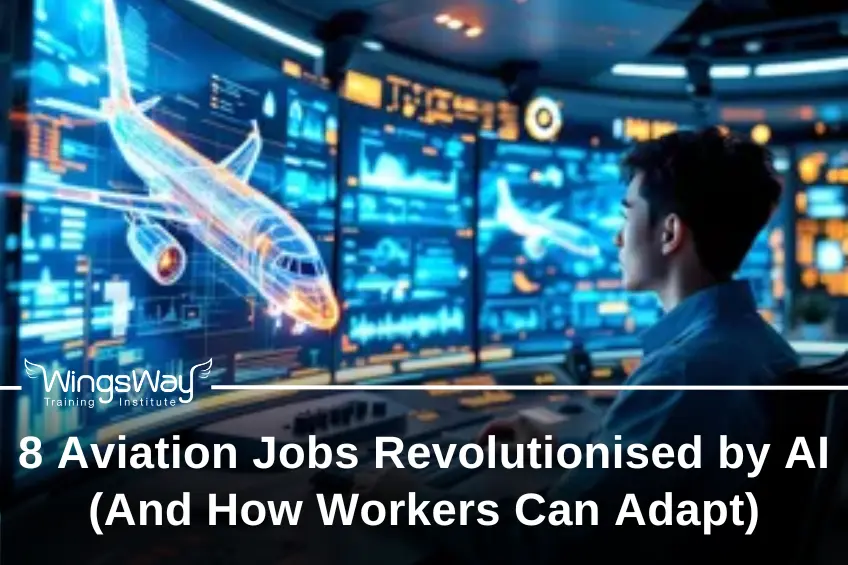
8 Aviation Jobs Revolutionised by AI (And How Workers Can Adapt)
Walk into any airport break room today. Listen to the conversations at aviation conferences. Check the comments on industry LinkedIn posts.
You’ll hear the same thing everywhere: AI in aviation. How is it going to affect me?
“Will a robot take my job?” asks the maintenance engineer, scrolling through news about AI diagnostics. The air traffic controller wonders if algorithms will replace human judgment in the tower. Pilots debate whether AI co-pilots are the future or a threat.
Meanwhile, airlines are quietly implementing AI systems. Predictive maintenance is already preventing breakdowns. Smart routing saves millions in fuel costs. AI chatbots handle passenger questions 24/7.
The reality? AI is already here, working alongside aviation professionals every day. But most workers don’t realise it yet.
The AI Takeover in Aviation
Artificial Intelligence (AI) is rapidly reshaping operations from the ground up to 30,000 feet. The global AI in aviation market is a testament to this, projected to soar from $6.07 billion in 2024 to an astounding $8.25 billion in 2025, with an anticipated compound annual growth rate (CAGR) of approximately 44.9% by 2037.
This meteoric rise signifies a fundamental shift. While this aviation automation brings unprecedented efficiencies and capabilities, it also sparks a dual narrative: the concern of job disruption versus the excitement of new opportunities and enhanced roles.
A recent survey by Goose Recruitment asked aviation leaders about AI’s impact. Here’s what they found:
- 40% believe AI will affect jobs across the industry
- 15% think AI will replace some positions
- 28% say AI will improve existing roles
- 9% expect AI to create entirely new jobs
Understanding these AI in aviation trends is crucial for navigating the evolving landscape.
8 Aviation Jobs Transformed by AI at a Glance

#1 Aircraft Maintenance Engineers (AME)
The most impactful AI application here is AI predictive maintenance. Sophisticated algorithms analyse data from Internet of Things (IoT) sensors embedded in aircraft components to predict potential failures before they occur.
The Old Way: Wait for something to break, then fix it.
The AI Way: Fix it before it breaks.
This proactive approach is a game-changer. According to the Boston Institute of Analytics, predictive maintenance systems powered by AI can reduce unplanned maintenance events by up to 30%.
IATA echoes this, stating such systems are saving billions annually for airlines by reducing these events by a similar margin.
👉 How to Adapt: To thrive, AMEs must upskill in data analytics and learn to interpret the insights generated by these AI systems. Their expertise will shift from purely reactive repairs to proactive maintenance planning and data-driven decision-making, enhancing aviation engineering skills for the modern era.
#2 Air Traffic Controllers
Air Traffic Controllers (ATCOs) manage the increasingly crowded skies, a task where AI offers powerful support.
Machine learning aviation algorithms are being developed and deployed for dynamic route optimisation, sequencing, and conflict detection.
What AI Does:
- Suggests the best routes for each flight
- Spots potential collisions before they happen
- Reduces airport delays and congestion
- Processes thousands of data points per second
👉 How to Adapt: The future for ATCOs lies in human-AI collaboration training. Controllers will work alongside AI systems, using them as advanced decision-support tools.
The AI will detect and trigger an alert to the ATCO. Then, it will be the ATCO’s job to check, confirm and take the advised course of action.
The human element remains crucial for overseeing complex scenarios, managing exceptions, and ensuring ultimate safety in AI air traffic control environments. AI suggests, but humans decide.
#3 Flight Dispatchers
Flight Dispatchers are the ones who are responsible for flight planning and operational control during the time when a flight arrives at and till it departs from the airport.
Advanced AI flight dispatch software incorporates sophisticated weather forecasting algorithms and fuel efficiency models. These tools can analyse myriad variables in real-time to create the safest and most economical flight plans.
Airlines like Delta Air and Lufthansa leverage AI algorithms to optimise fleet management and operations, leading to significant cost savings and improved operational performance.
👉 How to Adapt: Dispatchers need to become proficient in using these AI-powered dispatch software suites, understanding their outputs, and making informed final decisions. Their role evolves to supervising these intelligent systems and managing by exception.
#4 Cabin Crew
Even the highly interpersonal role of Cabin Crew is being augmented by AI to enhance the passenger experience.
AI systems are being used for passenger behaviour analysis (e.g., identifying passengers who might need extra assistance) and powering sophisticated chatbots to answer common queries, freeing up crew for more complex interactions.
Qatar Airways has taken it one step further and introduced the world’s first AI virtual digital human cabin crew, Sama 2.0. You can read more about it here.
Airlines and airports already use AI for personalised passenger services, indicating a strong trend towards passenger experience AI.
👉 How to Adapt: While AI handles routine tasks, cabin crew must further develop soft skills for tech-augmented service. Empathy, complex problem-solving, and providing a human touch in an increasingly automated environment become even more valuable.
#5 Aviation Safety Inspectors
AI is enhancing the critical function of Aviation Safety Inspectors by enabling more proactive and comprehensive oversight.
Risk prediction models analyse historical safety data, incident reports, and operational parameters to identify potential hazards before they escalate.
Drone inspections, often AI-guided, allow safer and more efficient examination of aircraft and infrastructure, especially in hard-to-reach areas.
👉 How to Adapt: Inspectors will need to certify in AI risk assessment tools and learn to leverage AI-generated insights to focus their efforts on the highest-risk areas, making aviation safety AI a cornerstone of their work.
#6 Aerospace Engineers
For Aerospace Engineers, AI is unlocking new frontiers in aircraft design and development.
Generative design software, powered by AI, can create thousands of design iterations based on specified parameters (e.g., weight, strength, aerodynamics), often leading to innovative and highly efficient solutions.
Advanced simulation software uses AI to test these designs under various conditions with greater speed and accuracy.
👉 How to Adapt: Engineers must master AI-driven design platforms and learn to collaborate with AI as a creative partner in the design process, pushing the boundaries of AI aerospace engineering.
#7 Ground Handling Staff
The fast-paced environment of airport ground handling is becoming more efficient and safer with AI. Autonomous baggage systems are streamlining baggage handling, reducing errors and manual labour.
Robotic loaders are being introduced for cargo and baggage, improving turnaround times. These AI ground handling solutions aim to optimise ramp operations significantly.
👉 How to Adapt: Ground handling staff will need to train for robotics oversight roles, managing and maintaining these autonomous systems, and handling exceptions or complex tasks that still require human intervention.
#8 Pilots
While fully autonomous commercial passenger flights are still on the horizon, AI is already making its way into the cockpit as a powerful assistant.
The concept of AI co-pilots or advanced intelligent assistants is gaining traction, helping with data processing, system monitoring, and decision support.
Sophisticated collision avoidance systems are already AI-enhanced. The discussion around autonomous aircraft is growing, particularly for cargo operations initially.
👉 How to Adapt: Pilots will increasingly need to focus on AI-augmented flight training, learning to effectively interact and manage AI systems in the cockpit, ensuring seamless human-AI teaming. Their role will emphasise strategic decision-making and system oversight.
How Workers Can Adapt: 4 Actionable Strategies
The integration of AI doesn’t necessarily mean job displacement; it calls for adaptation and upskilling. Here are four actionable strategies for aviation professionals:
- Embrace Hybrid Roles: The future likely lies in roles that combine deep aviation expertise with AI literacy. Focus on developing skills that complement AI, such as critical thinking, complex problem-solving, and human-machine interface management. This fosters the development of workforce upskilling relevant to AI in aviation jobs.
- Enrol in AI Certification Programmes: Specialised courses provide the necessary knowledge and credentials to work with AI technologies.
- Attend Industry Workshops on AI Integration: Stay updated with the latest AI advancements and best practices by participating in workshops, webinars, and conferences focused on AI in aviation
- Leverage Government-Funded Upskilling Schemes: Many governments are recognising the need for workforce transformation and offer programmes or incentives to support upskilling in emerging technologies like AI.
WingsWay Training Institute, Dubai: Leading the AI Wave
Navigating the AI revolution requires expert guidance and industry-relevant training. WingsWay Training Institute, Dubai, is at the forefront of equipping aviation professionals with the skills needed for the AI-driven future.
WingsWay offers a suite of aviation courses specifically designed to address the evolving needs of the sector. These courses are built on a deep understanding of aviation operations and the practical applications of AI.
- Industry Connections: WingsWay boasts strong partnerships with International Airports, ensuring their curriculum is aligned with real-world operational needs.
- Global Standards: Many courses are IATA-certified, meeting rigorous global aviation standards and providing internationally recognised qualifications.
- Guaranteed Internships: WingsWay offers guaranteed internships to all students after finishing the course.
The Future Is Collaborative
The integration of Artificial Intelligence into the aviation sector is undeniably transformative. However, the narrative should not be one of replacement, but of collaboration.
AI is a powerful tool that, when wielded effectively by skilled human professionals, can enhance safety, efficiency, and passenger experience to unprecedented levels.
The key for every individual in the aviation industry is proactive adaptation—embracing lifelong learning, acquiring new skills, and understanding how to work alongside intelligent systems. The future of aviation is not human versus AI, but human and AI, working together to reach new heights.
Tag:Aviation Courses