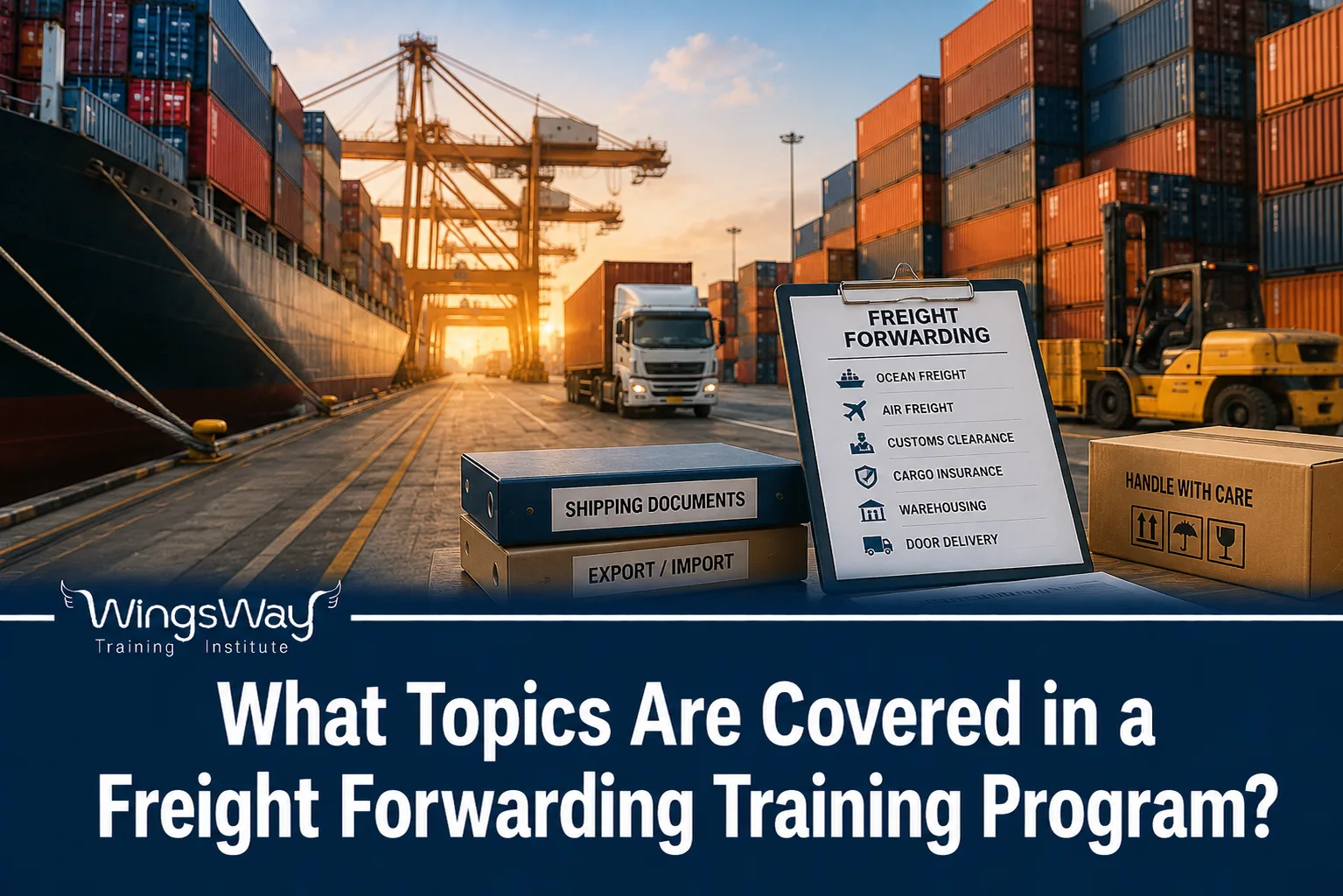
What Topics Are Covered in a Freight Forwarding Training Program?
Quick Answer: Freight forwarding training covers international shipping procedures, trade documentation, customs regulations, Incoterms, cargo handling, supply chain management, and logistics coordination. Programs vary in depth, but most shipping and freight forwarding courses in Dubai and across the UAE are structured to meet global industry standards set by bodies such as IATA and CILT.
Introduction
Freight forwarding training prepares professionals to manage the movement of goods across international borders. It covers the practical and regulatory knowledge required to work in shipping, logistics, and global trade.
The global supply chain relies on skilled freight forwarders every day. Whether goods move by air, sea, road, or rail, someone has to coordinate the documentation, compliance, and carrier arrangements that make each shipment possible.
This article explains exactly what freight forwarding training includes, why it matters, and what career opportunities it opens up. It is written for beginners, working professionals, and job seekers across the UAE, GCC, and global markets.
Why Does Freight Forwarding Training Matter?
The UAE is one of the world’s busiest trade hubs. Dubai alone handles millions of tonnes of cargo every year through Jebel Ali Port, Dubai International Airport, and its free zones. This level of trade requires a large pool of trained professionals.
Here is why structured training is essential:
- Regulatory changes happen frequently. Customs rules, tariff codes, and compliance requirements shift across regions. Trained professionals adapt faster.
- Errors are costly. A single documentation mistake can delay a shipment, trigger customs fines, or damage client relationships.
- Employers increasingly prefer certified candidates. Completing a recognized shipping course in Dubai or a logistics course in the UAE signals professional credibility.
- The sector is growing. E-commerce, regional manufacturing, and infrastructure investment across the GCC are creating consistent demand for freight and supply chain professionals.
- Career mobility improves with formal training. Individuals who complete a supply chain course in the UAE or a procurement course are better positioned for senior roles and international opportunities.
Key Takeaways
- Freight forwarding training is multidisciplinary. It combines logistics, legal compliance, documentation, and commercial skills.
- UAE-based programs are globally relevant. Shipping courses in Dubai align with international standards from IATA, CILT, and CIPS.
- Certifications add value. Accreditations from bodies like CPD (UK) and KHDA are recognized by employers locally and internationally.
- The training suits multiple audiences. Beginners, experienced professionals, and career changers all benefit from structured freight forwarding courses.
- Practical knowledge is central. Real-world topics such as Incoterms, HS codes, Letters of Credit, and dangerous goods handling are core components.
- Career outcomes are broad. Graduates work in freight forwarding companies, airlines, shipping lines, customs brokerages, and multinational supply chains.
Recognized Bodies and Accreditation in Freight Forwarding Training
Several international organizations set the standards that freight forwarding and logistics training programs follow. Understanding these bodies helps learners choose programs that are credible and recognized by employers.
IATA – International Air Transport Association
IATA is the global trade association for the world’s airlines. It develops training standards, certification programs, and safety regulations for air cargo and passenger operations. Freight forwarding training programs that follow IATA standards cover air cargo documentation, dangerous goods regulations (DGR), and airfreight operations. Some training centers are designated as Authorized Training Centers (ATCs) by IATA, which means their curricula meet IATA’s quality benchmarks.
CILT – Chartered Institute of Logistics and Transport (UK)
CILT is one of the most respected professional bodies for logistics and transport worldwide. It operates in over 30 countries and provides qualifications, professional membership, and continuing development programs. Logistics courses in the UAE that carry CILT recognition are valued by employers who operate internationally.
CIPS – Chartered Institute of Procurement and Supply
CIPS is a global body for procurement and supply chain professionals. It sets educational benchmarks and offers internationally recognized qualifications. Procurement courses in the UAE that align with CIPS standards are particularly relevant for professionals moving into sourcing, vendor management, or strategic purchasing roles.
CPD – Continuing Professional Development Standards Office (UK)
The CPD Standards Office accredits learning activities that help professionals develop their skills beyond initial qualifications. CPD-accredited freight forwarding and logistics training is recognized by employers as a mark of structured, quality-assured learning.
AAPSCM – American Association of Procurement, Supply-Chain, and Tourism Management (USA)
AAPSCM offers internationally recognized certifications in procurement and supply chain management. Its programs are designed for professionals seeking formal credentials in sourcing, vendor relations, and logistics coordination.
APS – The American Purchasing Society
APS is a professional organization focused on procurement and purchasing education. It provides certification programs and educational resources that are recognized across North America and internationally.
IFPSM – International Federation of Purchasing and Supply Management
IFPSM is a global federation representing purchasing and supply management organizations. It sets international benchmarks for professional standards in procurement and supply chain, and its affiliated programs are recognized across member countries.
KHDA – Knowledge and Human Development Authority (UAE)
KHDA is the government authority that regulates and quality-assures private education and training in Dubai. Training centers that hold KHDA approval operate under government oversight, which gives learners confidence in the quality and legitimacy of the program.
Market Demand and Industry Trends Driving Freight Forwarding Training
Demand for qualified freight forwarding professionals continues to rise across the UAE and the wider GCC. Several trends are shaping this growth.
Dubai’s Position as a Global Trade Hub
Dubai is consistently ranked among the top logistics hubs in the world. Jebel Ali Port is the Biggest port in the Middle East. Dubai International Airport is one of the busiest cargo airports globally. This scale creates ongoing demand for trained freight and logistics professionals.
E-Commerce Growth
The rapid expansion of e-commerce in the region has created new demand for last-mile delivery expertise, customs clearance speed, and warehouse management. Freight forwarding training programs are responding by adding modules on e-commerce logistics and digital supply chain tools.
Supply Chain Disruptions
The global supply chain disruptions of recent years highlighted how important skilled supply chain professionals are. Companies across the UAE and GCC are investing in workforce training to reduce vulnerability to future disruptions. Enrollment in supply chain courses in the UAE and logistics courses in the UAE increased significantly as businesses prioritized professional development.
Free Zone Expansion
The UAE’s free zones, including JAFZA, DAFZA, and Dubai CommerCity, continue to attract multinational companies. These businesses need staff with knowledge of free zone regulations, customs procedures, and international trade compliance.
Career Demand Summary:
| Job Role | Typical Employer Type |
|---|---|
| Freight Forwarder | Freight agencies, logistics companies |
| Customs Clearance Officer | Brokerage firms, free zones |
| Supply Chain Analyst | Manufacturers, retailers, FMCG |
| Procurement Specialist | Government, construction, healthcare |
| Air Cargo Coordinator | Airlines, ground handling companies |
| Shipping Operations Manager | Shipping lines, port operators |
What Is Freight Forwarding Training?
Freight forwarding training is a structured educational program that teaches professionals how to coordinate the shipment of goods internationally. It covers the full lifecycle of a shipment, from the point of origin to the final destination.
A freight forwarder acts as an intermediary between the shipper (exporter) and various carriers, including airlines, shipping lines, trucking companies, and customs authorities. The forwarder does not physically move the cargo. Instead, they organize, document, and manage every step of the process.
Freight forwarding training programs teach learners how to perform this coordination role effectively. The best programs combine theoretical knowledge with practical, scenario-based learning.
Training typically covers three broad areas:
- Operational knowledge: How goods move, which carriers handle which types of cargo, and how routes are planned.
- Regulatory knowledge: Customs law, import/export regulations, international trade agreements, and compliance requirements.
- Commercial knowledge: Pricing, rate negotiation, client management, and business documentation.
Topics Covered in a Freight Forwarding Training Program
Freight forwarding training is broad. It touches on every part of the international trade process. Below is a comprehensive breakdown of the main subject areas.
1. Introduction to International Trade and Freight Forwarding
The program usually begins with an overview of how global trade works. This includes:
- The role of freight forwarders in the supply chain
- Types of freight: air, ocean, road, rail, and multimodal
- Key stakeholders: shippers, consignees, carriers, customs authorities, and banks
- The structure of the freight forwarding industry
- Overview of major international trade organizations and agreements
2. Incoterms (International Commercial Terms)
The International Chamber of Commerce (ICC) has established standardized trade terms called Incoterms. They define the responsibilities of buyers and sellers in international transactions. Freight forwarding training covers:
- All 11 Incoterms rules and what each one means
- How Incoterms affect shipping costs, insurance, and documentation
- Practical exercises using Incoterms in real trade scenarios
- Common mistakes and how to avoid them
3. Shipping Documentation
Incorrect documentation is one of the leading causes of shipment delays and customs penalties. Training programs teach learners to prepare, read, and verify all key shipping documents, including:
- Bill of Lading (B/L) – ocean freight
- Airway Bill (AWB) – air freight
- Commercial Invoice
- Packing List
- Certificate of Origin
- Dangerous Goods Declaration (DGD)
- Phytosanitary Certificates and Health Certificates
- Shipper’s Letter of Instruction (SLI)
4. Customs Clearance and Compliance
Customs clearance is one of the most technically demanding areas in freight forwarding. Programs cover:
- Import and export customs procedures
- Harmonized System (HS) codes and tariff classification
- Customs duties, VAT on imports, and excise taxes
- UAE Federal Customs Authority procedures and UAE e-customs platforms
- Free zone vs. mainland customs differences in the UAE
- Anti-dumping duties, sanctions compliance, and trade restrictions
- Customs audits and post-clearance processes
5. Ocean Freight Operations
Ocean freight moves the majority of the world’s traded goods by volume. Training covers:
- Types of ocean freight: FCL (Full Container Load) and LCL (Less than Container Load)
- Container types: dry, reefer, open-top, flat rack, tank
- Port procedures, terminal handling, and vessel schedules
- Ocean freight rate structures and carrier contracts
- Bills of Lading: types, endorsement, and legal implications
- Marine insurance and liability
6. Air Freight Operations
Air freight is the fastest mode of international cargo transport Courses aligned with IATA standards cover:
- Air cargo terminology and IATA procedures
- ULD (Unit Load Device) types and regulations
- Airway Bill preparation and IATA e-AWB
- Airline capacity booking and rate structures
- Perishable, valuable, and sensitive cargo handling
- Security screening and regulated agent requirements
7. Dangerous Goods Regulations (DGR)
Transporting hazardous materials by air, sea, or road requires specialized knowledge. Freight forwarding training includes:
- IATA Dangerous Goods Regulations (DGR) for air
- IMDG Code (International Maritime Dangerous Goods) for sea
- UN classification system for hazardous materials
- Appropriate labeling, packaging, and record-keeping for dangerous items
- Carrier acceptance procedures and shipper declarations
8. Supply Chain Management
Modern freight forwarding does not exist in isolation. It operates within a broader supply chain. Training programs introduce:
- Core supply chain concepts: procurement, production, distribution, and returns
- Inventory management and demand planning basics
- Warehouse management and distribution center operations
- Supply chain risk management
- Technology in supply chain: ERP systems, TMS, and WMS platforms
This component aligns with supply chain courses in the UAE and logistics courses in the UAE that are increasingly integrated into freight forwarding curricula.
9. Trade Finance and Letters of Credit
International trade involves financial instruments that protect both buyers and sellers. Freight forwarding training covers:
- Letter of Credit (LC): types, documents required, and common discrepancies
- Documentary Collections
- Open account and advance payment risks
- Bank guarantees and trade finance instruments
- How freight documents interact with bank requirements
10. Insurance in International Trade
Cargo insurance protects businesses from financial loss due to damage, theft, or delay. Training includes:
- Types of marine insurance: All Risk, WA (With Average), FPA (Free of Particular Average)
- Institute Cargo Clauses A, B, and C
- How to calculate cargo insurance premiums
- Claims procedures
- War and strike clauses
11. Warehousing and Distribution
Many freight forwarders also manage bonded warehouses, free zone storage, or distribution operations. Training covers:
- Types of warehouses: bonded, free zone, temperature-controlled
- Warehouse receiving and dispatch procedures
- Inventory control and cycle counting
- Value-added services: labelling, repackaging, kitting
- Health, safety, and compliance in warehousing
12. Procurement and Sourcing Fundamentals
Some freight forwarding programs include foundational procurement modules, especially in comprehensive supply chain courses in the UAE. This is particularly relevant for those also pursuing a procurement course in the UAE. Topics include:
- Supplier selection and evaluation
- Purchase order management
- Vendor contracts and service level agreements
- Total cost of ownership analysis
- Ethical sourcing and sustainability
13. Information Technology in Freight Forwarding
Digital tools are now central to freight operations. Training programs introduce:
- Freight management software and TMS (Transport Management Systems)
- Electronic data interchange (EDI) and API integrations with carriers
- Customs e-portals: UAE’s Mirsal system and GCC e-customs platforms
- Track and trace platforms
- Blockchain applications in supply chain transparency
14. UAE and GCC Trade Regulations
For professionals based in or working with the UAE and GCC region, local regulatory knowledge is essential. Courses cover:
- UAE import and export regulations
- GCC customs union rules and cross-border trade procedures
- Free trade agreements involving UAE
- Dubai Multi Commodities Centre (DMCC) and JAFZA free zone procedures
- UAE Federal Tax Authority rules on imports and VAT
- Sanctioned countries, restricted goods, and dual-use items
15. Soft Skills and Professional Communication
Freight forwarding involves coordination with carriers, clients, customs authorities, and banks. Programs increasingly include:
- Business communication for shipping professionals
- Negotiation skills for freight rate discussions
- Customer service and complaint resolution
- Report writing and professional email practices
- Time management in deadline-driven logistics environments
Career Outcomes After Freight Forwarding Training
Completing a freight forwarding training program opens doors across a wide range of industries. The skills gained are transferable, and the qualifications are recognized internationally.
Entry-Level Roles
- Freight Forwarding Coordinator
- Customs Documentation Clerk
- Logistics Operations Assistant
- Shipping and Receiving Clerk
- Cargo Tracking Agent
Mid-Level Roles
- Air Freight or Ocean Freight Executive
- Customs Clearance Specialist
- Procurement Officer
- Supply Chain Analyst
- Warehouse Supervisor
Senior and Specialist Roles
- Freight Operations Manager
- Trade Compliance Manager
- Global Supply Chain Manager
- Head of Procurement
- Logistics Consultant
Sectors Hiring Freight Forwarding Professionals in the UAE
- Freight forwarding and third-party logistics companies (3PLs)
- Airlines and ground handling companies
- Shipping lines and port operators
- Free zone authorities and operators
- Retail, FMCG, and consumer goods companies
- Construction and infrastructure firms
- Government and public sector bodies
- Oil and gas companies with international supply chains
How to Start a Freight Forwarding Training Program
Starting a freight forwarding training program is straightforward. Here is a step-by-step guide for professionals in the UAE and GCC.
- Assess your current knowledge level. Are you a complete beginner or someone with some shipping experience? This helps you choose the right entry point.
- Research accredited programs. Look for programs approved by KHDA (in Dubai), CPD (UK), or aligned with IATA, CILT, or CIPS standards.
- Choose your preferred learning format. Options include in-person classroom sessions, live online training, blended learning, and self-paced e-learning.
- Check the curriculum. Confirm that the course covers the core topics listed in this article, not just a surface-level overview.
- Verify the trainer’s credentials. Experienced instructors with real industry backgrounds make a significant difference in learning quality.
- Enroll and complete the program. Most freight forwarding courses in Dubai run over several days to several weeks depending on depth.
- Apply for certification. Upon completing the training, claim your certificate and, where applicable, apply for professional membership with the relevant accrediting body.
- Start applying your knowledge. Look for roles in freight companies, logistics firms, or supply chain departments across the UAE and GCC.
Frequently Asked Questions (FAQ)
Q1: What is covered in a freight forwarding training program?
A freight forwarding training program covers international shipping procedures, trade documentation, customs clearance, Incoterms, ocean and air freight operations, dangerous goods regulations, supply chain fundamentals, trade finance, and UAE/GCC-specific trade regulations. Some programs also include modules on procurement, warehousing, and logistics technology.
Q2: Is freight forwarding training suitable for beginners?
Yes. Many freight forwarding training programs are designed for beginners with no prior experience. These programs start with the basics of international trade and gradually introduce more complex topics like HS codes, Letters of Credit, and customs compliance. Job seekers and career changers frequently enroll in introductory courses before pursuing employment in the sector.
Q3: Are shipping courses in Dubai recognized internationally?
Yes, provided the training center holds accreditation from recognized bodies. Programs accredited by KHDA, CPD (UK), IATA, or CILT are recognized by employers in the UAE, GCC, and internationally. It is advisable to confirm the accreditation status of any shipping course in Dubai before enrolling.
Q4: What is the difference between a freight forwarding course and a supply chain course in the UAE?
A freight forwarding course focuses specifically on the movement of goods internationally, including documentation, customs, and carrier management. A supply chain course in the UAE has a broader scope, covering procurement, production planning, inventory management, and distribution alongside logistics. Many programs combine both, offering a shipping and freight forwarding course in Dubai that also includes supply chain fundamentals.
Q5: How long does a freight forwarding training program take?
Duration varies by program. Short professional development courses run for 2 to 5 days. Comprehensive certification programs may span 4 to 12 weeks. Some institutions offer modular formats where learners can complete individual topic areas at their own pace.
Q6: What qualifications or certifications can I earn from freight forwarding training?
Depending on the program, you may earn a CPD-accredited certificate, an IATA-aligned certification, a CILT qualification, or a CIPS-affiliated credential. Some programs also offer institutional certificates from the training provider, which carry weight with regional employers when issued by a KHDA-approved center.
Q7: What career can I pursue after completing a freight forwarding course in Dubai?
Completing a freight forwarding course in Dubai provides access to career opportunities in freight agencies, customs brokerages, shipping lines, airlines, free zone operators, and multinational supply chains. Roles range from freight coordinator and customs officer at the entry level to logistics manager and trade compliance director at senior levels.
What Makes a Freight Forwarding Training Program Credible?
Not all training programs are equal. When choosing a freight forwarding or logistics course, it is important to assess the credibility of the provider. Here are the key indicators to look for.
KHDA Approval (Dubai, UAE)
The Knowledge and Human Development Authority (KHDA) is the regulatory body for private training providers in Dubai. A KHDA-approved training center is subject to government oversight, quality inspections, and regulatory compliance. This approval is an important indicator for learners and employers based in Dubai and the UAE.
CPD Accreditation (UK)
The CPD Standards Office (UK) accredits professional learning activities that meet its quality criteria. CPD-accredited training is internationally recognized as structured, high-quality professional development.It is crucial for professionals pursuing credentials that are valued and recognized outside of the UAE.
ISO Standards
Training centers that align with ISO 9001 quality management standards reveal a dedication to maintaining consistent, process-driven service delivery.ISO certification applies to the provider’s operations and systems, not just the content of the training.
Industry-Body Alignment
Programs developed in alignment with IATA, CILT, CIPS, AAPSCM, APS, or IFPSM follow international benchmarks for curriculum content and learning outcomes. This alignment is particularly valuable for professionals who may work in multiple countries during their careers.
Instructor Experience
Credible freight forwarding programs are delivered by instructors with real industry experience. Academic knowledge alone is not sufficient in a field as practical as international logistics. Trainers with hands-on backgrounds in freight operations, customs, or trade compliance deliver better learning outcomes.
Conclusion
Freight forwarding training is a comprehensive educational path that covers international shipping operations, customs compliance, trade documentation, supply chain management, and trade finance. It is relevant for beginners entering the industry, working professionals seeking to formalize their knowledge, and career changers looking to move into logistics or supply chain roles.
The UAE, and Dubai in particular, offers a strong environment for this kind of professional development. The combination of world-class infrastructure, a government committed to trade facilitation, and a growing roster of accredited training providers makes the region one of the best places to study freight forwarding and logistics.
Selecting the right program requires attention to accreditation, curriculum depth, instructor quality, and the recognition of the issuing body. Programs aligned with IATA, CILT, CIPS, or CPD standards and approved by KHDA provide the strongest foundations for professional growth in this field.
Message From the Author
At WingsWay Training Institute, we help learners build practical skills for freight forwarding, shipping, logistics, and supply chain careers in Dubai and across the GCC.
Our freight forwarding and logistics courses combine KHDA-approved training, internationally recognised certifications, and flexible learning options designed for working professionals, job seekers, and fresh graduates.
To learn more about our freight forwarding course in Dubai, contact us for a blog enquiry at
information@wingsway.org, or connect with us via WhatsApp or call on +971509063371.
Reviewed by WingsWay Training Institute Admission Team
This guide is based on current freight forwarding course requirements, KHDA training standards, and internationally recognised certification pathways relevant to shipping, logistics, and supply chain professionals in Dubai and the UAE.
Also Read
- How Much Do Shipping Courses in Dubai Typically Cost ?
- How to Prepare for CIPS Exam: A Comprehensive Guide
- 5 Ways a Supply Chain Management Course Can Transform Your Career
- How do I choose the right freight forwarding course in Dubai?
- What is Supply Chain Planning and Control?
- Which Online Courses or Institutes Offer Credible CIPS Certification Prep in the UAE or UK?
Need More Details About This Course?
Connect with our team directly on WhatsApp for course details, fees, schedules, and guidance.
Tag:CSCP Training Course in Dubai, freight forwarders in Dubai, freight forwarding courses and Certification, freight forwarding courses in Dubai, freight forwarding jobs in Dubai, Logistics and freight forwarding, Logistics and Supply Chain Management Course, Logistics Training Center, what is freight forwarding