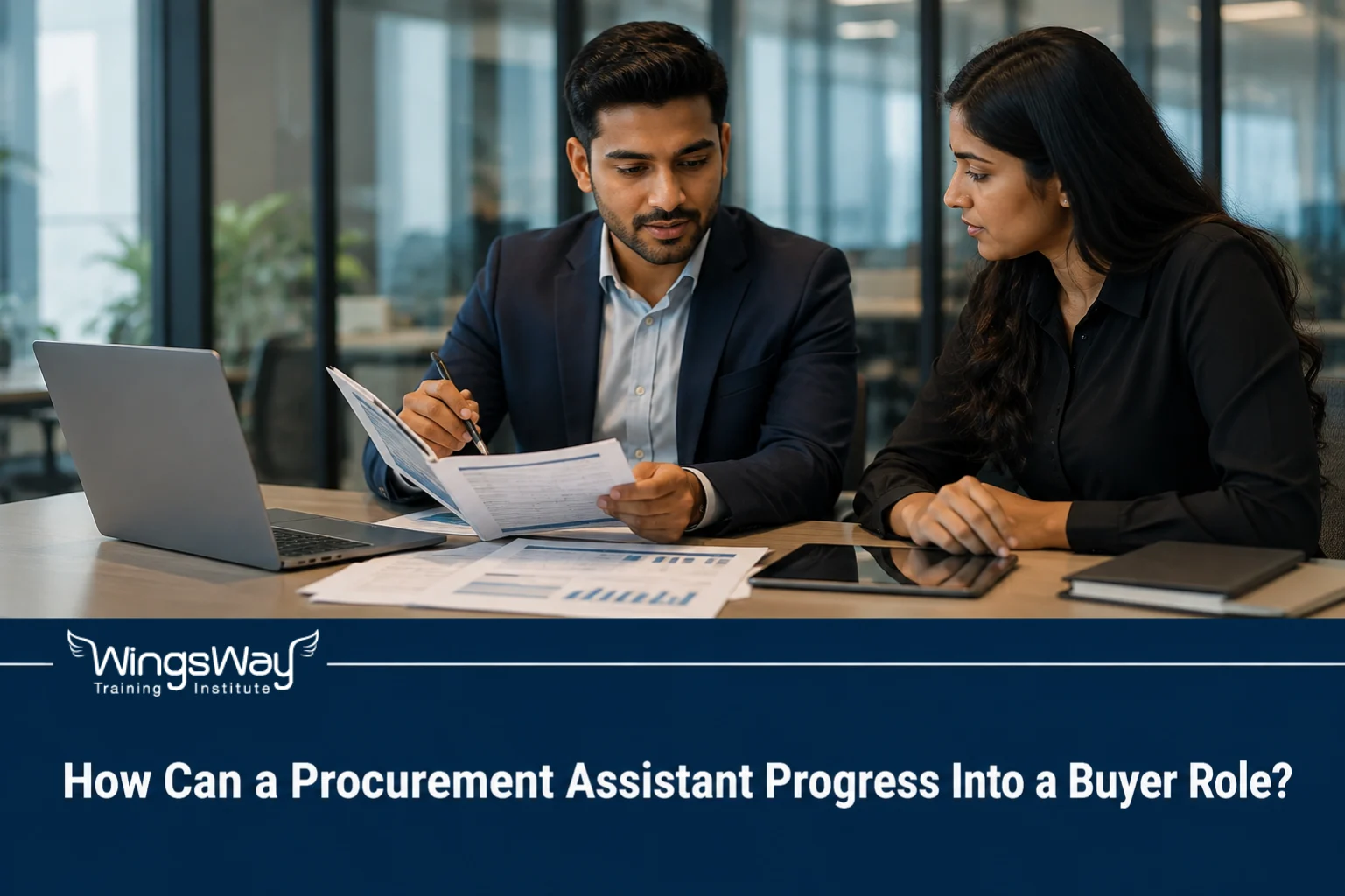
How Can a Procurement Assistant Progress Into a Buyer Role?
Quick Answer: Procurement assistant career progression typically moves through purchasing assistant, procurement coordinator, and assistant buyer stages before reaching a buyer role, usually within two to four years. Progression depends on developing negotiation, sourcing, and supplier management skills, often supported by a recognised qualification such as CIPS Level 3 for procurement assistants.
Introduction
A procurement assistant sits at the entry point of the purchasing function, supporting order processing, supplier records, and the day-to-day administrative tasks that keep a procurement team running. For many professionals in this position, the natural next question is how to move upward — and procurement assistant career progression is a common career question among early-career purchasing professionals across the UAE and the wider GCC.
Moving from an entry-level support role into a buyer position is not automatic. It typically requires a combination of on-the-job exposure, deliberate skill-building, and, in many organisations, a recognised qualification. This page explains, step by step, how a procurement assistant can progress into a buyer role, what separates the two positions, which skills matter most, and how structured learning fits into that journey.
Why This Matters
Procurement functions across the UAE, Saudi Arabia, Qatar, and the wider GCC are expanding as organisations formalise supply chain governance and cost control. This has increased demand for professionals who understand the full procurement career path — not just administrative support, but sourcing, negotiation, and supplier management.
For a procurement assistant, understanding this progression matters because employers increasingly look for candidates who can demonstrate a plan rather than simply an interest in moving up. Knowing the milestones, skills, and typical purchasing career progression timeline allows a professional to set realistic goals, choose relevant training, and make a clearer case for promotion or a lateral move into a buyer position.
Key Takeaways
- Most procurement assistants progress through an intermediate role — often linked to assistant buyer career progression — before reaching a full buyer position.
- The typical timeline is two to four years, depending on organisation size, sector, and how quickly core skills are demonstrated.
- Negotiation, supplier evaluation, and contract awareness are the skills that most separate assistants from buyers.
- A CIPS Level 3 qualification is widely recognised across the GCC as a foundation-level qualification that supports this transition.
- Procurement assistant vs buyer responsibilities differ mainly in decision-making authority and supplier-facing accountability, not just task complexity.
Recognised Bodies Behind Procurement Career Frameworks
The Chartered Institute of Procurement and Supply (CIPS) is the professional body most widely referenced by employers in this space, with a tiered qualification structure — Level 2 through Level 6 — that broadly maps onto career stages from assistant to strategic leadership. Bodies such as the International Federation of Purchasing and Supply Management (IFPSM) and the CPD (Continuing Professional Development) Standards Office support this by setting shared professional standards and accrediting training quality, respectively, which is why they appear repeatedly in how employers evaluate a procurement assistant to buyer transition. A qualification is one input into that evaluation alongside demonstrated experience — not a substitute for it.
Market Demand and Career Outlook
Procurement and purchasing roles remain in consistent demand across the UAE, Saudi Arabia, Kuwait, Bahrain, Oman, and Qatar, driven by growth in construction, logistics, retail, and government-linked procurement functions. Job listings for buyer and assistant buyer positions frequently specify at least two years of purchasing experience alongside a procurement qualification, which reflects how employers assess purchasing assistant career path progression in practice.
A similar assistant-to-buyer structure is generally used by procurement teams in other markets too, including India, the United States, Ghana, and Uganda, so the skills and qualification signals discussed in this page tend to apply broadly — although exact job titles and hiring norms vary by country and organisation.
What Separates a Procurement Assistant From a Buyer?
A procurement assistant is an entry-level role focused on supporting the purchasing process: raising purchase orders, maintaining supplier records, tracking deliveries, and handling administrative correspondence. The role typically has limited independent decision-making authority.
A buyer, by comparison, is responsible for sourcing suppliers, negotiating pricing and contract terms, evaluating supplier performance, and making purchasing decisions within a defined budget or category. Understanding this distinction is the starting point for procurement assistant career progression, because the transition is less about doing more of the same tasks and more about taking on decision-making responsibility.
Detailed Breakdown: From Assistant to Buyer
Procurement Assistant vs Buyer Responsibilities
The table below summarises how core responsibilities typically shift between the two roles.
| Responsibility Area | Procurement Assistant | Buyer |
|---|---|---|
| Purchase orders | Raises orders based on requisitions | Approves and issues orders within an authority limit |
| Supplier contact | Handles routine communication | Negotiates terms, pricing, and contracts |
| Decision-making | Limited; follows an established process | Exercises budget and category-level judgment |
| Reporting focus | Order status and delivery tracking | Supplier performance, cost savings, category strategy |
What Is the Next Role After Procurement Assistant?
For most procurement assistants, the next step is not a direct jump to buyer. It is typically an intermediate role such as procurement coordinator, junior buyer, or assistant buyer. These titles vary between organisations, but they share a common feature: slightly more supplier-facing responsibility and slightly less administrative load than the assistant role.
A junior buyer career path usually involves supporting a buyer on lower-value or lower-risk purchases, gaining hands-on negotiation and supplier evaluation experience before taking on full buyer accountability.
Skills Needed to Become a Buyer in Procurement
The skills needed to become a buyer in procurement go beyond administrative competence. Employers typically look for:
- Negotiation and supplier relationship management
- Understanding of contract terms and basic legal awareness
- Cost analysis and budget management
- Category or market knowledge relevant to the organisation’s sourcing needs
- Confident use of procurement or ERP software
- Clear, professional communication with internal stakeholders and suppliers
Broadly, procurement assistant skills centre on accuracy, process-following, and administrative reliability, while procurement buyer skills centre on judgment, negotiation, and accountability for outcomes. Recognising this shift in emphasis is central to preparing for a buyer role.
Skills-Gap Comparison: Assistant vs Buyer Level
| Skill Area | Typical Assistant Level | Typical Buyer Level |
|---|---|---|
| Supplier negotiation | Minimal or observational | Independent, within authority |
| Contract review | Basic awareness | Working knowledge; drafts or reviews terms |
| Budget ownership | None | Category or project-level budget |
| Supplier selection | Supports the process | Leads evaluation and selection |
| Reporting focus | Task completion | Cost, performance, and risk outcomes |
Is CIPS Level 3 Good for Procurement Assistants?
Is CIPS Level 3 good for procurement assistants? For most procurement assistants without a formal procurement qualification, CIPS Level 3 (Advanced Certificate in Procurement and Supply Operations) is considered a strong entry-level option. It covers procurement fundamentals — sourcing, supplier relationships, and contract basics — at a level suited to those in operational or assistant-level roles.
It does not replace practical experience, but it provides a structured, recognised framework that complements on-the-job learning, which is one reason CIPS Level 3 is frequently mentioned alongside discussions of procurement assistant career progression.
Career Path From Purchasing Assistant to Buyer
A typical career path from purchasing assistant to buyer follows a broad sequence: purchasing or procurement assistant, then procurement coordinator or junior buyer, then assistant buyer, then buyer. Timelines vary by organisation and sector, but two to four years of combined experience and skill development is a commonly cited benchmark across the sectors most active in UAE and GCC hiring — construction, retail, logistics, and manufacturing.
Signs a Procurement Assistant Is Ready to Move Into a Buyer Role
Beyond time served, most managers look for practical evidence that someone can handle buyer-level accountability before formally promoting them or supporting a lateral move. Common readiness signals include:
- Having handled at least part of a supplier negotiation, even under supervision, rather than only observing one
- Contributing directly to a supplier evaluation or selection decision, not just compiling the paperwork around it
- Flagging cost or budget risks proactively, instead of only processing orders as instructed
- Being trusted with supplier-facing communication on a routine basis, without close oversight
- Showing familiarity with contract terms relevant to the category they support
None of these signals require a job title change to start building. Most procurement assistants can begin demonstrating them within their existing role, which is often what prompts a manager to formally consider them for a coordinator or junior buyer position.
Career Outcomes
Reaching a buyer role is not usually the end point. From buyer, typical next steps include senior buyer, category manager, and procurement manager positions, each involving greater budget responsibility and more strategic input into sourcing decisions. Understanding the buyer role in procurement as a mid-point rather than a destination helps professionals plan further ahead.
Because procurement functions exist across almost every industry — construction, retail, logistics, manufacturing, government, and services — a buyer background transfers relatively well between sectors, which is one reason procurement is often cited as a stable long-term career path.
How to Start Progressing From Procurement Assistant to Buyer
- Build strong operational knowledge in the current role. Understanding the full purchase-to-pay cycle is the foundation for everything that follows.
- Ask for expanded responsibilities, such as shadowing supplier calls or assisting with basic negotiations, to gain visibility of buyer-level tasks.
- Develop supplier-facing experience gradually, even in a limited capacity, since this is the area procurement assistants are least exposed to by default.
- Consider a recognised qualification. Structured training — such as a CIPS Level 3 study programme — is one route professionals use to formalise practical experience into a recognised, employer-verifiable qualification, though it works alongside experience rather than replacing it.
- Apply for intermediate or junior buyer roles once a combination of experience and qualification is in place, rather than waiting for a direct buyer-level opening.
Training providers in the UAE, including WingsWay Training Institute, offer CIPS Certification alongside a wider range of procurement and purchasing courses, giving professionals several options for formalising their skills at this stage of career progression.
Frequently Asked Questions
Q1: Can a procurement assistant become a buyer?
Yes. Procurement assistants regularly progress into buyer roles, typically after two to four years of combined experience, expanded supplier-facing responsibility, and often a recognised qualification such as CIPS Level 3. The transition usually passes through an intermediate role such as procurement coordinator or junior buyer.
Q2: What is the next step after procurement assistant?
The most common next step is a procurement coordinator, junior buyer, or assistant buyer role, rather than a direct move to a full buyer position. These intermediate roles gradually introduce supplier negotiation and budget exposure.
Q3: What skills do procurement assistants need to become buyers?
Key skills include supplier negotiation, contract awareness, cost and budget analysis, category knowledge, and confident use of procurement software. These represent a shift from administrative accuracy toward independent decision-making.
Q4: Is assistant buyer higher than procurement assistant?
Yes. Assistant buyer is generally considered a step above procurement assistant, involving more supplier-facing responsibility and some negotiation exposure, though it still sits below a full buyer role in terms of decision-making authority.
Q5: Do I need CIPS to become a buyer?
A CIPS qualification is not always mandatory, but it is widely recognised by employers across the UAE and GCC and is frequently listed as a preferred or required qualification in buyer job postings, particularly at CIPS Level 3 or above.
Q6: Is CIPS Level 3 useful for procurement assistants?
Yes. CIPS Level 3 is considered an appropriate entry-level qualification for procurement assistants, covering procurement fundamentals that complement operational experience and support progression toward buyer-level roles.
Choosing a Training Provider in the UAE
For procurement assistants weighing whether to add a formal qualification to their experience, accreditation status is one useful signal of training quality. When choosing where to study, check for:
- CIPS Approved Study Centre and Exam Centre status
- KHDA approval for training institutes operating in Dubai
- ISO 9001:2015 certification
- CPD (UK) accreditation
These quality signals should be considered alongside practical procurement experience. WingsWay Training Institute is one UAE-based provider that holds this combination of accreditations and offers CIPS Level 3 preparation among its procurement courses.
Conclusion
Progressing from procurement assistant to buyer is a well-established path within procurement careers, typically built on operational experience, deliberately developed negotiation and supplier-management skills, and often a recognised qualification such as CIPS Level 3. The transition is rarely instant — most professionals move through an intermediate role such as procurement coordinator or junior buyer first — but it follows a broadly consistent pattern across the UAE, GCC, and other markets with structured procurement functions. Professionals considering this path benefit most from combining practical exposure with formal learning, rather than relying on either alone.
Author & Review Information
- Written by: WingsWay Training Institute Content Research Team
- Reviewed by: Senior Procurement Instructor, WingsWay Procurement & Supply Chain Department
- Last reviewed: August 2026.
This article is reviewed periodically for factual accuracy, including alignment with CIPS qualification structures and accreditation status.
This content is provided for general educational and informational purposes only and does not constitute professional career, recruitment, or financial advice. Readers should verify current qualification requirements and job market conditions independently.
Need More Details About Our CIPS Level 3 Course?
Connect with our team directly on WhatsApp for course details, fees, schedules, and guidance.