Finance vs Accounting Career: Which Is Better in Dubai?
Quick Answer: A finance vs accounting career comes down to focus. Accounting centres on recording, reporting, and compliance — bookkeeping, auditing, and tax. Finance centres on analysis, planning, and investment decisions. In Dubai, both paths are in steady demand and pay well; the right choice depends on whether structured reporting or forward-looking analysis suits you better.
Introduction
Choosing between a finance vs accounting career is one of the most common questions commerce graduates and early-career professionals ask when planning their future in the UAE. Both fields sit under the same broad umbrella of business and numbers, yet they lead to different day-to-day work, different qualifications, and different career ladders.
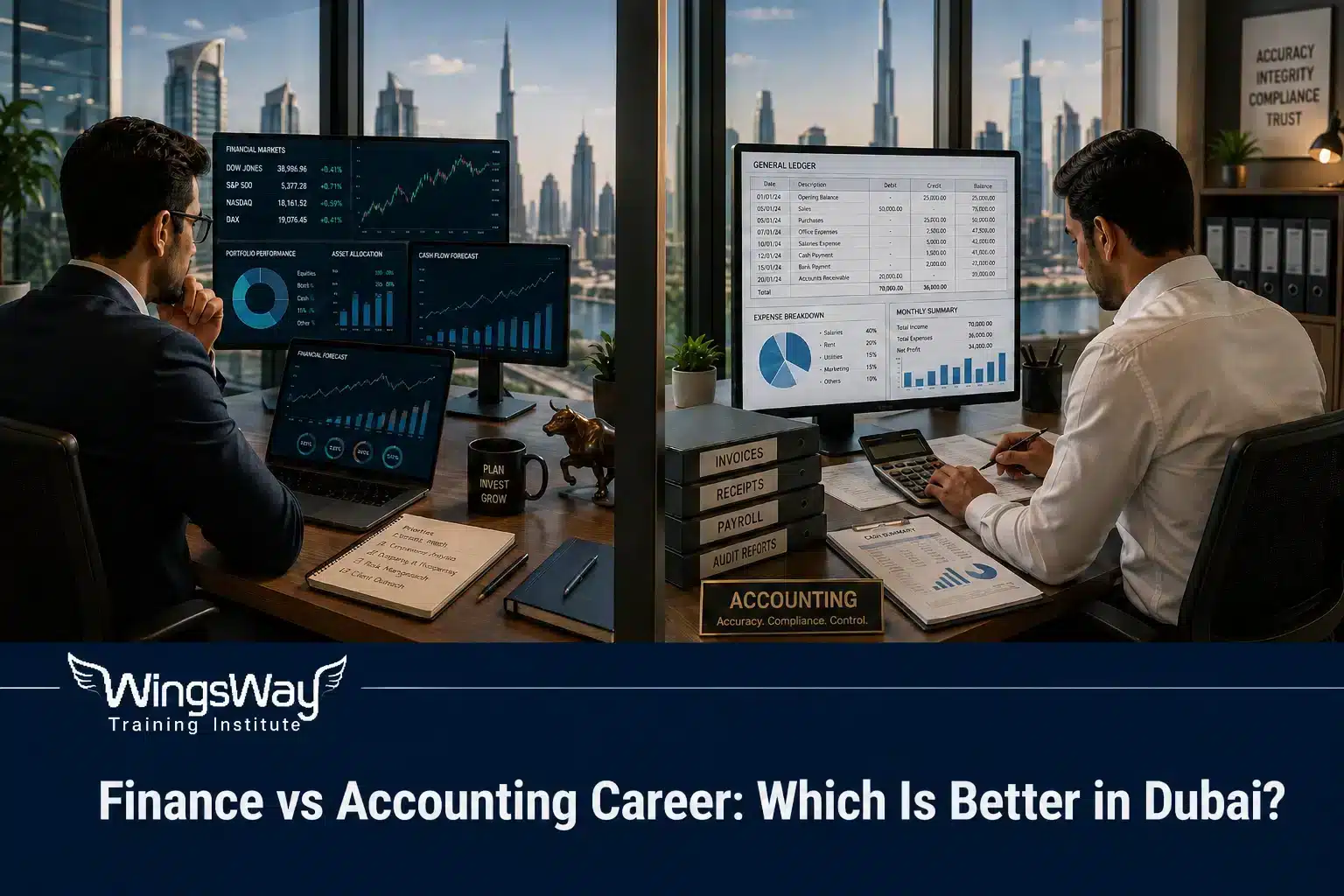
Accounting is largely about accuracy and compliance: recording transactions, preparing financial statements, and making sure a business meets its tax and regulatory obligations. Finance is more forward-looking: analysing data, forecasting performance, and helping a business decide where to invest or where to cut costs.
Understanding the accounting vs finance career distinction early helps professionals in Dubai target the right degree, the right certification, and the right first job, rather than discovering the mismatch three or four years into a role that does not suit their strengths.
Why This Matters
Dubai’s position as a regional financial and business hub means demand for both accounting career Dubai and finance career Dubai talent stays consistently strong. Businesses operating in the UAE need reliable accounting and financial reporting to meet applicable tax, regulatory and reporting obligations, including UAE Corporate Tax requirements and, where applicable, IFRS reporting requirements
At the same time, the growth of banking, asset management, and fintech across Dubai and Abu Dhabi Global Market (ADGM) has increased demand for finance professionals who can analyse numbers rather than only record them. Getting this decision right early matters because it shapes which certifications are worth pursuing, which internships are useful, and how quickly a professional can move into senior, well-paid roles across the UAE and wider GCC job market.
Key Takeaways
- Accounting is transaction-focused and backward-looking — recording what happened. Finance is analysis-focused and forward-looking — planning what happens next.
- Both accounting jobs in Dubai and finance jobs in Dubai remain in steady demand, driven by UAE Corporate Tax compliance and the growth of DIFC and ADGM financial services.
- ACCA vs CMA is one of the clearest signals of career direction: ACCA suits broad accounting, audit, and reporting careers, while CMA suits management accounting and corporate finance roles.
- An accountant vs financial analyst comparison comes down to compliance and reporting versus forecasting and investment analysis, and the qualifications, tools, and daily tasks differ accordingly.
- Salaries in both fields scale steeply with certification and experience. Entry-level pay is broadly similar, but the gap widens significantly at manager and director level.
- Movement between the two fields is common. An accounting to finance career switch is realistic for professionals who add analytical, forecasting, or investment-related skills to a reporting background.
Who Sets the Standards in Accounting and Finance Careers
Several recognised bodies shape how accounting and finance careers are structured in the UAE. The Association of Chartered Certified Accountants (ACCA), headquartered in the UK, is one of the most widely held qualifications among Dubai’s accounting workforce and is recognised by regulators including the Dubai Financial Services Authority (DFSA). The Institute of Management Accountants (IMA), based in the United States, awards the CMA designation, which is relevant to many management accounting, FP&A and corporate finance roles.
Ongoing professional development is an important part of both accounting and finance careers. Training providers may use recognised CPD frameworks to structure continuing learning, while professional bodies such as ACCA and IMA set their own continuing-development requirements or expectations for members. Free zones such as DIFC and ADGM have also become concentration points for finance-specific roles — investment analysis, asset management, and treasury — while accounting roles remain distributed across every sector of the UAE’s mainland economy.
Market Demand and Insights
Recruitment data from UAE-focused salary guides consistently points to steady hiring across both fields through 2026. On the accounting career Dubai side, demand is strongest for professionals who understand UAE Corporate Tax, VAT compliance, and IFRS reporting — skills every company operating in the UAE now needs, regardless of size.
On the finance career Dubai side, growth is concentrated in FP&A, treasury, and financial analysis roles that support decision-making inside banks, real estate groups, and multinational regional headquarters.
A common thread across both markets is that certification matters more than the underlying degree title. Employers in Dubai routinely list ACCA, CMA, CFA, or CPA as preferred or required, even for roles that a generic finance or accounting degree alone would not unlock. Professionals asking which is better accounting or finance career should treat certification choice as the more consequential decision, since it tends to influence salary and promotion speed more than the original degree specialisation.
What Is the Real Difference Between Finance and Accounting?
At its core, the finance vs accounting career choice reflects two different relationships with the same financial data. Accounting is the discipline of recording, classifying, and reporting financial transactions accurately, so that a business’s financial statements reflect reality and satisfy tax authorities, auditors, and shareholders. Finance is the discipline of using that financial data, together with market and economic information, to make decisions: how to raise capital, where to invest it, and how to manage risk.
A simple way to remember it: accountants document what has already happened financially, and finance professionals help decide what should happen next. Both disciplines require strong numerical ability, but they draw on different types of thinking — accounting rewards precision and rule-following, while finance rewards judgement and forward projection.
Accounting vs Finance: Roles, Skills, and Certifications
What Does an Accountant Do?
Accountants record and verify financial transactions, prepare financial statements, manage payroll and accounts payable or receivable, ensure compliance with UAE VAT and Corporate Tax rules, and support external or internal audits. Common Dubai job titles include Junior Accountant, Accounts Executive, Senior Accountant, Chief Accountant, and Financial Controller.
What Does a Financial Analyst Do?
Financial analysts build budgets and forecasts, analyse variances between actual and planned performance, model business scenarios, evaluate investment opportunities, and prepare reports that support management decisions. Common Dubai job titles include Financial Analyst, FP&A Analyst, Investment Analyst, Treasury Analyst, and Finance Manager.
Accountant vs Financial Analyst: Key Differences at a Glance
The table below summarises the core accountant vs financial analyst differences that shape day-to-day work in Dubai.
| Aspect | Accountant | Financial Analyst |
|---|---|---|
| Primary focus | Recording and reporting financial transactions accurately | Analysing data to guide business and investment decisions |
| Time orientation | Backward-looking (what already happened) | Forward-looking (what is likely to happen) |
| Typical daily work | Bookkeeping, reconciliations, VAT/tax filing, audit support | Forecasting, budgeting, variance analysis, financial modelling |
| Core qualifications | ACCA, CPA, CA, CertIFR/DipIFR | CMA, CFA, MBA in Finance, advanced Excel/modelling skills |
| Typical entry point | Junior Accountant / Accounts Executive | Financial Analyst / FP&A Analyst |
| Career ceiling | Financial Controller, Chief Accountant, CFO | Finance Director, Head of FP&A, CFO |
How Qualifications Differ Between Accounting and Finance Career Paths
Certification is one of the clearest signals of which path a professional is on. ACCA (Association of Chartered Certified Accountants) offers broad coverage of financial accounting, audit, taxation, and business law, which is why it sits more naturally on the accounting side. CMA (Certified Management Accountant), awarded by the US-based IMA, focuses more narrowly on management accounting, financial planning and analysis, and strategic decision-making, which is why it sits more naturally on the finance side. Directly comparing ACCA and CMA essentially reflects a comparison between accounting-focused and finance-focused career paths: ACCA is ideal for roles in audit, tax, and reporting, while CMA is particularly relevant to roles in FP&A, management accounting, controllership and corporate finance. Some professionals choose to pursue both over time, since the two qualifications can be complementary rather than directly competing.
Professionals whose accounting or finance work involves multinational or listed-company reporting often add a Certificate in International Financial Reporting Standards (CertIFR) on top of ACCA or CMA, since IFRS knowledge is expected in both audit-facing accounting roles and finance roles that report to international parent companies. For a full qualification-by-qualification breakdown, see WingsWay’s guide to ACCA, CMA and IFRS accounting courses in Dubai.
Accounting vs Finance Salary in Dubai
Accounting and finance salaries in Dubai vary by role, experience, sector, and professional qualification. The ranges below are indicative and reflect patterns reported across UAE recruitment salary guides, including sources such as Cooper Fitch, Michael Page, and Robert Walters. They should not be treated as guaranteed figures, and candidates should always compare them with current live job postings for their specific sector.
| Level | Accounting track (AED/month) | Finance track (AED/month) |
|---|---|---|
| Entry-level | 3,000 – 5,500 | 8,000 – 12,000 |
| Junior / 1–3 yrs experience | 4,000 – 7,000 | 10,000 – 15,000 |
| Mid-level / Senior | 7,000 – 18,000 | 12,000 – 20,000 |
| Manager / Controller | 18,000 – 30,000+ | 20,000 – 30,000+ |
| Director / CFO | 40,000 – 80,000+ | 40,000 – 80,000+ |
Professional qualifications can influence salary potential, particularly once candidates move into roles where credentials such as ACCA, CMA or CFA are preferred or role-relevant. Actual pay still varies by employer, sector, experience and job scope.
Can Accountants Move Into Finance?
Yes. Accountants can move into finance, and the transition is realistic for professionals who build analytical, forecasting and financial-modelling skills alongside their reporting experience. An accounting background provides a strong understanding of financial statements, while moving into roles such as FP&A, treasury or financial analysis typically requires additional capability in advanced Excel, budgeting, variance analysis, forecasting and financial modelling. Qualifications such as CMA or CFA can also help demonstrate finance-specific knowledge, depending on the role being targeted.
Not every accountant moves toward analysis and forecasting — some move sideways into regulatory and compliance-focused roles instead, such as AML certification or CAMS, which is a related but distinct compliance-focused career track.
Career Outcomes in Accounting and Finance
Both tracks offer clear, structured progression in the UAE. On the accounting side, professionals typically move from Junior Accountant to Senior Accountant, then Chief Accountant or Financial Controller, before reaching Finance Director or CFO. On the finance side, the path usually runs from Financial Analyst to Senior Analyst, then FP&A Manager or Finance Manager, before reaching Finance Director or CFO.
Notably, both tracks can converge at senior leadership level. Professionals may reach CFO or Finance Director roles from either an accounting or finance background, particularly when they combine strong reporting knowledge with broader strategic, analytical and commercial skills. At senior levels, organisations typically value a balance of compliance awareness, financial judgement and business strategy rather than a purely accounting or purely finance profile.
How to Start: Choosing and Building Your Path
Choosing between accounting and finance does not need to be complicated. The steps below outline a practical starting process for professionals weighing accounting vs finance for beginners in Dubai.
- Assess your working style. If you prefer structured, rules-based work with clear right answers, accounting is likely the better fit. If you prefer ambiguity, forecasting, and judgement calls, finance tends to suit better.
- Build the right academic foundation. A degree in accounting, finance, commerce, or a related business field is the common starting point for both tracks. Professionals without that background sometimes begin with a foundational finance course in the UAE before pursuing a full certification.
- Choose a certification aligned to your direction. ACCA, CPA, or CertIFR/DipIFR-style qualifications support an accounting-track finance career path in Dubai, while CMA or CFA better support a finance-track path.
- Gain UAE-specific practical exposure. Familiarity with UAE Corporate Tax, VAT, and IFRS reporting is expected in almost every accounting and finance role in the country.
- Target the right entry roles. Accounts Executive or Junior Accountant roles build an accounting track; Financial Analyst or FP&A Analyst roles build a finance track.
- Keep building after qualifying. Continuing professional development, benchmarked against frameworks such as CPD (UK) Standards, keeps both accounting and finance professionals current as reporting standards and tools evolve.
Structured training, such as ACCA exam-preparation courses or CMA exam-preparation courses, is one route professionals in Dubai use to work through this process systematically rather than relying only on self-study — particularly for candidates balancing preparation with a full-time job.
Frequently Asked Questions
Q1: Which is better, accounting or finance?
Neither is universally better; each suits a different working style. Which is better, accounting or finance? depends on whether you prefer structured, compliance-driven work (accounting) or analytical, forward-looking work (finance). In terms of a finance vs accounting career outcome, both offer strong, well-paid career paths in Dubai.
Q2: Should I choose accounting or finance?
Should I choose accounting or finance? comes down to your strengths. Choose accounting if you enjoy precision, rules, and reporting accuracy. Choose finance if you enjoy modelling, forecasting, and interpreting numbers to guide decisions. Many professionals also start in accounting and later move into finance once they have built analytical skills.
Q3: Is accounting easier than finance?
Is accounting easier than finance? Neither is inherently easier; the difficulty is different in kind. Accounting demands precision, attention to detail, and knowledge of evolving regulations. Finance demands comfort with ambiguity, financial modelling, and judgement under uncertainty. Professionals who prefer clear rules over open-ended analysis often find accounting more comfortable, and vice versa.
Q4: Can accountants move into finance?
Can accountants move into finance? Yes. Accountants who build forecasting, budgeting, and financial modelling skills, and who often add a certification such as CMA or CFA, regularly move into FP&A, treasury, or finance manager roles in Dubai. Their existing knowledge of financial statements is a strong foundation for this transition.
Q5: What is the difference between accountant and financial analyst?
The main difference between an accountant and a a financial analyst is their time orientation and purpose: an accountant records and reports what has already happened financially, while a financial analyst studies that data to forecast and guide what should happen next.
Q6: Which qualifications typically support accounting and finance career paths?
ACCA typically supports accounting-track careers such as audit, tax, and reporting, because of its broad accounting curriculum. CMA typically supports finance-track careers such as FP&A and corporate finance, because it focuses on management accounting and strategic decision-making. Comparing ACCA vs CMA directly is less useful than asking which side of the accounting vs finance career divide you are targeting first — the qualification choice follows from that.
Q7: Which career is better in Dubai?
There is no single “better” career in Dubai; the stronger choice depends on your interests, preferred type of work, and the qualifications you plan to pursue. Accounting roles are needed across a wide range of UAE industries because businesses require support with financial reporting, Corporate Tax, VAT and compliance. Finance roles are more concentrated in areas such as banking, asset management, treasury and corporate FP&A, particularly around DIFC and ADGM. Both paths can offer strong career progression for commerce graduates, depending on individual strengths and long-term goals.
Why Credentials Matter, and Where to Go Next
When evaluating a training provider for accounting or finance certifications, it is useful to verify each credential directly. KHDA approval confirms that an institute is licensed to provide training in Dubai, ISO 9001:2015 relates to the organisation’s quality-management system, and CPD Standards Office accreditation indicates that relevant learning activities have been assessed against its continuing-professional-development framework.
Why Choose WingsWay Training Institute
- KHDA-Approved: Licensed by Dubai’s Knowledge and Human Development Authority to deliver private training.
- ISO 9001:2015 Certified: An audited quality-management certification covering how courses are designed and delivered.
- CPD (UK) Standards Office Accredited: Course content is benchmarked against UK continuing-professional-development standards.
For readers ready to act on a specific qualification rather than the broader career decision, the most relevant next steps are WingsWay’s ACCA, CMA and IFRS accounting courses guide, CMA certification training, and finance courses in Dubai.
Conclusion
There is no single correct answer to the finance vs accounting career question. Accounting suits professionals who value precision, compliance, and structured reporting work, while finance suits professionals who value analysis, forecasting, and strategic decision-making. In Dubai’s market, both paths can offer clear career progression, supported by continued demand for accounting, compliance, analysis and finance skills across the UAE.
The most useful step for someone weighing this decision is not to search for a universal winner, but to match the working style, certification path (ACCA, CMA, CFA, or CPA), and sector exposure to their own strengths and interests.
Author & Review Information
- Written by: WingsWay Training Institute Content Research Team
- Reviewed by: Accounting & Finance Faculty, WingsWay Training Institute
- Last reviewed: August 2026
Career and salary guidance referenced in this article is developed and periodically reviewed by WingsWay’s subject-matter instructors to maintain factual accuracy and alignment with current UAE market conditions.
This article is intended for general educational and career-guidance purposes only and does not constitute professional financial, legal, or career advice. Salary figures, career outcomes, and certification requirements vary by employer, sector, and individual circumstances, and may change over time. Readers should conduct their own research or consult a relevant professional body or career advisor before making certification or career decisions.
Need More Details About The Finance Courses?
Connect with our team directly on WhatsApp for course details, fees, schedules, and guidance.
You may also like