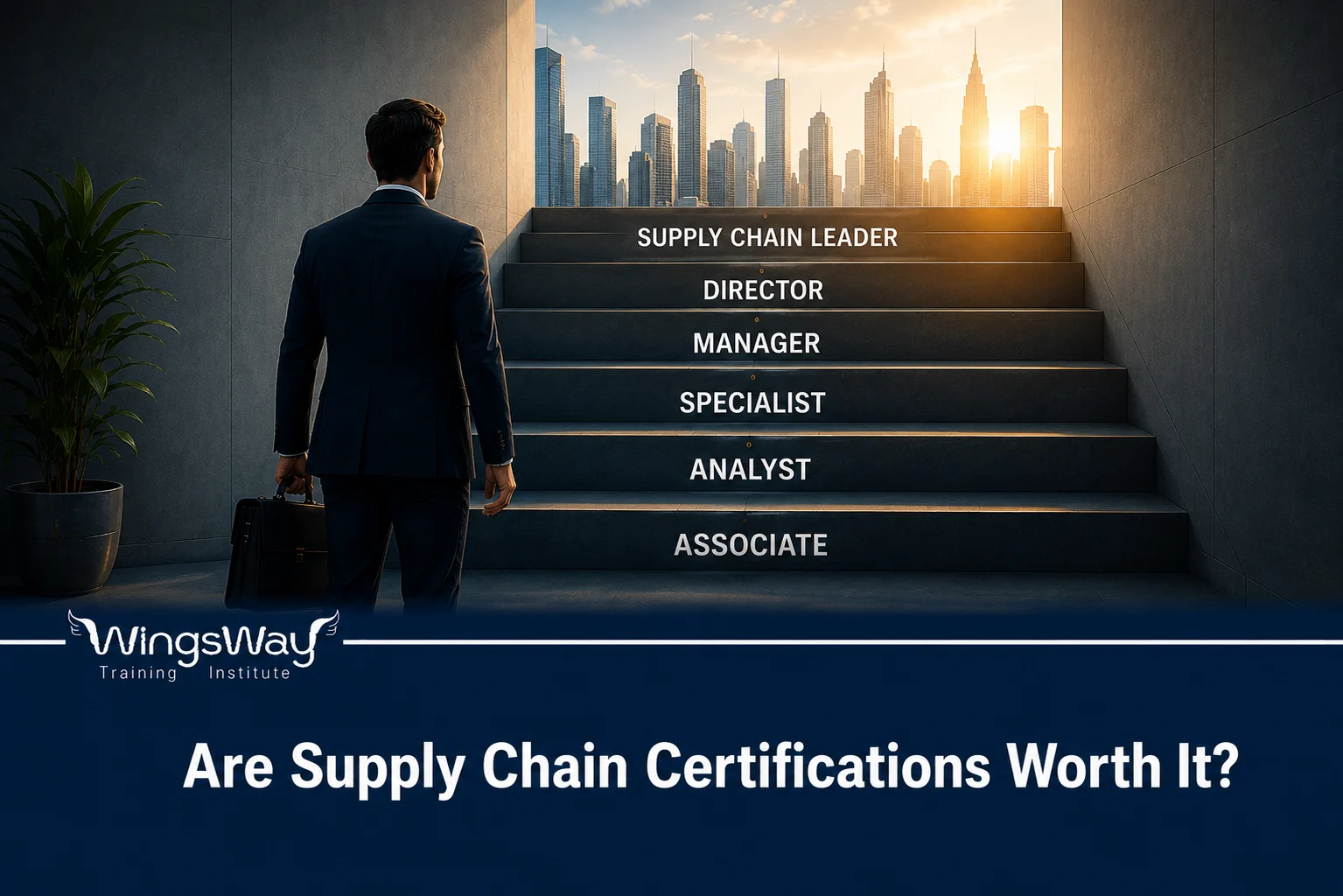
Are Supply Chain Certifications Worth It?
Quick Answer: Yes. Supply chain certifications are worth it in the UAE. They improve your job prospects, support career advancement, and are actively sought by employers in Dubai and across the GCC. Certifications such as CSCP, CPIM, CIPS,CGSCP,CGSCM,CGPP,CGPM,ACPP,ACPM,ACSCP,ACSCM and CILT add measurable value — whether you are a fresher entering the field or a professional aiming for a senior role.
The UAE has one of the most active logistics and supply chain sectors in the world. From the ports of Dubai and Abu Dhabi to the free zones and retail supply networks across the GCC, professionals with the right credentials are in strong demand.
For many professionals and fresh graduates, the question is not whether to pursue supply chain certifications — it is which one to choose and when to start. The good news is that structured training is now widely accessible in Dubai and across the region.
This guide covers everything you need to know: the value of supply chain certifications, how employers view them, how to compare the top options, and who benefits most from earning one.
Key Takeaways
- Supply chain certifications are recognised and valued by employers across the UAE and GCC.
- CSCP, CPIM, CIPS, and CILT are among the most respected globally and in the region.
- Freshers can use certifications to compete with experienced candidates in the job market.
- Working professionals benefit from certifications through salary increases and promotions.
- KHDA-approved and CPD-accredited training programmes carry significant credibility in Dubai.
- The right certification depends on your career stage, industry focus, and professional goals.
- Certification and experience work best together — neither fully replaces the other.
What Are Supply Chain Certifications?
Direct Answer: Supply chain certifications are structured credentials awarded by recognised professional bodies that validate your knowledge and skills in procurement, logistics, operations, inventory management, and end-to-end supply chain management.
- They are issued by international bodies such as ASCM, CIPS, CILT, IFPSM, and AAPSCM.
- They assess competency across procurement, demand planning, warehousing, and distribution.
- They are available for all levels — from beginners to senior professionals.
- Many are aligned with ISO standards and are recognised across global industries.
In the UAE context, certifications from internationally recognised awarding bodies — especially those delivered through KHDA-approved training providers — carry strong professional weight in both the public and private sectors.
Are Supply Chain Certifications Worth It?
Direct Answer: Yes. Supply chain certifications are worth it in the UAE. They open doors to better jobs, support salary negotiations, and give professionals a structured understanding of global supply chain practices.
- UAE employers in logistics, retail, oil and gas, healthcare, and construction actively look for certified candidates.
- Certified professionals in Dubai and the GCC consistently report higher salaries than non-certified peers.
- Certifications demonstrate initiative and technical competence — qualities employers in a competitive market value.
- They reduce the skill gap for freshers entering a field where experience is often required.
For professionals already working in supply chain roles, certification validates what they already know and gives them the formal recognition needed for career advancement.
Why Do Professionals Choose Supply Chain Certifications?
Direct Answer: Professionals pursue supply chain management certification to improve career prospects, gain global recognition, build technical knowledge, and stand out in a competitive job market.
- To qualify for senior roles such as Supply Chain Manager, Procurement Head, or Logistics Director.
- To meet employer requirements in regulated industries such as aviation, oil and gas, and healthcare.
- To earn the credibility needed when changing industries or relocating to the UAE or GCC.
- To build a structured knowledge base that day-to-day work experience alone does not always provide.
- To satisfy CPD requirements and maintain professional membership with bodies like CIPS or CILT.
In the UAE market, many multinational companies and government-linked organisations now list supply chain certifications as preferred or required qualifications for mid-to-senior level positions.
Do Employers Value Supply Chain Certifications?
Direct Answer: Yes. Most employers in the UAE — particularly in logistics, procurement, retail, and manufacturing — view supply chain certifications as a positive differentiator during recruitment and internal promotions.
- Job advertisements across UAE platforms frequently list CIPS, CSCP, CGSCM,APSCM,or CPIM as preferred qualifications.
- Government entities in Dubai and Abu Dhabi often require KHDA-recognised certifications for procurement roles.
- International companies operating in the GCC use certifications as a standard benchmark during shortlisting.
- Internal HR policies at several large organisations link certifications to pay grades or promotion eligibility.
Employers do care about supply chain certifications — especially when candidates hold credentials from well-known bodies such as ASCM, CIPS, CILT, or IATA, delivered through accredited training providers.
Certification vs Experience: Which Matters More?
Direct Answer: Both matter. Experience shows what you have done; certification shows what you know. In the UAE job market, the strongest candidates combine relevant work experience with at least one recognised supply chain certification.
Certification vs Experience Comparison
| Factor | Certification | Experience |
|---|---|---|
| Job Entry | Helps freshers qualify without prior work history | Required for mid-senior roles |
| Salary Negotiation | Supports higher salary demands | Directly linked to salary benchmarks |
| Promotion | Recognised by HR as formal qualification | Demonstrated through performance |
| Knowledge Depth | Structured and globally standardised | Practical but varies by employer |
| Employer Shortlisting | Signals credibility before interview | Assessed during interview and reference checks |
For freshers, certifications can substitute for experience at the application stage. For experienced professionals, certifications formalise their expertise and open access to senior roles they may otherwise be overlooked for.
Which Supply Chain Certification Is Best for Your Career?
Direct Answer: The best supply chain certification depends on your career focus. CSCP and CPIM are ideal for end-to-end supply chain and operations professionals. CIPS is best for procurement specialists. CILT suits logistics and transport professionals.
There is no single best certification for everyone. Your choice should depend on your industry, current role, career ambitions, and whether you are just starting out or looking to specialise further.
Top Supply Chain Certifications Overview
| Certification | Awarding Body | Best For | Level |
|---|---|---|---|
| CSCP | ASCM | End-to-end supply chain | Intermediate to Advanced |
| CPIM | ASCM | Operations and inventory | Entry to Intermediate |
| CIPS | CIPS UK | Procurement and sourcing | All levels |
| CILT | CILT International | Logistics and transport | All levels |
| AAPSCM | AAPSCM | GCC procurement roles | Professional |
| IATA DG / Cargo | IATA | Aviation and air cargo | Specialist |
CSCP vs CPIM vs CIPS vs CILT: Which One Should You Choose?
Direct Answer: Choose CSCP if you want broad supply chain strategy knowledge. Choose CPIM if your focus is operations and inventory. Choose CIPS for procurement. Choose CILT for logistics, transport, and freight.
Detailed Certification Comparison
| Cert | Focus Area | Awarding Body | Duration | GCC Demand |
|---|---|---|---|---|
| CSCP | Global supply chain strategy and design | ASCM (USA) | 4–6 months | High |
| CPIM | Production, inventory, planning | ASCM (USA) | 3–5 months | High |
| CIPS | Procurement, sourcing, supplier management | CIPS (UK) | 6–18 months | Very High |
| CILT | Logistics, transport, distribution | CILT International | 3–12 months | High |
| AAPSCM | Procurement and SC management in GCC | AAPSCM | 3–6 months | Growing |
If you are unsure where to start, CIPS Level 4 or CPIM Part 1 are common entry points for professionals in Dubai who want to formalise their procurement or operations knowledge without committing to a long programme immediately.
Are Supply Chain Certifications Useful for Freshers?
Direct Answer: Yes. Supply chain certifications for freshers and beginners provide the foundational knowledge needed to enter the field and compete with experienced candidates when applying for entry-level roles in the UAE.
- They signal commitment and professional intent to potential employers.
- They provide structured knowledge in procurement, logistics, and inventory that a degree alone may not cover.
- Many programmes — such as CIPS Level 3 or CPIM — are designed specifically for those entering the field.
- Freshers with a certification often progress to interviews faster than those without one.
- KHDA-approved supply chain courses in Dubai are recognised by UAE government and private sector employers.
For fresh graduates in the UAE, pairing a supply chain certification with a targeted job search strategy makes a significant difference in how quickly you land your first role.
Are Supply Chain Certifications Useful for Working Professionals?
Direct Answer: Absolutely. Working professionals in the UAE use supply chain certifications to qualify for promotions, move into specialist roles, satisfy CPD requirements, and increase their earning potential.
- Professionals with CIPS, CSCP, or CILT designations are eligible for senior procurement and logistics roles across the GCC.
- Certifications help professionals transition from operational roles into strategic supply chain management positions.
- Many employers in Dubai link certification attainment to internal pay bands and promotion criteria.
- CPD UK-accredited training is valued by professionals who need to maintain membership with bodies like CIPS or CILT.
- Supply chain certification for promotion is a well-established pathway in multinationals, government entities, and large corporates in the UAE.
Can Supply Chain Certifications Help You Get a Job?
Direct Answer: Yes. A recognised supply chain certification improves your chances of passing CV screening, gets you shortlisted faster, and demonstrates relevant competency before an interview even begins.
- Certified candidates appear more credible on application portals used by UAE companies.
- Recruiters in Dubai frequently filter for CIPS, CSCP,CGSCM,APSCM or CPIM when filling procurement and supply chain roles.
- Logistics and supply chain jobs in the UAE are growing due to ongoing investment in trade infrastructure, free zones, and e-commerce.
- A certification helps non-UAE nationals demonstrate their credentials meet regional standards when applying for jobs in Dubai or the wider GCC.
In short: a supply chain certification does not guarantee a job, but it meaningfully improves your positioning in a competitive market.
What Jobs Can You Get After a Supply Chain Certification?
Direct Answer: Certified supply chain professionals in the UAE can access a wide range of roles across procurement, logistics, operations, and strategic sourcing — in both the private sector and government organisations.
Common Job Roles After Supply Chain Certification
| Entry Level | Mid Level | Senior Level |
|---|---|---|
| Supply Chain Coordinator | Procurement Manager | Supply Chain Director |
| Purchasing Assistant | Logistics Manager | Head of Procurement |
| Warehouse Planner | Demand Planning Manager | VP Supply Chain |
| Freight Coordinator | Inventory Control Manager | Chief Procurement Officer |
| Import / Export Officer | Operations Manager | Regional Supply Chain Lead |
Sectors actively recruiting certified supply chain professionals in Dubai and the GCC include oil and gas, retail, healthcare, aviation, e-commerce, construction, and government.
How to Choose the Right Supply Chain Certification
Direct Answer: Choose based on your current role, career goal, and industry. Beginners should start with foundational programmes. Experienced professionals should consider advanced or specialist certifications aligned with their sector.
Certification Selection Guide
| Your Profile | Career Goal | Recommended Cert | Awarding Body |
|---|---|---|---|
| Fresh Graduate | Enter procurement or logistics | CIPS Level 3 or 4 | CIPS UK |
| Operations Professional | Move into planning or inventory | CPIM | ASCM |
| Procurement Professional | Advance to strategic sourcing | CIPS Level 5 or 6 | CIPS UK |
| Supply Chain Generalist | Build end-to-end expertise | CSCP | ASCM |
| Logistics / Transport Professional | Progress in freight or distribution | CILT | CILT International |
| GCC-Focused Procurement Role | Align with regional standards | AAPSCM | AAPSCM |
Are Supply Chain Certifications Worth the Cost?
Direct Answer: Yes. The ROI on supply chain certifications in the UAE is strong. The cost of training is typically recovered within the first year through salary increases, new job offers, or promotions.
- CIPS Level 4–6 certification range from AED 4,000 to AED 15,000 depending on the level and provider.
- CSCP and CPIM certifications typically cost AED 5,000 to AED 12,000 including study materials.
- CILT certifications vary by level, with many accessible between AED 3,500 and AED 9,000.
- Supply chain certification ROI is measurable — certified professionals in the UAE frequently report 10–25% salary increases post-certification.
When evaluating supply chain certification cost, consider not just the fee but also the quality of the training provider, whether the programme is KHDA-approved, and the practical career outcomes it delivers.
Who Should Take a Supply Chain Certification?
Direct Answer: Supply chain certifications are suitable for a wide range of candidates — from graduates entering the field to senior professionals seeking formal recognition of their expertise.
- Fresh graduates with degrees in business, engineering, or logistics.
- Professionals in procurement, warehouse, inventory, or logistics roles wanting formal credentials.
- Career changers moving into supply chain from adjacent fields such as finance, operations, or project management.
- Job seekers in Dubai or the GCC targeting supply chain or procurement positions.
- Managers seeking a promotion into strategic or director-level supply chain roles.
- Professionals relocating to the UAE who want to demonstrate their credentials meet regional standards.
Why Supply Chain Certifications Matter in the UAE
Direct Answer: The UAE’s position as a global trade hub makes supply chain expertise a critical skill. With major ports, free zones, and a growing e-commerce sector, certified professionals are in consistent demand across Dubai and the wider GCC.
- Dubai handles over 15 million TEUs annually through Jebel Ali Port — one of the world’s largest container terminals.
- The UAE’s Vision 2031 and GCC economic diversification plans are driving significant investment in logistics infrastructure.
- Free zones such as JAFZA, KIZAD, and Dubai South are creating thousands of supply chain jobs each year.
- The UAE government has established procurement frameworks that prioritise nationally recognised qualifications.
- Logistics and supply chain jobs in UAE are among the fastest-growing categories in the professional sector.
In this environment, holding a globally recognised supply chain certification positions you as a strong candidate — not just locally but across Saudi Arabia, Qatar, Kuwait, and the broader GCC region.
Why Accreditation and Quality Assurance Matter
Direct Answer: Not all supply chain certifications carry equal weight. Choosing a programme delivered by an accredited provider — such as a KHDA-approved institute in Dubai — ensures your certification is recognised by UAE employers and international organisations.
- KHDA (Knowledge and Human Development Authority) approval is the standard quality benchmark for training providers in Dubai.
- CPD UK accreditation ensures training meets continuing professional development standards recognised globally.
- International awarding bodies — including CIPS, ASCM, CILT, AAPSCM, IFPSM, and IATA — each have their own rigorous quality standards.
- ISO-aligned training content ensures learners are equipped with knowledge that meets international operational benchmarks.
- Training providers with KHDA approval and international body affiliations are better positioned to prepare you for UAE and GCC job market requirements.
When selecting logistics and supply chain training in Dubai, always verify the KHDA status of the provider and confirm which accrediting body issues the final certificate.
Why Choose WingsWay for Supply Chain Certification Training?
Direct Answer: WingsWay Training Institute is a KHDA-approved training provider in Dubai offering internationally recognised supply chain and procurement certification programmes for working professionals, job seekers, and fresh graduates.
- KHDA-approved training — trusted by UAE employers and recognised by government entities.
- Programmes aligned with internationally recognised awarding bodies including CIPS, CILT, AAPSCM, and CPD UK.
- Flexible scheduling options designed for working professionals in Dubai and across the GCC.
- Practical, application-focused training — not just theory.
- Expert instructors with real-world industry experience in UAE and GCC supply chain environments.
- Personalised guidance from enrolment to certification, including career support.
WingsWay also offers complementary business and contract management programmes. If you are working in commercial or contracts roles, explore our
WingsWay also supports professionals looking to complement their supply chain skills with contract management knowledge. You can learn more about our contract management certification in Dubai, UAE as part of your broader professional development plan.
Final Verdict: Are Supply Chain Certifications Worth It?
Supply chain certifications are worth it in the UAE. For freshers, they create a competitive entry point into the job market. For experienced professionals, they formalise expertise and open pathways to senior roles. For job seekers, they provide a tangible credential that employers look for during shortlisting.
The UAE’s growing trade infrastructure, expanding free zones, and GCC-wide demand for procurement and logistics talent make this one of the best regions in the world to invest in supply chain education.
Choose a KHDA-approved training provider, select a certification aligned with your career goals, and take the next step toward a stronger, more credible professional profile.
Frequently Asked Questions (FAQs)
Q1: Are supply chain certifications worth it in the UAE?
Yes. Supply chain certifications are worth it in the UAE. They are recognised by employers in Dubai and the GCC, improve job prospects, support salary growth, and demonstrate professional credibility. The UAE’s active logistics and trade sector makes certified professionals particularly valuable in this region.
Q2: Which is the best supply chain certification for a beginner?
For beginners and supply chain courses for beginners, CIPS Level 3 or 4 and CPIM Part 1 are strong starting points. They provide foundational knowledge in procurement and operations, are globally recognised, and are available through KHDA-approved training providers in Dubai.
Q3: CSCP vs CPIM: which should I choose?
CSCP is best if you want a broad, strategic understanding of end-to-end supply chain management. CPIM is better suited if your focus is production planning, inventory control, and operations. Both are issued by ASCM and are well recognised by UAE and GCC employers.
Q4: CIPS vs CILT: what is the difference?
CIPS focuses on procurement, sourcing, and supplier management — ideal for those in purchasing roles. CILT covers logistics, transport, and distribution — best for professionals in freight, warehousing, or supply chain movement. Both are globally recognised and valued highly in the UAE.
Q5: Can a supply chain certification help me get a job without experience?
Yes. A supply chain certification for freshers helps you qualify for entry-level roles even without direct work experience. It signals to employers that you have structured knowledge of the field and are committed to professional development — both of which matter during CV screening in Dubai.
Q6: Do employers in Dubai care about supply chain certifications?
Yes. Most employers in Dubai and across the GCC value supply chain certifications, especially from recognised bodies like CIPS, ASCM, CILT, and AAPSCM. Many job postings list certifications as preferred or required qualifications, and KHDA-approved training adds further credibility in the UAE market.
Q7: What is the average ROI on a supply chain certification in the UAE?
The supply chain certification ROI in the UAE is strong. Certified professionals typically recover the course fee within the first year through a salary increase, a new job offer, or an internal promotion. Many report 10–25% increases in compensation after earning a recognised certification.
Message From the Author
At WingsWay Training Institute, we help learners build practical skills for supply chain, procurement, and logistics careers in Dubai and across the GCC. Our supply chain certification training combines KHDA-approved training, internationally recognised certifications, and flexible learning options designed for working professionals, job seekers, and fresh graduates.
To learn more about our contract management certification in Dubai, UAE, contact us for a blog enquiry at information@wingsway.org, or connect with us via WhatsApp or call us on +971 50 906 3371.
Reviewed by WingsWay Training Institute Admission Team
This guide is based on current supply chain certification requirements, KHDA training standards, and internationally recognised certification pathways relevant to professionals in Dubai and the UAE.
Also Read
- How Much Do Shipping Courses in Dubai Typically Cost ?
- What Are the Benefits of Getting a CILT Certification in UAE?
- What Is the Average Air Hostess Salary in UAE?
- How do I choose the right freight forwarding course in Dubai?
- What is Contract Management?
- What Topics Are Covered in a Freight Forwarding Training Program?
Need More Details About This Course?
Connect with our team directly on WhatsApp for course details, fees, schedules, and guidance.
Tag:APICS certification Dubai, are supply chain certifications worth it, are supply chain certifications worth it in UAE, ASCM certification UAE, best supply chain certification for beginners, best supply chain certification in UAE, best supply chain course in Dubai, CILT certification Dubai, CILT certification UAE, CIPS certification Dubai, CIPS certification UAE, CIPS or CSCP which is better, CIPS vs CILT, CPIM certification Dubai, CPIM certification UAE, CPIM or CSCP which is better, CSCP certification Dubai, CSCP certification UAE, CSCP vs CIPS, CSCP vs CPIM, do employers value supply chain certifications, KHDA approved supply chain course, logistics and supply chain jobs in UAE, online supply chain course in UAE, supply chain certification Dubai, supply chain certification for freshers, supply chain certification for promotion, supply chain certification in UAE, supply chain certification ROI, supply chain certification salary increase, supply chain certifications, supply chain courses in Dubai, supply chain courses in uae, supply chain jobs in UAE, supply chain management courses in Dubai, supply chain management courses in UAE