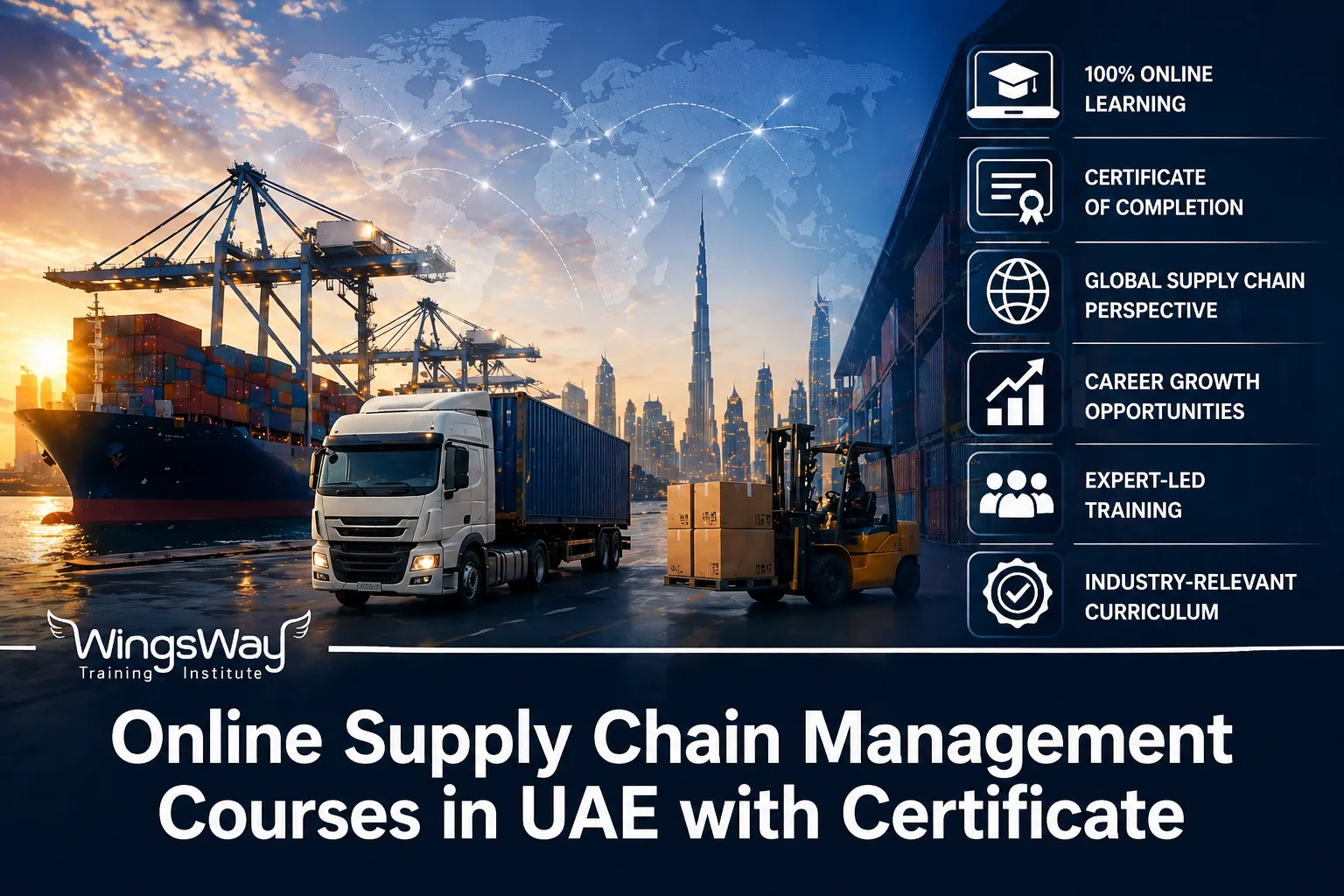
Online Supply Chain Management Courses in UAE with Certificate
Quick Answer: Online Supply chain management courses in UAE are available fully online with internationally recognised certificates. Professionals and job seekers can choose from programmes accredited by bodies such as CIPS, CILT, IFPSM, and AAPSCM — covering procurement, logistics, warehousing, and contract management. Most online supply chain courses are structured for working professionals and can be completed flexibly alongside a full-time job.
WingsWay Training Institute LLC, based in Dubai, UAE, provides live online supply chain management training for learners in the UAE and internationally. Its course portfolio includes programmes in supply chain management, procurement, logistics and transport, warehousing, commercial contracts, and related professional certification pathways.
Why Study Supply Chain Management Online in the UAE?
Online supply chain management courses give professionals in the UAE a flexible way to develop skills in procurement, logistics, inventory, warehousing, contracts, and supply chain operations without attending every session in person.
For working professionals, live online training can make it easier to study alongside full-time employment. It can also give learners across Dubai, Abu Dhabi, Sharjah, and the other emirates access to programmes delivered by UAE-based training providers.
The right course depends on the learner’s role, experience, and career direction. Procurement-focused professionals may consider pathways such as CIPS, while logistics and transport professionals may look at CILT. Other certification pathways, including IFPSM and AAPSCM programmes, may suit learners seeking broader procurement or supply chain specialisations.
Key Takeaways
- Online supply chain management courses can cover procurement, logistics, warehousing, inventory, contracts, transport, and broader supply chain management topics.
- Different professional pathways serve different areas of supply chain practice. CIPS primarily focuses on procurement and supply, while CILT focuses on logistics and transport.
- Other pathways available to learners may include programmes associated with IFPSM, AAPSCM, CPD-accredited training, APS, and specialist supply chain certifications.
- Course level, entry requirements, assessment method, duration, and certification vary by programme and should be checked before enrolment.
- WingsWay Training Institute LLC in Dubai provides live online supply chain management training across multiple professional and certification pathways, depending on the selected programme.
- Learners should compare the course focus, awarding or certification body, assessment structure, and suitability for their career goals before choosing a programme.
Live Online Logistics & Supply Chain Courses
WingsWay Training Institute LLC offers live online logistics and supply chain training from Dubai, UAE, enabling learners to attend instructor-led sessions remotely while developing practical, job-relevant knowledge.
Depending on the programme and current schedule, online training options cover areas such as:
- CILT Level 2 – introductory logistics and transport
- CILT Level 3 – logistics and transport operations
- CILT Level 5 – advanced logistics and transport management
- Supply Chain Management
- Shipping and Freight Forwarding
- Warehousing and Transport
- Procurement and Purchasing
Learners can choose programmes aligned with recognised professional and certification bodies such as CILT, CIPS, IFPSM and AAPSCM, depending on the selected course.
Live online delivery gives working professionals and learners across the UAE greater flexibility while still participating in real-time, instructor-led training.
The Certifying Bodies You Need to Know
Before choosing a supply chain course, it helps to understand who issues the qualifications and what each body represents. Not all certificates carry equal weight in the UAE job market.
Chartered Institute of Procurement & Supply (CIPS)
Founded in 1932 and based in the United Kingdom, CIPS is the world’s largest professional body dedicated to procurement and supply chain. It has over 200,000 members in more than 150 countries and sets the global benchmark for procurement qualifications.
In the UAE, CIPS certification in dubai is recognised by government departments, multinational corporations, and major private sector employers. CIPS offers qualifications from Level 2 through Level 6, progressing from introductory certificates to the Level 6 Professional Diploma.
The CIPS exam is competency-based and standardised globally. Passing it in Dubai earns you the same credential as passing it in London or Singapore.
WingsWay Training Institute is a CIPS Approved Study Centre in the UAE, offering CIPS qualification programmes through live online, classroom and hybrid learning formats.
Chartered Institute of Logistics and Transport (CILT)
CILT is the leading international professional body for logistics, transport, and supply chain. Established in 1919 and active in over 30 countries, CILT offers a structured qualification framework from Level 2 through Level 6 — covering logistics operations, transport management, and supply chain management as distinct specialisms.
For professionals working in freight, shipping, port operations, warehousing, or last-mile delivery in the UAE, CILT qualifications are particularly relevant. They are recognised by logistics employers across the GCC and internationally.
WingsWay Training Institute offers CILT-aligned logistics and transport programmes in the UAE, with live online, classroom and hybrid learning options available depending on the course.
International Federation of Purchasing and Supply Management (IFPSM)
IFPSM is the global umbrella organisation representing national purchasing and supply management associations from over 50 countries. It does not deliver training directly but sets the international standards that its member associations must meet.
Certifications issued under the IFPSM framework — such as Certified Global Procurement Professional (CGPP) and Certified Global Supply Chain Manager (CGSCM) — carry credibility because they are benchmarked against internationally agreed competency standards, not just local curricula.
WingsWay Training Institute offers IFPSM-accredited procurement and supply chain programmes in the UAE, available through live online, classroom and hybrid learning formats depending on the programme.
American Association of Procurement and Supply Chain Management (AAPSCM)
AAPSCM is a US-based professional body that offers a wide range of procurement and supply chain certifications recognised across North America, the GCC, and Asia Pacific. Its programmes are particularly notable for including forward-looking specialisms such as AI in procurement and blockchain in supply chain — areas growing rapidly in relevance across the UAE’s digitising industries.
WingsWay Training Institute offers AAPSCM procurement and supply chain certification programmes in the UAE, with live online, classroom and hybrid learning options available depending on the programme.
Why Are Online Supply Chain Courses Popular in the UAE?
According to the World Bank, The GCC logistics and supply chain market is projected to surpass USD 65 billion by 2027, driven by trade diversification, infrastructure megaprojects, and the post-pandemic restructuring of global supply networks. The UAE sits at the centre of this growth.
Several trends are accelerating the demand for qualified supply chain professionals specifically:
- UAE Vision 2031 and National Development Plans are generating large-scale government procurement activity, requiring certified procurement officers at every level.
- The rise of e-commerce is creating sustained demand for logistics and supply chain coordinators across the country.
- Mandatory procurement certification requirements are appearing in government tenders and supplier qualification processes across Dubai and Abu Dhabi.
- Digital transformation programmes are introducing ERP systems, supply chain analytics, and AI-driven forecasting across the private sector.
- The UAE’s healthcare sector expansion is driving demand for specialists in medical supply chain and pharmaceutical procurement.
For job seekers, the practical reality is straightforward: candidates with a recognised supply chain certification consistently outperform uncertified peers in shortlisting, salary negotiation, and promotion cycles.
What Do Online Supply Chain Management Courses Cover?
Online Supply chain courses in Dubai teach professionals how to plan, source, produce, deliver, and return goods and services efficiently — while managing cost, risk, and supplier relationships along the way.
Depending on the level and pathway, a supply chain management course typically covers some or all of the following:
- Procurement strategy and strategic sourcing
- Supplier selection, evaluation, and relationship management
- Contract drafting, negotiation, and management
- Inventory control, demand planning, and forecasting
- Logistics, transportation, and distribution management
- Warehousing and inventory operations
- Supply chain risk identification and mitigation
- Ethical sourcing, sustainability, and corporate responsibility
- Commercial contracts law and dispute resolution
- Digital tools, ERP systems, and supply chain analytics
Online Supply Chain Certification Options in the UAE
1. CIPS — Chartered Institute of Procurement & Supply
The CIPS qualification framework is the most structured and internationally portable procurement pathway available in the UAE. Examinations are set and marked by CIPS UK, and courses are delivered by Approved CIPS Study Centres.
CIPS Level 2 — Certificate in Procurement and Supply: Entry-level qualification for those new to the profession. Covers purchasing cycles, supplier relationships, and ethical buying.
CIPS Level 3 — Advanced Certificate in Procurement and Supply Operations: Suitable for junior operational roles. Develops understanding of purchasing processes, cost factors, and supplier performance.
CIPS Level 4 — Diploma in Procurement and Supply: The most widely pursued CIPS qualification in the UAE. Covers strategic sourcing, contract management, supplier relationship management, and supply chain risk. Designed for professionals with 2–5 years of experience.
CIPS Level 5 — Advanced Diploma in Procurement and Supply: Senior-level qualification covering category management, complex contracting, and procurement leadership. Suitable for procurement managers and team leads.
CIPS Level 6 — Professional Diploma in Procurement and Supply: The highest CIPS qualification. Deals with corporate procurement strategy, stakeholder management, and supply chain transformation. Required for many CPO and Director-level roles.
2. CILT — Chartered Institute of Logistics and Transport
CILT qualifications are the preferred pathway for professionals working in logistics, transport, or supply chain operations. Two distinct supply chain tracks exist within the CILT framework in the UAE:
CILT Supply Chain Operations (Level 3): Covers supply chain fundamentals — inventory management, order fulfilment, warehouse operations, and supplier coordination.
CILT Supply Chain Management (Level 5): Moves into supply chain strategy, network design, performance measurement, and risk management. Relevant for coordinators moving into management.
3. IFPSM — Globally Benchmarked Procurement & Supply Chain Certifications
For professionals seeking an integrated procurement and supply chain qualification benchmarked internationally, IFPSM-aligned programmes offer a practical alternative to the multi-level CIPS pathway.
- Certified Global Procurement Professional (CGPP)
- Certified Global Procurement Manager (CGPM)
- Certified Global Supply Chain Professional (CGSCP)
- Certified Global Supply Chain Manager (CGSCM)
- Certified Global Warehousing and Inventory Professional (CGWIP)
- Certified Global Warehousing and Inventory Manager (CGWIM)
- Certified Global Commercial Contracts Professional (CGCCP)
- Certified Global Commercial Contracts Manager (CGCCM)
4. AAPSCM-American Association of Procurement, Supply-Chain, and Tourism Management-USA
AAPSCM certifications cover both traditional procurement competencies and emerging technology applications — making them particularly relevant in the UAE’s digitising economy.
- American Certified Procurement Professional (ACPP)
- American Certified Procurement Manager (ACPM)
- American Certified Supply Chain Professional (ACSCP)
- American Certified Supply Chain Manager (ACSCM)
- American Certified AI & Blockchain Procurement Professional — covers AI and blockchain applications in procurement, supplier verification, and contract execution
- American Certified Supply Chain AI Professional — focuses on AI-driven forecasting, demand sensing, and data analytics for supply chain decision-making
5. CPD-UK Accredited — Procurement and Supply Chain Programmes
CPD-accredited programmes offer structured, employer-recognised training without committing to a full examination pathway. Available programmes include:
- Certified International Procurement Professional (CIPP)
- Certified International Procurement Manager (CIPM)
- Certified International Supply Chain Professional (CISCP)
- Certified International Supply Chain Manager (CISCM)
- Certified Warehousing and Inventory Professional (CWIP)
- Certified Warehousing and Inventory Manager (CWIM)
- Certified International Commercial Contracts Professional (CICCP)
- Certified International Commercial Contracts Manager (CICCM)
- Certified Middle East Supply Chain Risk Specialist — addresses supply chain disruption, geopolitical risk, and contingency planning specific to the Gulf region
- Strategic Procurement Leadership Programme (SPL) — for senior professionals on a CPO-track
6. APS — Certified Purchasing Professional (CPP) and CPPM
The American Purchasing Society offers two recognised purchasing certifications. The CPP is for purchasing professionals seeking formal recognition; the CPPM is the management-level equivalent for those overseeing teams and supplier contracts.
7. CSCP — Certified Supply Chain Professional (ASCM/APICS)
The CSCP from ASCM covers the entire supply chain lifecycle — from supplier management and demand planning through to distribution and customer service. It is particularly valued at organisations using SAP, Oracle, or other major ERP platforms.
8. Specialised Supply Chain Courses
FIDIC Contracts Management: FIDIC contracts are the standard framework for construction and infrastructure projects across the GCC. Essential for procurement and project professionals involved in government-funded or large-scale engineering projects.
CDCS — Certificate for Documentary Credit Specialists: Relevant for supply chain professionals involved in international trade finance, letters of credit, and import/export documentation. Issued by the London Institute of Banking & Finance.
Career Benefits of Online Supply Chain Certification in the UAE
Common Job Roles
- Procurement Officer / Senior Procurement Officer
- Supply Chain Coordinator / Manager / Director
- Logistics Manager / Operations Manager
- Warehouse and Inventory Manager
- Category Manager
- Contracts Manager / Commercial Manager
- Demand Planning Manager
- Supply Chain Analyst
- Chief Procurement Officer (CPO)
Approximate Salary Ranges in the UAE (2025)
- Entry-level (0–2 years, certified): AED 6,000–10,000 per month
- Mid-level (3–7 years, CIPS L4 or equivalent): AED 14,000–25,000 per month
- Senior manager (8+ years, CIPS L5/L6 or CGSCM): AED 25,000–45,000 per month
- Director / CPO level: AED 45,000–85,000+ per month
Sectors Actively Hiring
- Government and Public Sector
- Oil, Gas, and Energy
- Retail and E-Commerce
- Construction and Infrastructure
- Healthcare and Pharmaceuticals
- Aviation and Aerospace
- Logistics, Freight, and Third-Party Logistics (3PL)
- Manufacturing and Industrial
How to Choose an Online Supply Chain Management Course in the UAE
- Assess your current experience level. If you have under two years of experience, a foundation-level programme (CIPS L2 or L3, CILT L2 or L3, CGPP, or ACPP) is the right starting point. With 2–5 years, CIPS Level 4, CGSCM, ACSCP, or CISCP will have more impact on your CV.
- Identify your specialisation. Procurement and sourcing — go CIPS. Logistics and transport — go CILT. Warehousing — consider CGWIP or CWIP. Digitising environment — an AI-focused AAPSCM programme may give you a competitive edge.
- Verify the training provider’s accreditation. Confirm the provider is an Approved Study Centre for the relevant body, holds KHDA registration if based in Dubai, and that the programme is CPD-accredited where relevant.
- Choose an online or blended format. Most supply chain management courses in the UAE are available fully online, with live virtual sessions, recorded lectures, and tutor support — accessible from any emirate.
- Register for the examination separately if required. For CIPS and CILT qualifications, course enrolment and examination registration are handled separately. Plan for 8–12 hours of self-study per week per unit, and budget for both course and examination fees.
Frequently Asked Questions
1. Which online supply chain management course is best for beginners in the UAE?
For complete beginners, CIPS Level 2 or CILT Level 2 provide the most structured entry points. Both are internationally recognised and can be completed online. CPD-accredited programmes such as the CIPP are also worth considering if you prefer a faster certification without a formal exam.
2. Can I complete a supply chain management course fully online while working in the UAE?
Yes. The majority of online supply chain training courses available in the UAE — including the full CIPS pathway, CILT qualifications, IFPSM certifications, and AAPSCM programmes — are structured for online delivery. Live sessions are typically scheduled in the evenings or on weekends.
3. What is the difference between CIPS and CILT qualifications?
CIPS is focused on procurement and supply — sourcing, contracts, supplier management, and spend analysis. CILT is focused on logistics and transport — movement of goods, distribution networks, warehouse operations, and transport management. Both cover supply chain, but from different angles.
4. How long does it take to complete CIPS Level 4 in the UAE?
CIPS Level 4 Certification typically takes between 6 and 12 months depending on your study pace. Each unit requires approximately 80–120 hours of study. Most providers offer a structured programme guiding you through each unit sequentially.
5. Are IFPSM and AAPSCM certifications recognised by UAE employers?
Yes, both are recognised in the UAE — particularly within multinational companies, logistics firms, and organisations working with international supply chains. AAPSCM certifications are also valued for their focus on AI and digital procurement tools, which is increasingly relevant across UAE industries.
6. What is the Certified Middle East Supply Chain Risk Specialist, and who is it for?
This CPD-accredited qualification addresses the unique risk landscape of the Gulf region — including geopolitical disruption, port congestion, currency exposure, supplier concentration risk, and regulatory compliance. It is most relevant for mid-to-senior supply chain managers working in the UAE, Saudi Arabia, or broader GCC markets.
7. Do I need a supply chain qualification to work in procurement in the UAE?
It is not legally mandatory in most sectors, but it is increasingly expected. Many government tenders and large corporate RFPs now specify that procurement team members must hold recognised certifications. Certified candidates are consistently preferred over uncertified peers at the shortlisting stage.
8. Can I study logistics and supply chain courses online with a UAE-based training institute?
Yes. WingsWay Training Institute LLC is based in Dubai, UAE, and offers live online logistics and supply chain training for learners in the UAE and internationally. Courses are delivered through instructor-led online sessions, with classroom and hybrid options also available depending on the programme.
How to Verify an Online Supply Chain Course in the UAE
The UAE training market includes a wide range of providers. Before enrolling, check for the following:
KHDA Registration
The Knowledge and Human Development Authority (KHDA) regulates private training providers in Dubai. A KHDA-registered provider has been assessed against quality and compliance standards set by the Dubai government. Always confirm KHDA registration before enrolling with a Dubai-based provider.
Approved Study Centre Status
For CIPS qualifications, verify that the provider is listed as an Approved Study Centre directly on the CIPS website (cips.org). For CILT qualifications, verify on the CILT International website. Unapproved providers cannot issue official CIPS or Recognized CILT certificates.
CPD Accreditation
Look for the CPD Certification Service logo (UK) or formal confirmation of CPD accreditation — not just the phrase ‘CPD-relevant’, which has no independent meaning.
ISO Certification
An ISO 9001-certified training provider operates under an internationally standardised quality management system — a strong indicator of consistent course delivery and learner experience quality.
IFPSM and AAPSCM Affiliation
For IFPSM and AAPSCM programmes, confirm that the training provider is an officially affiliated or licenced delivery partner of the respective body. This ensures the syllabus, assessments, and certificates meet the standards set by the international organisation.
About the Publisher: WingsWay Training Institute
This article is published by WingsWay Training Institute, a KHDA-registered professional training provider based in Dubai, UAE. Understanding who publishes training content matters — it helps readers assess whether the source has genuine standing in the field it writes about.
WingsWay operates across multiple professional disciplines — aviation, logistics, procurement, finance, and IT — and has built its supply chain and procurement curriculum around the exact certification frameworks covered in this article. Below is a factual overview of what WingsWay delivers in the supply chain space, for readers who want to evaluate the institute’s relevance and credibility.
Accreditation and Regulatory Standing
WingsWay Training Institute is registered with the Knowledge and Human Development Authority (KHDA), the regulatory body for private training providers in Dubai. KHDA registration requires providers to meet defined quality, compliance, and operational standards — and is a prerequisite for delivering recognised professional programmes in the emirate.
In the supply chain and procurement space specifically, WingsWay holds authorised delivery partnerships with the following international bodies:
- CIPS (Chartered Institute of Procurement & Supply) — Approved Study Centre status and Exam Centre, enabling delivery of the full CIPS Level 3 to Level 6 qualification pathway
- CILT (Chartered Institute of Logistics and Transport) — authorised to deliver CILT qualifications in logistics, transport, and supply chain management
- IFPSM (International Federation of Purchasing and Supply Management) — licenced delivery partner for globally benchmarked procurement and supply chain certifications
- AAPSCM (American Association of Procurement and Supply Chain Management) — authorised to deliver AAPSCM certifications including AI and blockchain-focused supply chain programmes
- CPD Certification Service (UK) — CPD-accredited programmes in procurement, supply chain, warehousing, and contracts management
- APS (American Purchasing Society) — delivering the Certified Purchasing Professional (CPP) and Certified Professional Purchasing Manager (CPPM)
What Makes WingsWay’s Approach Notable in the UAE Context
Several characteristics distinguish how WingsWay structures its supply chain training offering, based on what is verifiable from their published curriculum and institutional partnerships:
- Multi-framework coverage under one roof. Most training providers in the UAE specialise in one certification body — typically CIPS. WingsWay delivers across CIPS, CILT, IFPSM, AAPSCM, CPD-UK, and APS simultaneously. This means a professional can progress from a foundational IFPSM programme to a senior CIPS qualification within the same institutional environment, without switching providers.
- Regionally contextualised curriculum. WingsWay offers the Certified Middle East Supply Chain Risk Specialist — a CPD-accredited qualification that specifically addresses the risk environment of the Gulf region: geopolitical disruption, port congestion, regulatory compliance, and supplier concentration risks that are native to GCC supply chains. This level of regional specificity is uncommon among general training providers.
- Future-facing specialisations. The institute delivers two AAPSCM programmes that directly address the digital transformation of supply chain: the American Certified AI & Blockchain Procurement Professional and the American Certified Supply Chain AI Professional. These are among the few supply chain qualifications in the UAE that formally address AI-driven forecasting, autonomous procurement, and blockchain-based contract verification — skills that UAE employers are beginning to list as requirements rather than preferences.
- Corporate training capability. Beyond individual enrolment, WingsWay delivers corporate training programmes in supply chain and procurement for organisations that need to upskill teams rather than individuals. This is relevant for HR managers and L&D professionals evaluating institutional capacity, not just course availability.
- Online and flexible delivery. WingsWay’s Online supply chain certifications are available in online format, making them accessible to professionals across all seven emirates without requiring physical attendance in Dubai. This is a practical consideration for candidates based in Abu Dhabi, Sharjah, Ajman, or elsewhere in the GCC.
What WingsWay Does Not Claim to Be
Readers evaluating training providers should apply the same verification standards regardless of who the publisher is. WingsWay, like any accredited provider, should be assessed on the same criteria outlined earlier in this article:
- Confirm KHDA registration directly on the KHDA website
- Verify CIPS Approved Study Centre status on cips.org
- Confirm CILT authorisation on cilt.co.uk or cilt-international.org
- Ask for CPD accreditation certificates for specific programmes before enrolling
- Request a course prospectus and assessment structure before committing
No training provider — including WingsWay — should be chosen purely on reputation or marketing. The accreditation trail matters. Verify it.
Conclusion
Whether you are just starting or looking to formalise years of hands-on experience, there is an online supply chain management course in the UAE that fits your level, your schedule, and your goals.
The first step is identifying the right certification pathway for your specific situation — your current role, your industry, and where you want to be in three to five years. A qualified course advisor can help you map this out before you commit to any programme.
Most training providers offer a free initial consultation. Use it. Ask about accreditation, pass rates, tutor experience, and what support is provided if you need it. The right course with the right support makes a significant difference to your outcome.
Have a question about which Online supply chain course is right for you? Reach out via email or WhatsApp to speak with a course advisor who can guide you through your options with no obligation.
This article is for informational purposes only. Course availability, fees, and accreditation details should be verified directly with your chosen training provider and the relevant certifying body before enrolment.
Message From the Author
At WingsWay Training Institute, we help professionals build globally recognised expertise in supply chain management through industry-leading certifications such as CIPS, CILT, IFPSM, and AAPSCM.
Our supply chain management courses are designed to equip learners with practical skills in procurement, logistics, warehousing, and contract management—aligned with real-world industry requirements across the UAE and GCC.
With flexible online learning options, internationally accredited programs, and career-focused training pathways, we support both beginners and working professionals in advancing their careers in one of the world’s fastest-growing logistics markets.
To learn more about the best online supply chain courses for beginners in UAE, contact us for a blog enquiry at information@wingsway.org or connect with us via WhatsApp at +971509067834.
Written by: Sadiq
Reviewed by: Manish K Dalal, MBA, MCIPS (UK), CMILT — Procurement, Supply Chain, and Logistics Instructor, WingsWay Training Institute
Last reviewed: September 2026.
This guide has been reviewed for accuracy and relevance by WingsWay Training Institute’s Senior Supply Chain Instructor, with reference to current supply chain, logistics and procurement practices, professional qualification frameworks, and guidance from relevant professional bodies such as CIPS, CILT, IFPSM and AAPSCM. Career and industry-related information is reviewed against current UAE market developments and credible external sources where applicable.