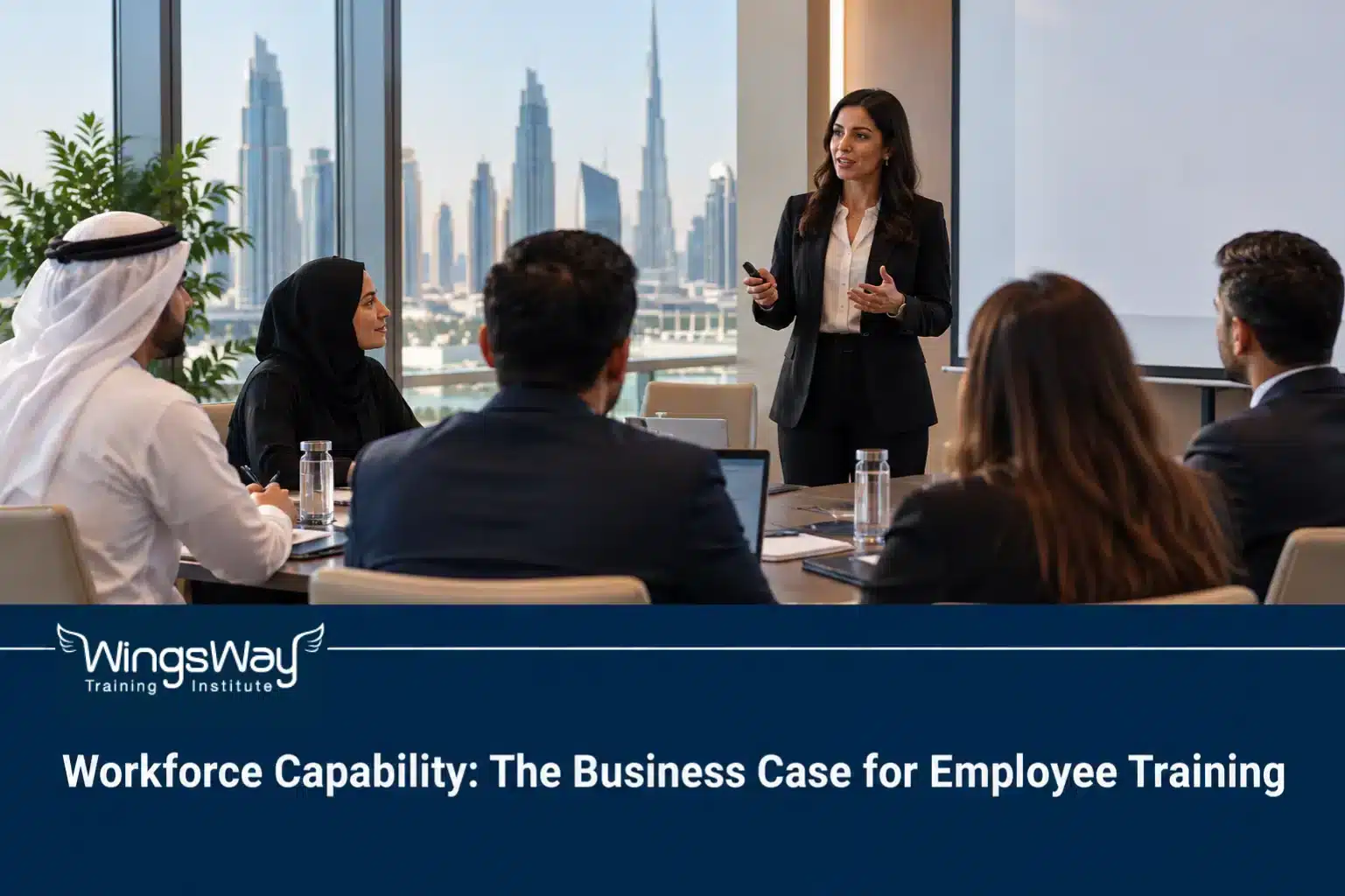
Workforce Capability: The Business Case for Employee Training
Quick Answer: Workforce capability is an organisation’s ability to ensure employees have the skills, knowledge and behaviours needed to meet business requirements. Employee training, upskilling and reskilling can help close genuine capability gaps, improve performance and support changing organisational priorities when learning is the right intervention.
Introduction
Organisations today are navigating a business environment where the expectations placed on their workforce are changing rapidly. Technology is transforming how work gets done, customer expectations are evolving, regulatory requirements are becoming more complex, and businesses are under constant pressure to improve productivity, efficiency, and performance.
Across the UAE, GCC, and Africa, these changes are creating new demands on employees at every level. Leaders must manage increasingly complex business environments, managers must guide teams through transformation, and employees must continuously adapt their skills to meet changing operational requirements.
Yet, while organisations invest in new technologies, processes, and growth strategies, one critical question is often overlooked:
Does our workforce have the capabilities required to deliver what our business expects?
This is where workforce capability becomes a strategic priority.
Workforce capability goes beyond the qualifications employees hold or the experience they bring to their roles. It reflects their collective ability to apply the right knowledge, skills, behaviours, and judgement to achieve organisational objectives.
When these capabilities do not keep pace with business requirements, the consequences can appear in several ways: declining productivity, operational inefficiencies, inconsistent customer experiences, difficulty adopting new technologies, and an inability to execute strategic initiatives effectively.
Building workforce capability, therefore, requires more than hiring qualified people or conducting occasional training programmes. It calls for a structured approach to understanding current and future skill requirements, identifying genuine capability gaps, and investing in development that supports measurable business outcomes.
Corporate training and learning and development (L&D) play an important role in this process. When designed around organisational needs, employee training, workforce upskilling, and reskilling can help businesses strengthen existing capabilities, prepare employees for evolving responsibilities, and build the adaptability needed for long-term performance.
For decision-makers, the question is no longer simply “What training should we provide our employees?” It is “What capabilities does our organisation need to succeed, and how do we build them?”
This article explores why workforce capability has become a leadership priority, the business implications of capability gaps, and how organisations can approach employee development as a strategic investment rather than a standalone HR activity.
Why Workforce Capability Has Become a Leadership Priority
For many organisations, the traditional question was straightforward: “What training courses should we run this year?”
Today, that question is too narrow.
The more useful leadership question is: “What capabilities will our organisation need to execute its strategy, and where are the gaps?”
That shift matters because the environment in which organisations operate is changing quickly.
The World Economic Forum’s Future of Jobs Report 2025 found that employers expect 39% of workers’ existing skill sets to be transformed or become outdated between 2025 and 2030.
Skills gaps were identified by 63% of surveyed employers as a major barrier to business transformation, and 85% expect to prioritise workforce upskilling.
The regional picture is particularly relevant for organisations in the UAE and wider GCC. Employers headquartered in the Middle East and North Africa expect 46% of on-the-job skills to change by 2030, compared with 39% globally.
This does not mean every employee needs the same programme or that every organisation needs more classroom training. It means workforce capability needs to be treated as an active management issue.
The same principle applies across Africa, although the context is diverse.
The International Labour Organization’s 2026 regional research for Africa highlights how digital and green transitions are reshaping skills demand, while access to quality learning that leads to recognised skills and qualifications remains uneven.
The ILO also notes that employers increasingly need rounded skills profiles that combine technical, cognitive, and socio-emotional capabilities.
The implication for leaders is clear: workforce capability development should not begin with a catalogue of courses. It should begin with business requirements, current capability, future capability, and evidence of a gap.
What is Workforce Capability?
Workforce capability is an organisation’s collective ability to apply the knowledge, skills, behaviours, judgement, and role-specific competence required to achieve business objectives consistently.
It is broader than individual qualifications.
A workforce may contain highly qualified employees and still have capability gaps if people cannot apply what they know in the organisation’s real operating environment.
For example, a company may invest in a new CRM system, but employees continue tracking customers in Excel. The technology is available, yet the team lacks the practical skills or work habits to use it consistently.
Building workforce capability means enabling employees to apply the system effectively in their daily work.
A useful way to think about workforce capability is as the point where four questions meet:
- What does the business need people to do?
- What can people currently do?
- What will they need to do differently in the future?
- What prevents consistent performance today?
Corporate training becomes strategically valuable when the answer to one or more of these questions reveals a genuine knowledge, skill or behaviour gap that learning can address.
Workforce capability is, therefore, not simply about what employees know. It is about what they can consistently do, how effectively they apply their knowledge, and whether their collective abilities support the organisation’s goals.
Why Workforce Capability Gaps Become Business Problems
A skills gap is rarely visible on a financial statement as a “skills gap”.
It appears through operational consequences.
A procurement team may struggle to negotiate value. A sales team may be unable to qualify complex opportunities. Managers may avoid difficult performance conversations. Analysts may spend hours manually preparing reports that could be automated.
New systems may be underused because employees have not developed the confidence or workflow knowledge to use them effectively.
The business problem, therefore, comes first. Training is one possible intervention.
A workforce capability gap can affect:
- Productivity and cycle time
- Quality and error rates
- Customer experience and service consistency
- Sales execution and commercial performance
- Compliance and operational risk
- Technology adoption
- Leadership consistency and employee experience
- Succession and internal mobility
- The ability to execute transformation initiatives
This is why workforce capability becomes relevant to business leaders, not only HR.
Consider a procurement team that negotiates the lowest supplier price but overlooks delivery reliability and payment terms. The organisation may save money initially but incur additional costs later. Developing negotiation and supplier-evaluation capabilities can help employees make more informed commercial decisions.
The performance consequences sit inside operations, finance, customer service, sales, procurement, technology and every other function where strategy depends on people doing something well.
Learning and development becomes a business priority when the capability of employees directly influences the organisation’s ability to perform.
What is Changing Across the UAE, GCC and African Workplaces?
1. Technology is changing the content of work
AI, automation, digital platforms, and data tools are changing tasks within existing jobs as well as creating new ones.
The World Economic Forum identifies AI and big data, networks and cybersecurity, and technology literacy among the fastest-growing skill areas through 2030.
At the same time, analytical thinking, resilience, flexibility, leadership and social influence remain important core capabilities.
For leaders, the practical issue is not simply whether employees know that AI exists. It is whether teams can use new tools appropriately, verify outputs, protect data, redesign workflows, and make better decisions.
Organisations, therefore, need to develop both technical and human capabilities to ensure that technology investments translate into operational value.
Technology investment without workforce capability can leave organisations with expensive tools that are inconsistently adopted.
2. Middle East employees are already learning and adopting AI rapidly
PwC’s Middle East Workforce Hopes and Fears Survey 2025 , based on 1,286 employees across the region, found that 75% of respondents had used AI in their jobs during the previous 12 months.
It also found that 69% had learned new skills during the previous year and 81% would prefer a job that offers opportunities to build transferable skills.
These results should not be interpreted as proof that every Middle East workforce is equally AI-ready.
They do, however, indicate that learning, skills relevance and technology adoption are already part of the employee experience.
For organisations, the challenge is to convert that momentum into workforce capability aligned with business priorities, governance and role requirements.
3. Africa’s workforce development challenge is both economic and organisational
The ILO’s 2026 Africa brief frames lifelong learning and skills development as important for resilience, innovation, decent work and inclusion.
It also highlights unequal access to quality learning and the need for learning systems that respond to local realities.
For organisations operating across African markets, this makes context especially important.
A regional workforce capability strategy may need common standards, but the delivery model, language, infrastructure, qualification pathways and practical examples may need to vary significantly by country, workforce segment and operating environment.
4. Learning needs are becoming more continuous
CIPD describes effective learning needs analysis as a systematic and ongoing process that connects learning and development needs to performance gaps and internal and external organisational drivers.
It cautions against treating the process as a rigid annual exercise.
This does not make annual corporate training plans obsolete.
It means annual planning should create a strategic baseline, while quarterly reviews, operational data and emerging requirements keep the plan current.
For organisations, workforce capability development is increasingly an ongoing responsibility rather than an activity confined to an annual training calendar.
The Cost of Workforce Capability Gaps
The cost of inadequate workforce capability is not limited to the price of mistakes.
It can include delayed decisions, repeated rework, underused technology, dependency on a small number of experts, weak management practices, inconsistent customer service, avoidable compliance exposure, and slower execution of strategic initiatives.
However, decision-makers should be cautious about generic claims that employee training automatically produces a specific percentage increase in productivity or profit.
Training outcomes depend on the quality of the diagnosis, the design of the intervention, the relevance of the content, learners’ opportunities to practise, manager reinforcement, the work environment, and the metrics being measured.
A stronger business case asks a more disciplined question:
What performance, risk or workforce capability issue are we trying to change, and what evidence would show that the intervention worked?
Training is Not Always the Answer to a Workforce Capability Problem
One of the most important principles in corporate learning is that not every performance gap is a training need.
Organisations lose time and money when they use training to compensate for a problem caused by something else.
Consider a customer service team with long response times.
Possible causes might include:
- Employees do not know the required process.
- Employees know the process, but the system is slow.
- Roles and escalation rules are unclear.
- Staffing levels do not match demand.
- Managers reinforce conflicting priorities.
- Employees lack the communication skills needed for complex cases.
Only some of these causes are primarily training issues.
If the system itself is slow, a communication workshop will not solve the bottleneck.
If the team lacks a defined escalation process, process design may be needed before training.
If the issue is skill, knowledge, or judgement, targeted employee training may be appropriate.
This distinction is central to a credible L&D strategy.
Learning should be recommended when it is likely to change the required behaviour or capability, not simply because a course exists.
Effective workforce capability development may therefore involve a combination of training, process improvements, coaching, management support and technology changes.
When Does Employee Training Become a Strategic Investment?
Corporate training is most defensible as an investment when it is linked to a clearly defined business or workforce requirement.
Common situations include:
- New strategy or operating model: Teams need new commercial, leadership, operational or technical capabilities to execute a change in direction.
- Technology adoption: Employees must use new platforms, AI tools, systems or data practices safely and effectively.
- Regulatory or compliance requirements: The organisation needs employees to understand and apply mandatory standards, policies or controls.
- Performance gaps: Evidence shows a gap in skill, knowledge or behaviour that is affecting operational results.
- Growth and scale: Managers, supervisors and specialist teams require stronger capability as the organisation expands.
- Succession and internal mobility: Employees need development pathways that prepare them for broader or more senior responsibilities.
- Customer and market change: Teams need new service, communication, commercial or technical capability as customer expectations evolve.
- Future skills: The organisation needs to build workforce capability before a skill becomes an urgent shortage.
In each situation, the purpose of employee training should be clearly defined.
The question is not simply whether employees would benefit from learning something new, but whether developing that capability will support a meaningful organisational requirement.
Corporate Training Should Connect Learning to Application
A well-designed programme is not complete when the final session ends.
The business value of learning depends on whether employees can apply what they have learned in their roles.
Imagine a customer service team completes communication training and receives excellent assessment scores. However, employees return to their previous habits after the training because their managers did not reinforce the new techniques.
This illustrates why training effectiveness depends on practical application, follow-up, and management support, not simply programme completion.
For this reason, an effective corporate learning approach should consider the full cycle:
- Define the business outcome or workforce capability requirement.
- Diagnose the current capability gap.
- Identify who needs development and at what level.
- Choose the right learning method.
- Build practice around real work.
- Assess learning or competence.
- Support application after training.
- Measure relevant changes over time.
CIPD similarly emphasises that workplace learning methods should support individuals, teams and organisations in building skills and capability that drive performance.
The aim is not merely to improve employees’ knowledge at the point of assessment. It is to strengthen their ability to perform relevant tasks consistently in their actual working environment.
Training creates greater business value when learning transfer and application are designed into the programme from the beginning.
Upskilling, Reskilling and Employee Development are Not the Same Thing
Different workforce capability requirements call for different approaches to learning.
| Term | Purpose | Example |
|---|---|---|
| Upskilling | Deepen or extend capability for a current or evolving role. | A procurement specialist develops advanced negotiation and data-analysis skills. |
| Reskilling | Build capability for substantially different work or a new role. | An employee moves from manual reporting into a business-intelligence role. |
| Employee development | Broader growth that may include current-role, future-role and career capability. | A high-potential manager develops coaching, financial and strategic decision-making capability. |
| Compliance training | Build knowledge and behaviour required to meet a policy, legal or control requirement. | Employees learn required data-protection or safety practices. |
Understanding the difference helps leaders choose the right intervention and the right measurement.
A reskilling programme should not be evaluated in exactly the same way as mandatory compliance training or a leadership development programme.
An effective workforce capability strategy recognises these differences and aligns each learning intervention with its intended purpose.
What Decision-Makers Should Ask Before Approving Training
Before committing to a corporate training programme, leaders should ask:
- What business outcome, operational requirement or risk is driving this request?
- What should employees be able to do differently after the intervention?
- What evidence shows that the current gap is caused by skill, knowledge, or behaviour?
- Who genuinely needs the training, and at what proficiency level?
- What happens if the organisation does nothing?
- Is training the primary solution, or do process, technology, staffing, or management changes also need to happen?
- How will employees practise the capability in their real work?
- What support is required from managers after the programme?
- What metric can be observed before and after the intervention?
- Does the requirement need external accreditation, internal customisation, or both?
These questions move the conversation from “Which course should we buy?” to “What capability does the organisation need?”
That is the foundation of a more mature L&D strategy.
How Should Organisations Build Business Cases for Workforce Capability Development?
A practical business case does not need to predict an unrealistic return for every training programme.
It needs to show why workforce capability matters, what the organisation is trying to change and how progress will be evaluated.
A useful structure is:
- Business requirement: Describe the strategic, operational, regulatory or customer requirement.
- Current-state evidence: Show the gap using performance data, assessments, audit findings, manager input or another credible source.
- Required capability: Define the knowledge, skill, behaviour or judgement employees need.
- Intervention: Explain why training is appropriate and what other changes may be required.
- Target population: Identify who needs development and why.
- Application plan: Explain how learning will be practised and reinforced.
- Measures: Define the indicators that will show whether capability or performance improved.
- Cost and risk: Set out programme costs and the consequences of not addressing the gap.
This approach allows organisations to evaluate learning as an investment in workforce capability rather than treating training simply as an expenditure.
What Should Be Measured After Corporate Training?
Measurement should match the reason the training exists.
Useful measures may include:
- Knowledge or assessment scores
- Demonstrated competence
- Manager-observed behaviour
- Quality or error rates
- Time to complete a task
- Customer-service indicators
- Sales or conversion measures where attribution is reasonable
- Compliance findings or audit results
- Adoption of a new process or system
- Internal mobility or readiness for expanded responsibility
Not every programme should be forced into a financial ROI calculation.
Some interventions exist primarily to reduce risk, meet compliance requirements or create future capability.
The discipline is to choose evidence that matches the purpose.
For example, an AI upskilling programme may be evaluated through employees’ ability to use approved tools effectively and safely. A procurement programme may be assessed through demonstrated competence in relevant procurement practices.
The objective is to determine whether the organisation’s workforce capability has meaningfully improved in the areas the intervention was designed to address.
Why Workforce Capability Matters for Leaders in the UAE and GCC
The UAE and GCC are experiencing rapid investment in digital transformation, AI, infrastructure and new economic sectors.
Workforce capability therefore becomes part of execution risk.
The WEF finding that MENA employers expect 46% of on-the-job skills to change by 2030 provides a useful regional indicator of the scale of skill disruption.
PwC’s UAE findings also describe a workforce that is highly engaged with technology while remaining focused on skills relevance, career progression and job security.
For decision-makers, the practical challenge is to build learning systems that are fast enough for change but disciplined enough to remain aligned with organisational priorities.
Building workforce capability requires organisations to look beyond immediate training requests and consider the skills, behaviours and professional competence their teams will need to sustain performance and support future business requirements.
Why Workforce Capability Matters for Organisations Operating in Africa
Africa is not a single labour market, and training strategies should not treat it as one.
The ILO’s regional evidence points to both strong demand for future-oriented skills and major differences in access to quality learning.
For employers, a regional workforce development plan may therefore need to balance consistency with localisation.
Common capability standards can be useful, but delivery may need to account for language, connectivity, regulation, existing qualifications, management maturity and opportunities for work-based practice.
In many contexts, recognised qualifications and practical application can both matter.
An effective workforce capability strategy should therefore reflect the realities of each market, the nature of the organisation’s operations and the specific requirements of its people.
A Practical Leadership Framework: From Business Priority to Workforce Capability
Decision-makers can use the following sequence when considering corporate training:
| Stage | Key question |
|---|---|
| 1. Business priority | What must the organisation achieve? |
| 2. Critical work | What must people do well for that priority to succeed? |
| 3. Capability requirement | What knowledge, skill, behaviour and judgement does that work require? |
| 4. Current state | What can the workforce do today? |
| 5. Gap | Where is the difference material? |
| 6. Cause | Is the gap actually a learning problem? |
| 7. Intervention | What combination of training, practice, process, tools and management support is required? |
| 8. Evidence | What would demonstrate improvement? |
This framework keeps corporate learning connected to execution.
It also helps organisations avoid two common extremes: buying training with no diagnosis and postponing development until capability gaps become urgent operational problems.
Workforce capability development should begin with the business priority and end with evidence of improved capability or performance.
Frequently Asked Questions
Q1: What is workforce capability?
Workforce capability is an organisation’s collective ability to apply the knowledge, skills, behaviours, judgement and professional competence needed to achieve its business objectives. It includes both current capabilities and the ability to develop new ones as organisational requirements evolve.
Q2: Why is workforce capability important for organisations?
Workforce capability is important because business performance depends on what employees can consistently do. Strong workforce capability supports operational efficiency, technology adoption, customer experience, compliance, leadership, and organisational change. When critical capabilities are missing, an organisation may struggle to execute its strategy effectively.
Q3: How can organisations improve workforce capability?
Organisations can improve workforce capability by identifying business requirements, assessing existing skills, diagnosing capability gaps and implementing appropriate interventions. These may include targeted corporate training, workforce upskilling, reskilling, coaching, mentoring, process improvements, and practical learning opportunities. Progress should be measured against relevant capability or performance outcomes.
Q4: What is corporate training?
Corporate training is structured learning provided by or for an organisation to build employee knowledge, skills, behaviours or role-specific competence. It can include technical, professional, leadership, compliance, digital, and business capability development.
Q5: Why is employee training important for organisations?
Employee training is important when a business requirement depends on capabilities that employees do not yet have or cannot apply consistently. Well-targeted training can support performance, technology adoption, compliance, leadership, succession, and organisational change.
Q6: What is the difference between training and learning and development?
Training usually focuses on a defined capability or performance requirement. Learning and development is broader and can include training, coaching, mentoring, career development, work-based learning, leadership development, and other activities that build current and future workforce capability.
Q7: What is workforce upskilling?
Workforce upskilling is the development of additional or more advanced capabilities that help employees perform current or evolving roles more effectively.
Q8: What is reskilling?
Reskilling develops capabilities for substantially different tasks or roles, often where technology, restructuring, or business change is altering the work employees need to perform.
Q9: How do organisations know whether they need training?
Organisations should compare required capability with current capability, investigate the cause of any performance gap, and determine whether knowledge, skill or behaviour is a material part of the problem. A Training Needs Analysis or learning needs analysis can support this process.
Q10: How often should organisations review training needs?
Training needs should be reviewed as part of annual planning and revisited when business priorities, systems, regulation, performance data, or workforce requirements change. Continuous or periodic review is generally more useful than treating learning needs as a once-a-year exercise.
Q11: How can corporate training be measured?
Measures should reflect the purpose of the programme. They can include learning assessments, demonstrated competence, behavioural application, operational KPIs, customer outcomes, compliance results, technology adoption, or other indicators relevant to the original business need.
Q12: Should every corporate training programme be accredited?
No. Accreditation can be important when training relates to hard skills, regulated work, professional progression, or recognised certification. However, many organisation-specific capability needs may be better addressed through customised, non-accredited learning. The right choice depends on the business requirement.
Q13: What should companies look for in a corporate training provider?
When evaluating a corporate training provider, organisations should consider its ability to identify capability gaps, customise learning to business requirements, provide relevant expertise, create opportunities for practical application, and measure whether learning translates into improved performance.
The Leadership Takeaway
The strongest business case for employee training is not that “training is always good”.
It is that organisations need the right workforce capability to execute strategy, manage risk, adopt technology, and perform consistently.
When a material capability gap exists, doing nothing is also a decision, and it can carry operational consequences.
For leaders across the UAE, GCC and Africa, the goal should therefore be to make workforce capability development more selective, more evidence-led and more connected to performance.
Begin with the business requirement. Diagnose the gap. Decide whether learning is the right intervention. Design for application. Measure what matters.
Ultimately, investing in workforce capability means ensuring that people have the knowledge, skills and competence to meet today’s business needs while preparing for tomorrow’s requirements.
Building your organisation’s learning and capability plan?
WingsWay Corporate Excellency works with organisations to identify capability gaps, prioritise learning needs, and design structured training solutions aligned with workforce and business requirements. Write to us at information@wingsway.org and speak with our team to explore a needs-led corporate learning approach for your organisation.
Author & Review Information
Written by: Olivia Gomes
Reviewed by: Tina Dey – Manager – Training Solutions and Client Success, WingsWay Training Institute
Last reviewed: September 2026
This page is reviewed periodically for factual accuracy, including accreditation details and course-recognition criteria, and updated as needed.
This content is for educational and informational purposes only and does not constitute professional, career, or recruitment advice. Readers should verify current course and accreditation details directly with training providers or the relevant professional bodies.