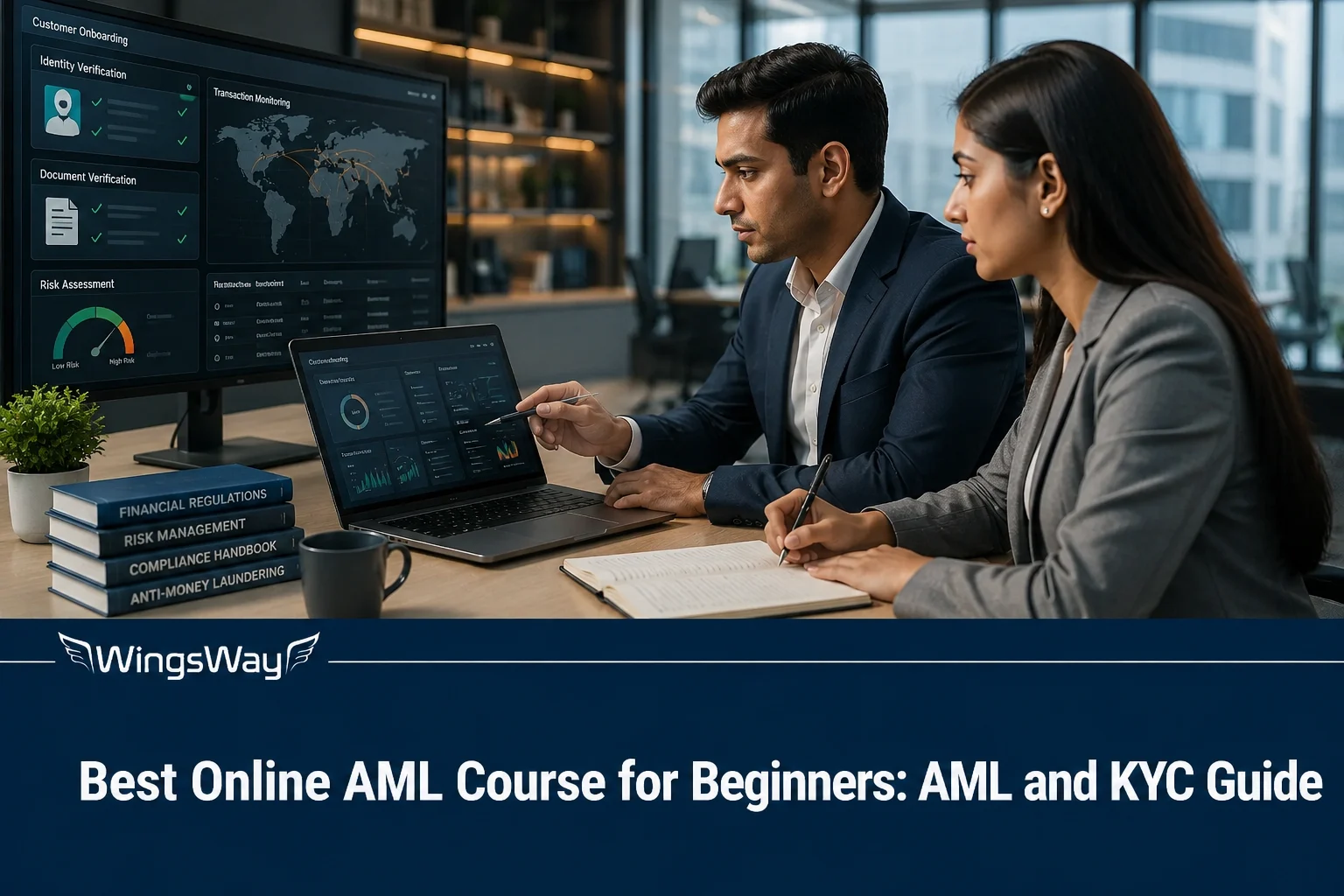
Best Online AML Course for Beginners: AML and KYC Guide
Quick Answer: The best online AML course for beginners combines AML fundamentals, KYC, and customer due diligence in one structured program. For beginners in Dubai, UAE, and the GCC, ACAMS AML Foundations and KYC Foundations certificates, paired with practical training like the AML Course in Dubai, offer the strongest starting point before CAMS.
Anti-money laundering has become one of the fastest-growing compliance fields in Dubai, the UAE, and across the GCC. Financial institutions, exchange houses, and fintech firms now expect new staff to understand AML and KYC from day one.
Choosing the right online AML course can feel confusing when you are new to the field. This guide compares beginner-friendly options, explains core concepts, and shows how to move from foundation training toward CAMS certification.
Whether you are a fresh graduate, a career switcher, or a working professional in Dubai, this article connects course selection to real career outcomes, including entry-level compliance and KYC analyst roles.
Key Takeaways
- An online AML course for beginners should cover AML basics, KYC, CDD, and red flag recognition before advanced topics.
- ACAMS AML Foundations and KYC Foundations certificates are widely recommended as the first step before CAMS.
- Individuals starting out in Dubai and the UAE ought to find courses that address goAML UAE training along with the local AML compliance requirements in the UAE.
- AML training online and classroom training both work, but online formats suit working professionals better.
- CAMS certification in Dubai is a strong next step after foundation-level training, not a starting point for complete beginners.
- Practical AML training online can open entry-level roles such as KYC analyst, junior compliance officer, and AML analyst.
- A KHDA-approved AML course in Dubai adds credibility for UAE and GCC employers.
What Is AML?
Direct Answer: AML (Anti-Money Laundering) is the set of laws, regulations, and controls designed to stop criminals from disguising illegally obtained money as legitimate funds.
- Prevents the placement, layering, and integration of illicit funds
- Requires financial institutions to track and report any activities that appear suspicious.
- Backed by global standards such as the FATF Recommendations
- Enforced in the UAE through federal AML/CFT legislation
AML compliance UAE has grown stricter as regulators align with international standards, making a solid grounding essential for anyone starting a compliance career. To understand the full AML CFT meaning and the career paths it opens, it helps to first master these fundamentals.
What Is KYC?
Direct Answer: KYC (Know Your Customer) is the process banks and regulated businesses use to verify customer identity and assess money laundering risk before and during a business relationship.
- Confirms customer identity using official documents
- Assesses risk level based on the customer profile
- Feeds into ongoing due diligence and transaction monitoring
- Required for banks, exchange houses, and DNFBPs in the UAE
Many beginners search for a KYC course for beginners because KYC skills are used directly in onboarding, account opening, and periodic review roles.
Why Should Beginners Learn AML and KYC Together?
Direct Answer: AML and KYC are taught together because KYC is the practical control that supports the wider AML framework, so understanding both gives beginners a complete compliance picture.
- AML explains the “why”, KYC explains the “how”
- Employers expect entry-level staff to know both areas
- An AML KYC course online avoids gaps between theory and practice
- It creates a faster route into roles that combine onboarding and monitoring
This is why an AML KYC course online, rather than an AML-only or KYC-only program, is usually the better starting point for someone completely new to the field.
Which Online AML Course Is Best for Beginners?
Direct Answer: The best online AML course for beginners starts with foundation-level content, such as ACAMS AML Foundations, and includes practical, instructor-guided training such as the AML Course in Dubai.
- Look for foundation-level content, not exam-only prep
- Choose a course covering AML, KYC, CDD, and red flags
- Prioritize recognized, internationally accepted certification
- Check for UAE-specific compliance context
For anyone asking which online AML course is best for beginners, or searching for the best online AML course for someone new to money laundering, a foundation certificate such as the AML Foundations certificate paired with structured guidance like the AML Course in Dubai tends to build stronger fundamentals than exam-cram courses alone.
What Should a Beginner AML Course Cover?
Direct Answer: A good beginner AML course should cover core AML concepts, red flags, reporting obligations, and an introduction to KYC and due diligence.
- Money laundering stages and typologies
- The regulatory framework and FATF standards
- Customer due diligence basics
- Suspicious activity and transaction reporting
- Sanctions and PEP screening basics
This directly answers what should an AML course include for someone starting from zero: breadth across the full compliance cycle, not just definitions.
What Should a Beginner KYC Course Cover?
Direct Answer: An introductory KYC course ought to include topics such as identity verification, risk categorization, documentation standards, and the fundamentals of ongoing monitoring.
- Customer identification procedures
- Risk-based customer categorization
- Document verification standards
- Periodic review and record-keeping
This is what makes the best KYC course for beginners practical rather than theoretical, since these are the daily tasks in onboarding and KYC analyst roles.
What Is Customer Due Diligence?
Direct Answer: Customer Due Diligence (CDD) is the process of verifying a customer’s identity and understanding the nature of their business to assess money laundering risk.
- Identity verification against official documents
- Understanding the source of funds
- Assessing the purpose of the relationship
- Ongoing monitoring of transactions
CDD applies to every customer, while higher-risk customers move into enhanced due diligence.
What Is Enhanced Due Diligence?
Direct Answer: Enhanced Due Diligence (EDD) is a deeper level of customer due diligence applied to higher-risk customers, such as politically exposed persons or those linked to high-risk jurisdictions.
- Applied to PEPs and other high-risk customers
- Requires additional source-of-wealth checks
- Often needs senior management approval
- Requires more frequent ongoing review
Beginners should understand exactly when standard CDD is not enough and EDD becomes mandatory under UAE and international AML rules.
What Is Transaction Monitoring?
Direct Answer: Transaction monitoring is the ongoing review of customer transactions to detect patterns that may indicate money laundering or terrorist financing.
- Flags unusual transaction size or frequency
- Compares activity against the expected customer profile
- Generates alerts for further investigation
- Feeds into suspicious transaction reporting
goAML UAE training is often introduced at this stage, since UAE-regulated entities must report suspicious transactions through the UAE FIU goAML platform.
What Are AML Red Flags Beginners Should Know?
Direct Answer: AML red flags are warning signs that a transaction or customer relationship may involve money laundering, such as unexplained wealth or unusual transaction patterns.
- Large cash transactions with no clear business reason
- Reluctance to provide identification documents
- Complex ownership structures with no economic purpose
- Transactions inconsistent with the customer’s known profile
Recognizing red flags early is one of the most practical skills gained from AML training online.
Online AML Course vs Classroom AML Training
Direct Answer: Online AML courses offer flexibility for working professionals, while classroom AML training in Dubai adds structured practice, direct mentorship, and networking.
| Course Type | Best For | Flexibility | Career Support |
|---|---|---|---|
| Online AML course | Working professionals, remote learners | High | Self-paced, on-demand |
| Classroom AML training in Dubai | Fresh graduates, job seekers | Moderate | Direct mentor guidance |
| Blended: AML training online + classroom | Beginners wanting both | High | Strongest overall support |
Both formats can lead to the same certifications, so the choice usually comes down to schedule and how much in-person practice a beginner wants alongside AML training online.
How to Choose the Right Online AML Course
Direct Answer: Choosing the right online AML course means checking accreditation, syllabus depth, UAE relevance, and whether it prepares you for further certification such as CAMS.
- Confirm the certification is internationally recognized
- Check if the course covers AML, KYC, CDD, and EDD
- Look for UAE-specific compliance content
- Ask if the provider offers KHDA-approved training
- Confirm the course supports progression toward CAMS certification in Dubai
An AML certification online is only as valuable as the syllabus behind it, so compare curriculum depth before comparing price.
Should Beginners Start with AML Training Before CAMS?
Direct Answer: Yes, most compliance trainers recommend completing foundation-level AML training before attempting CAMS, since the CAMS exam assumes working knowledge of AML and KYC concepts.
- Foundation courses build vocabulary and core concepts
- CAMS exam questions assume prior AML/KYC knowledge
- Foundation training reduces overall study time for CAMS
- A structured course before CAMS for beginners lowers first-attempt failure risk
This is also where the AML Foundations vs KYC Foundations comparison matters: AML Foundations builds the regulatory picture, while KYC Foundations certificate sharpens onboarding and due diligence skills. Completing both before moving to CAMS certification in Dubai is a common and effective sequence.
Interested in This AML Course?
Get the latest course fees, upcoming schedules, eligibility details,
and guidance directly from the WingsWay team.
Is CAMS Suitable for Complete Beginners?
Direct Answer: CAMS is not designed for complete beginners; it is built for professionals who already have foundation-level AML and KYC knowledge.
- CAMS assumes familiarity with AML terminology
- Best attempted after completing foundation certificates
- Suitable for professionals aiming to accelerate their careers
- Beginners without a base often need longer preparation time
This is the direct answer to is CAMS suitable for beginners: treat it as the next step, not the first one. For more detail on exam difficulty and preparation time, see is the ACAMS exam difficult?.
Is an Online AML Course Useful for Jobs?
Direct Answer: Yes, an online AML course can help you qualify for entry-level compliance roles, especially when paired with recognized certification and UAE-specific context.
- Demonstrates verified compliance knowledge to employers
- Directly supports applications for AML course for KYC analyst jobs
- Supports career switching into banking and fintech compliance
- Adds credibility alongside a degree or diploma
Recruiters in Dubai and the wider GCC increasingly shortlist candidates who can show a completed, verifiable AML and KYC certificate.
Entry-Level Jobs After AML or KYC Training
Direct Answer: Common entry-level roles after AML or KYC training include KYC analyst, AML analyst, compliance associate, and onboarding officer.
- KYC Analyst
- AML Analyst / Junior Compliance Officer
- Customer Onboarding Officer
- Transaction Monitoring Analyst
- Sanctions Screening Analyst
These roles sit alongside broader finance courses in Dubai for professionals who want to combine compliance skills with wider financial services knowledge.
AML and KYC Skills Beginners Should Build
Direct Answer: Beginners should build both technical AML and KYC knowledge and practical skills such as documentation review, red flag identification, and reporting.
- Understanding regulatory frameworks
- Document verification and risk rating
- Red flag identification
- Report writing for suspicious transaction reports
- Familiarity with screening and monitoring tools
These are the same skills employers test for at interview stage, so practical exercises during training matter as much as theory.
AML and KYC in UAE: What Beginners Should Know
Direct Answer: The UAE has a strict AML/CFT legal framework, and beginners should understand local compliance requirements alongside international standards such as FATF.
- AML compliance UAE is governed by federal AML/CFT executive regulation and related Cabinet decisions
- Regulated entities must report suspicious transactions through goAML
- KYC training Dubai programs should include DNFBP and financial institution obligations
- Financial crime compliance in UAE aligns with FATF and MENAFATF expectations
Whether you are searching for an AML course in UAE, a KYC course in UAE, or general compliance training in Dubai, make sure the syllabus reflects current UAE legislation, not only global theory.
Common Mistakes Beginners Make When Choosing an AML Course
Direct Answer: Common mistakes include picking exam-only prep courses, skipping KYC fundamentals, and ignoring UAE-specific compliance context.
- Jumping straight to CAMS without foundation training
- Choosing a course with no practical case studies
- Ignoring accreditation or certification recognition
- Overlooking UAE and GCC regulatory context
Avoiding these mistakes early saves both study time and course fees later in the certification journey.
Why Choose WingsWay for AML and KYC Training in Dubai?
Direct Answer: WingsWay Training Institute offers KHDA-approved AML and KYC training in Dubai, designed for beginners, working professionals, and job seekers preparing for a compliance career.
- KHDA-approved training standards for quality assurance
- Internationally recognised certification pathways
- A structured path from foundation knowledge to CAMS-level preparation
- Practical, UAE-focused compliance content
- Flexible online and classroom formats for working professionals
Accreditation matters because it signals that a program meets recognised quality and curriculum standards, not just marketing claims. Our AML Course in Dubai combines this accreditation with practical UAE case studies, and learners who complete it are well positioned to progress toward CAMS certification in Dubai.
Final Verdict: Which Online AML Course Should a Beginner Choose?
Direct Answer: Beginners should choose an online AML course that combines AML and KYC fundamentals with UAE compliance context, then progress toward CAMS once the basics are solid.
- Start with a combined AML and KYC foundation, not CAMS
- Choose a provider with recognised certification and UAE relevance
- Build practical skills in CDD, EDD, and red flag detection
- Progress to CAMS once foundation knowledge is confirmed
For most beginners in Dubai, the UAE, and the GCC, the right online AML course is a foundation-level program backed by practical, locally relevant training such as the AML Course in Dubai, followed by CAMS once the fundamentals are secure.
Online AML Course for Beginners FAQs
Q1: Which online AML course should I take first?
Start with a combined AML KYC course online covering fundamentals, such as AML Foundations or KYC Foundations, before considering CAMS.
Q2: Should I learn AML or KYC first?
There is no strict order. Most beginners learn AML and KYC together, since KYC is a core practical component of the wider AML framework.
Q3: Is CAMS suitable for beginners?
No. CAMS is designed for professionals with prior AML and KYC knowledge, not complete beginners. Foundation-level training should come first.
Q4: What is the best AML course for beginners?
The best AML course for beginners covers AML basics, KYC, CDD, and red flags, ideally paired with practical UAE-focused training such as the AML Course in Dubai.
Q5: What does KYC mean in AML?
KYC (Know Your Customer) is the identity verification and risk assessment process that supports the wider AML framework by confirming who a customer is and what risk they present.
Q6: What is customer due diligence?
Customer due diligence (CDD) is the process of verifying a customer’s identity, understanding their business, and assessing their money laundering risk before and during a relationship.
Q7: What is enhanced due diligence?
Enhanced due diligence (EDD) is a deeper level of due diligence applied to higher-risk customers, such as politically exposed persons, requiring additional checks and approvals.
Q8: Can AML training help me get a job?
Yes. AML training, especially when combined with recognised certification and UAE compliance knowledge, can help you qualify for entry-level roles such as KYC analyst or compliance associate.
Message From the Author
At WingsWay Training Institute, we help learners build practical skills for AML and compliance careers in Dubai and across the GCC.
Our AML and KYC training combines KHDA-approved standards, internationally recognised certification pathways, and flexible learning options designed for working professionals, job seekers, and fresh graduates.
To learn more about our AML Course in Dubai, contact us for a blog enquiry at information@wingsway.org, or connect with us via WhatsApp or call on +971 50 906 3371.
Reviewed by WingsWay Training Institute Admission Team
This guide is based on current AML and KYC training requirements, KHDA training standards, and internationally recognised certification pathways relevant to professionals in Dubai and the UAE.
Need More Details About This Course?
Connect with our team directly on WhatsApp for course details, fees, schedules, and guidance.
Tag:AML compliance UAE, AML course for beginners, AML course in Dubai, AML KYC course online, AML training UAE, CAMS certification Dubai, compliance training Dubai, customer due diligence, enhanced due diligence, financial crime compliance UAE, goAML UAE training, KHDA approved AML course, KYC course for beginners, online AML course, transaction monitoring
You may also like