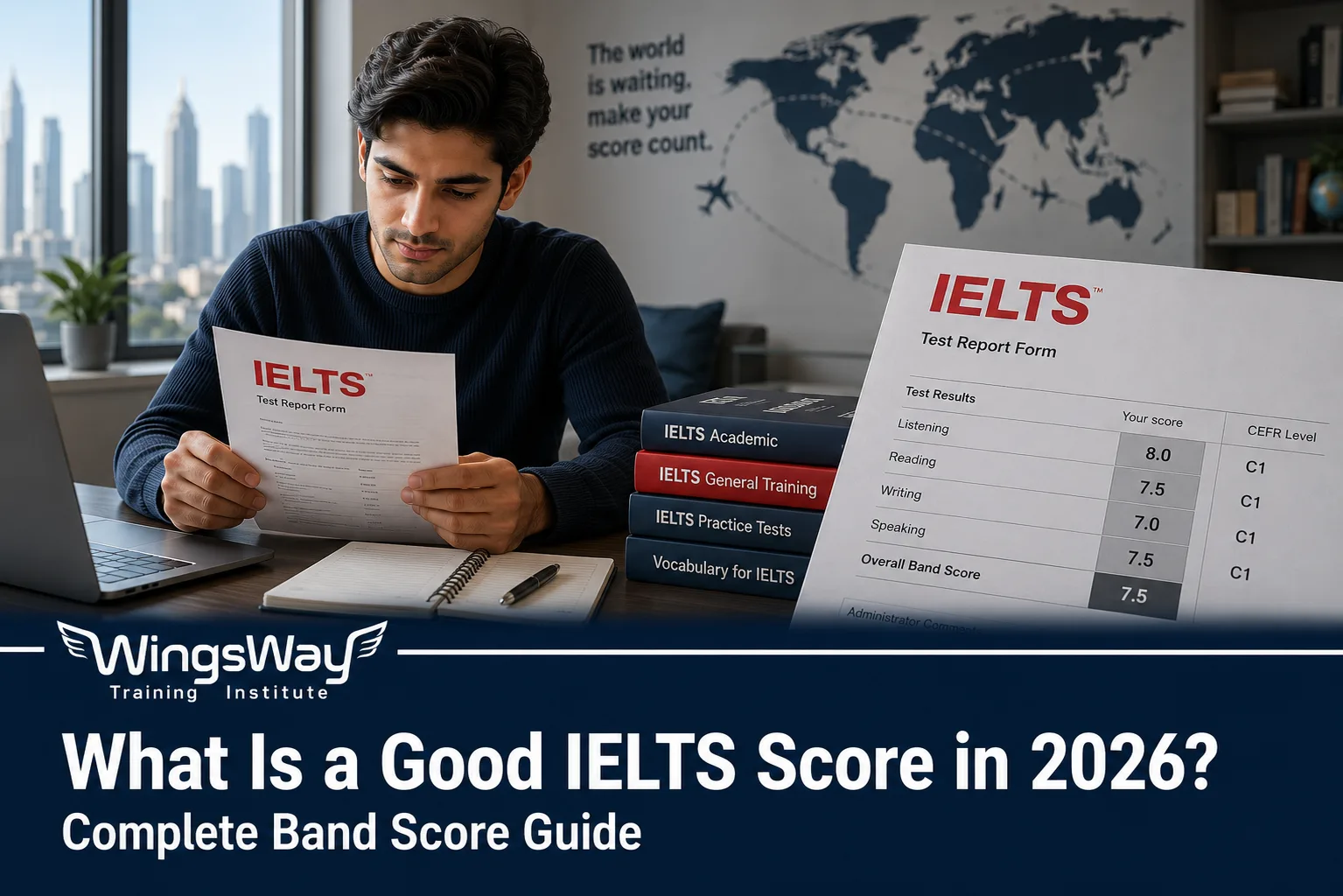
What Is a Good IELTS Score in 2026? Complete Band Score Guide
Quick Answer: A good IELTS score depends on your goal. For university admission, most institutions require an IELTS score of 6.0 to 7.5. For immigration to countries like Canada or Australia, a band of 6.0 to 8.0 is typically needed. For professional work visas, a score between 6.0 and 7.0 is generally considered strong.
Introduction
The IELTS exam is one of the most widely accepted English language tests in the world. Whether you are applying to a university, seeking a work visa, or planning to immigrate, your IELTS score plays a critical role.
In Dubai and across the UAE and GCC, demand for IELTS-qualified professionals continues to grow. Employers, universities, and immigration authorities all rely on IELTS band scores to assess English proficiency.
This guide explains everything you need to know about IELTS scores in 2026 — what each band means, what score you need for different purposes, and how to improve your result with the right preparation.
Key Takeaways
- IELTS scores range from Band 1 to Band 9, with Band 9 being the highest.
- A good IELTS score for university is typically 6.5 or above.
- For immigration to Canada or Australia, most programs require Band 6.0 to 7.0.
- The overall IELTS band score is the average of four skill scores: Listening, Reading, Writing, and Speaking.
- IELTS Academic and IELTS General Training are two separate test types with different purposes.
- Consistent practice and structured coaching significantly improve your band score.
WingsWay Training Institute offers KHDA-approved IELTS preparation courses in Dubai.
What Is an IELTS Band Score?
Direct Answer: An IELTS band score is a numerical rating between 1 and 9 that represents a test taker’s English language proficiency across four skills.
The four skills assessed in IELTS are:
- Listening
- Reading
- Writing
- Speaking
Each skill receives an individual band score. These four scores are averaged to produce the Overall Band Score. Scores are reported in whole and half bands, such as 6.0, 6.5, or 7.0.
What Is a Good IELTS Score in 2026?
Direct Answer: A good IELTS score in 2026 is generally considered to be 6.5 or above for most academic and professional purposes.
Here is a general benchmark for different purposes:
- Band 5.0 – 5.5: Sufficient for some foundation courses or lower-level diplomas
- Band 6.0: Minimum requirement for many undergraduate programmes and skilled migration pathways
- Band 6.5: Widely accepted for postgraduate programmes and professional registration
- Band 7.0+: Required for top-ranked universities, competitive immigration streams, and skilled professions
- Band 8.0+: Exceptional level required for certain medical, legal, and academic roles
The right target IELTS score depends entirely on your specific institution, visa category, or employer requirement.
IELTS Band Score Chart: What Each Band Means
Direct Answer: The IELTS band score chart ranges from Band 1 (non-user) to Band 9 (expert user), with each level representing a defined level of English ability.
| Band Score | Description | User Level |
|---|---|---|
| 9 | Expert user — full command of the language | Expert |
| 8 | Very good user — occasional errors only | Very Good |
| 7 | Good user — handles complex language well | Good |
| 6 | Competent user — mostly effective use | Competent |
| 5 | Modest user — partial command | Modest |
| 4 | Limited user — basic competence | Limited |
| 3 | Extremely limited user | Very Limited |
| 2 | Intermittent user — great difficulty | Intermittent |
| 1 | Non-user — no ability to use the language | Non-User |
Is IELTS Band 6 a Good Score?
Direct Answer: Yes, IELTS Band 6 is a competent score and meets the minimum requirement for many universities, work visas, and immigration programmes.
Band 6 is accepted for:
- Undergraduate admission at many universities in the UK, Australia, and Canada
- Skilled Worker visa categories in several countries
- Professional registration in some fields
- Entry-level positions requiring English language certification
However, Band 6 may not be sufficient for competitive postgraduate programmes or high-skilled immigration streams. Always confirm the exact requirement with your institution or visa authority.
Is IELTS Band 6.5 a Good Score?
Direct Answer: Yes, IELTS Band 6.5 is a strong score that meets the requirements of most postgraduate university programmes and many immigration pathways.
IELTS Band 6.5 is commonly required for:
- Master’s degree programmes at mid-ranked to top universities
- Canada Express Entry and Provincial Nominee Programmes
- Australian Skilled Migration (General Skilled Migration)
- Professional body registration in engineering, nursing, and teaching
- UK Skilled Worker visa in several job categories
For most working professionals and graduates in Dubai and the UAE, Band 6.5 is the most practical and widely accepted target score.
Is IELTS Band 7 a Good Score?
Direct Answer: IELTS Band 7 is an excellent score and is considered a good IELTS score for competitive universities, professional roles, and preferred immigration streams.
Band 7 is required or preferred for:
- Top-ranked universities including Russell Group (UK) and Group of Eight (Australia)
- Highly skilled occupations such as medicine, law, and advanced nursing
- Canada Federal Skilled Worker Programme (higher CRS points)
- Australia Points-Tested Skilled Migration (additional points)
- Academic and research roles in UAE universities
Achieving Band 7 places you in a strong position for competitive applications. It reflects a high level of professional communication ability in English.
Is IELTS Band 8 a Good Score?
Direct Answer: IELTS Band 8 is an exceptional score and demonstrates near-native English proficiency. It is required for a small number of highly specialised roles and programmes.
Band 8 is typically required for:
- Certain medical licensing boards such as the GMC (UK) and AMC (Australia)
- Academic positions including lecturing and research at leading universities
- Legal qualification boards in some jurisdictions
- Senior media, journalism, and editorial roles
Very few programmes require Band 8 or above. If your target requirement is Band 7 or below, focus your preparation energy on that specific score rather than over-preparing.
How Is the IELTS Overall Score Calculated?
Direct Answer: The IELTS overall band score is the average of your four individual skill scores: Listening, Reading, Writing, and Speaking.
Step-by-step calculation:
- Add your scores for Listening, Reading, Writing, and Speaking
- Divide the total by 4
- Round to the nearest whole or half band
Example: Listening 7.0 + Reading 6.5 + Writing 6.0 + Speaking 6.5 = 26.0 divided by 4 = 6.5 Overall Band Score.
Rounding rules: 0.25 rounds down; 0.75 rounds up. For example, an average of 6.25 becomes 6.5, while 6.75 becomes 7.0.
IELTS Listening Band Score Explained
Direct Answer: The IELTS Listening section has 40 questions. Your raw score out of 40 is converted to a band score on the 1-9 scale.
| Raw Score (out of 40) | Band Score |
|---|---|
| 39 – 40 | 9.0 |
| 37 – 38 | 8.5 |
| 35 – 36 | 8.0 |
| 32 – 34 | 7.5 |
| 30 – 31 | 7.0 |
| 26 – 29 | 6.5 |
| 23 – 25 | 6.0 |
| 18 – 22 | 5.5 |
| 16 – 17 | 5.0 |
Listening tests your ability to understand spoken English in academic and everyday settings. Regular practice with a variety of accents is essential for higher bands.
IELTS Reading Band Score Explained
Direct Answer: The IELTS Reading section also has 40 questions. Band scores vary slightly between the Academic and General Training modules.
| Raw Score (out of 40) | Academic Band | General Training Band |
|---|---|---|
| 40 | 9.0 | 9.0 |
| 39 | 9.0 | 8.5 |
| 37 – 38 | 8.5 | 8.0 |
| 35 – 36 | 8.0 | 7.5 |
| 33 – 34 | 7.5 | 7.0 |
| 30 – 32 | 7.0 | 6.5 |
| 27 – 29 | 6.5 | 6.0 |
| 23 – 26 | 6.0 | 5.5 |
Reading tests your ability to understand complex texts. Academic Reading uses excerpts from books and journals, while General Training Reading uses everyday materials such as notices, job advertisements, and letters.
IELTS Writing Band Score Explained
Direct Answer: IELTS Writing is marked on four criteria: Task Achievement, Coherence and Cohesion, Lexical Resource, and Grammatical Range and Accuracy.
Each criterion is weighted equally. To improve your Writing band score:
- Address all parts of the task fully
- Organise your ideas clearly with paragraphs
- Use a range of vocabulary accurately
- Demonstrate varied sentence structures
- Avoid repetition and grammatical errors
Writing is often the most challenging section for test takers. Structured practice with tutor feedback is the most effective way to improve.
IELTS Speaking Band Score Explained
Direct Answer: IELTS Speaking is a face-to-face interview assessed on Fluency and Coherence, Lexical Resource, Grammatical Range and Accuracy, and Pronunciation.
Tips to improve your Speaking band score:
- Speak fluently without long pauses
- Use precise and varied vocabulary
- Give extended answers with reasons and examples
- Practise on a wide range of topics
- Focus on clarity of pronunciation, not native accent
What IELTS Score Do You Need for Study Abroad?
Direct Answer: Most universities require an IELTS score between 6.0 and 7.5 for admission, depending on the programme and institution ranking.
| Country / Institution Type | Typical IELTS Requirement |
|---|---|
| UK Undergraduate (mid-ranked) | 6.0 – 6.5 |
| UK Postgraduate (top-ranked) | 6.5 – 7.0 |
| Australia Undergraduate | 6.0 – 6.5 |
| Australia Postgraduate | 6.5 – 7.0 |
| Canada Undergraduate | 6.0 – 6.5 |
| Canada Postgraduate | 6.5 – 7.0 |
| USA Universities | 6.5 – 8.0 |
| UAE Universities (English medium) | 5.0 – 6.5 |
Always check the specific IELTS requirements of your target university and programme. Requirements may vary by department.
What IELTS Score Do You Need for Immigration?
Direct Answer: Immigration IELTS requirements vary by country and visa category. Most skilled migration programmes require a minimum IELTS score of 6.0 to 7.0.
| Country / Visa Type | Minimum IELTS Score |
|---|---|
| Canada — Express Entry (FSW) | CLB 7 = IELTS 6.0 |
| Canada — Express Entry (CEC) | CLB 7 = IELTS 6.0 |
| Australia — General Skilled Migration | Competent = IELTS 6.0 |
| Australia — Employer Sponsored | Vocational English = IELTS 5.0 |
| UK — Skilled Worker Visa | B1 level = IELTS 4.0+ |
| New Zealand — Skilled Migrant | IELTS 6.5 or equivalent |
| UAE — Residency (professional roles) | Variable by employer |
Higher IELTS scores improve your Comprehensive Ranking System (CRS) score for Canada Express Entry and add points to your Australian Skilled Migration application. A higher IELTS score directly increases your immigration chances.
What IELTS Score Do You Need for Work?
Direct Answer: For work purposes, the required IELTS score depends on the profession and country. Most professional registrations require a minimum of Band 6.0 to 7.0.
Common professional IELTS requirements:
- Nursing (UK NMC): IELTS 7.0 with no section below 6.5
- Medicine (GMC UK): IELTS 7.5 overall with 7.0 in each section
- Teaching (UAE KHDA): IELTS 6.0 to 7.0 depending on level
- Engineering (Engineers Australia): Competent English = IELTS 6.0
- General employment (UAE / GCC): IELTS 5.5 to 7.0 depending on employer
IELTS Academic vs General Training: Does a Good Score Change?
Direct Answer: The band score scale is the same for both IELTS Academic and General Training, but the two tests are used for different purposes.
| Feature | IELTS Academic | IELTS General Training |
|---|---|---|
| Purpose | University admission, professional registration | Immigration, work visas, secondary education |
| Reading Difficulty | Higher — academic texts | Lower — everyday materials |
| Writing Tasks | Graph/chart analysis + essay | Formal letter + essay |
| Speaking & Listening | Same for both | Same for both |
| Who Should Take It | University applicants, doctors, nurses | Immigrants, job seekers, diploma seekers |
| Score Scale | Band 1 to 9 | Band 1 to 9 |
Choosing the wrong test type is a common and costly mistake. Confirm which module — Academic or General Training — is accepted by your target institution or visa authority before you register.
What Is a Good IELTS Score for Beginners?
Direct Answer: For beginners, achieving a Band 5.0 to 6.0 is a realistic first target. With structured preparation, most learners can reach Band 6.5 within 3 to 6 months.
If you are new to IELTS preparation, here is a recommended approach:
- Take a diagnostic mock test to identify your current level
- Set a target score based on your specific goal
- Focus on your weakest skill first
- Practise with official IELTS materials
- Enrol in a structured IELTS preparation course for guided support
How to Improve Your IELTS Band Score
Direct Answer: Consistent, structured preparation is the most effective way to improve your IELTS band score. Each skill requires a different approach.
Listening
- Listen to English podcasts, news, and lectures daily
- Practise with IELTS-specific listening tests
- Focus on understanding different accents
Reading
- Read a variety of English texts including academic articles and news
- Practise skimming and scanning techniques
- Work on time management — 60 minutes for 40 questions
Writing
- Practise both Task 1 and Task 2 regularly
- Get feedback from an experienced IELTS tutor
- Study model answers and analyse their structure
Speaking
- Practise speaking English every day, not just before the test
- Record yourself to identify errors in fluency and pronunciation
- Prepare topic-specific vocabulary for common IELTS themes
Common IELTS Score Mistakes Students Make
Direct Answer: Many students reduce their IELTS band score by making avoidable mistakes during preparation and on test day.
- Not checking which test type — Academic or General Training — is required
- Focusing only on one skill and neglecting the others
- Relying on unverified practice materials from unofficial sources
- Underestimating the Writing section, which is often the lowest score
- Not practising under timed conditions before the test
- Attempting the test without a structured preparation plan
Why Accreditation and Quality Assurance Matter for IELTS Training
Direct Answer: Choosing a KHDA-approved IELTS training institute in Dubai ensures that your preparation meets recognised quality standards and is delivered by qualified instructors.
When selecting an IELTS coaching programme in the UAE, look for:
- KHDA Approval: The Knowledge and Human Development Authority regulates training quality in Dubai
- CPD Accreditation: Continued Professional Development recognition from CPD UK adds credibility to your course
- Qualified Instructors: IELTS trainers with demonstrated teaching qualifications and experience
- Official Materials: Use of British Council or IDP-endorsed IELTS preparation resources
- Proven Results: Track record of students achieving target band scores
In the UAE and GCC, IELTS is commonly required for visa applications, professional licensing, and university admissions. Investing in quality preparation from an approved training provider is essential for achieving your target score.
Why Choose WingsWay for IELTS Training in Dubai?
Direct Answer: WingsWay Training Institute is a KHDA-approved training provider in Dubai offering structured IELTS preparation courses for working professionals, job seekers, and fresh graduates across the UAE and GCC.
What sets WingsWay apart:
- KHDA-approved training programmes in Dubai
- Experienced IELTS trainers with a strong track record
- Flexible learning options including weekday, weekend, and online classes
- Comprehensive coverage of all four IELTS skills
- Regular mock tests with personalised feedback
- Small batch sizes for focused, individual attention
- Courses designed for working professionals in the UAE and GCC
To learn more, visit our IELTS training in Dubai course page for full programme details.
Final Verdict: What Is a Good IELTS Score in 2026?
Direct Answer: A good IELTS score in 2026 depends on your specific goal. Here is a clear, practical summary:
| Purpose | Minimum Score | Recommended Score |
|---|---|---|
| Foundation / Diploma | 5.0 | 5.5 |
| Undergraduate University | 6.0 | 6.5 |
| Postgraduate University | 6.5 | 7.0 |
| Skilled Immigration | 6.0 | 7.0+ |
| Professional Registration | 6.5 | 7.0 |
| Medical / Legal Roles | 7.5 | 8.0 |
| Work Visa (UAE / GCC) | 5.5 – 6.5 | 6.5+ |
Set your target IELTS score based on the specific requirements of your chosen university, employer, or immigration pathway. A structured preparation plan and the right coaching significantly increase your chances of achieving that score.
IELTS Score FAQs
Q1: What is a good IELTS score for most universities?
A good IELTS score for most universities is Band 6.5. Top-ranked universities typically require Band 7.0 or above. Always confirm the specific requirement of your chosen programme, as it can vary by department and course level.
Q2: Is 6.5 a good IELTS score?
Yes, 6.5 is a widely accepted and practical IELTS score. It meets the requirements of most postgraduate programmes, skilled immigration streams, and professional body registrations. For many working professionals in Dubai and the UAE, Band 6.5 is the most useful target.
Q3: Is IELTS Band 7 good?
IELTS Band 7 is an excellent score. It qualifies you for competitive universities, high-skilled immigration streams, and professional roles in medicine, nursing, and engineering. A Band 7 score places you in the top tier of test takers.
Q4: How is the IELTS overall score calculated?
The overall IELTS score is the average of your four individual skill scores: Listening, Reading, Writing, and Speaking. The average is then rounded to the nearest whole or half band. For example, an average of 6.25 becomes 6.5.
Q5: What IELTS score do I need for immigration to Canada or Australia?
For Canada Express Entry (Federal Skilled Worker), a minimum of CLB 7 is typically required, which equates to IELTS 6.0 in most sections. For Australia General Skilled Migration, Competent English (IELTS 6.0 in each section) is the standard minimum. Higher scores earn additional points.
Q6: What is the difference between IELTS Academic and General Training?
IELTS Academic is used for university admission and professional registration. IELTS General Training is used for immigration, work visas, and non-degree programmes. Both use the same 1 to 9 band scale, but the Reading and Writing tasks differ significantly between the two modules.
Q7: Where can I find IELTS training in Dubai?
WingsWay Training Institute offers KHDA-approved IELTS preparation courses in Dubai. Courses are available for all levels and designed for working professionals, job seekers, and fresh graduates across the UAE and GCC. Visit the WingsWay IELTS training in Dubai page for full programme details.
Message From the Author
At WingsWay Training Institute, we help learners build practical English language skills for academic success, professional growth, and immigration pathways across Dubai and the GCC.
Our IELTS preparation training combines KHDA-approved instruction, officially recognised preparation materials, and flexible learning options designed for working professionals, job seekers, and fresh graduates.
To learn more about our IELTS training in Dubai, contact us for a blog enquiry at information@wingsway.org, or connect with us via WhatsApp or call on +971 50 906 3371.
Reviewed by WingsWay Training Institute Admission Team
This guide is based on current IELTS band score requirements, KHDA training standards, and internationally recognised certification pathways relevant to professionals in Dubai and the UAE. Information is reviewed regularly to ensure accuracy and relevance
Need More Details About This Course?
Connect with our team directly on WhatsApp for course details, fees, schedules, and guidance.
Tag:english proficiency test, good ielts score, ielts academic score, ielts academic vs general, ielts band 7, ielts band 8, ielts band score, ielts coaching uae, ielts exam uae, ielts for canada, ielts for uk universities, ielts preparation dubai, ielts results, ielts score, ielts score calculator, ielts score chart, ielts score requirements, ielts speaking score, ielts writing score, study abroad uae
You may also like