Is PTE Exam Difficult to Pass?
Quick Answer: The PTE Exam is not inherently difficult to pass because it has no fixed pass or fail mark — candidates receive a score between 10 and 90 based on their English proficiency. Difficulty depends on a test-taker’s current language level, familiarity with the computer-based format, and the quality of their PTE Exam Preparation. With structured practice, most candidates reach their required score within 4 to 8 weeks.
The Pearson Test of English (PTE) Academic is a computer-based English language proficiency test used for university admissions, visa applications, and immigration purposes across Australia, the UK, Canada, New Zealand, and several other countries. Many candidates in the UAE and GCC ask whether the PTE Exam is difficult, largely because it is scored entirely by artificial intelligence rather than human examiners. Unlike traditional exams, the PTE Academic does not use a pass or fail system. In place of that, it provides a score from 10 to 90 that represents a candidate’s authentic mastery of English in Speaking, Writing, Reading, and Listening.
Understanding how the exam is structured, scored, and prepared for helps remove much of the uncertainty around its difficulty. This article breaks down the exam format, scoring logic, common challenges, and preparation pathways relevant to test-takers in the UAE.
Why This Matters
English proficiency scores directly influence university admissions, work visa eligibility, and professional licensing in many countries. For candidates in the UAE, choosing between the PTE Exam and other options such as IELTS preparation can significantly affect application timelines, since PTE results are typically issued within 48 hours, compared to longer processing times for some other English tests. Getting a realistic picture of PTE difficulty helps candidates set an accurate study timeline and avoid wasted attempts or unnecessary retests.
Key Takeaways
- The PTE Exam has no pass or fail threshold; results are reported as a score from 10 to 90.
- Scoring is AI-based, which rewards clear pronunciation, correct grammar, and natural fluency rather than memorised answers.
- Test difficulty is relative — it depends more on a candidate’s starting English level than on the exam itself.
- Structured PTE Exam Preparation, including timed mock tests, is the most reliable way to reduce perceived difficulty.
- Candidates already familiar with IELTS Training in Dubai often adapt to PTE format changes within a short adjustment period.
- Results are typically available within 48 hours, making PTE a practical option for candidates on tight visa or admission deadlines.
Recognized Accreditation & Regulatory Bodies
While the PTE itself is owned and administered by Pearson, the broader landscape of language and professional exam preparation in the UAE is shaped by recognized regulatory and accreditation bodies. The KHDA (Knowledge and Human Development Authority) oversees private training providers in Dubai, ensuring that institutes offering language exam preparation meet defined quality benchmarks. Training providers that also hold accreditation from bodies such as CPD (UK) — the Continuing Professional Development Standards Office — demonstrate that their courses meet an external, independently verified quality standard rather than relying solely on marketing claims. These entities are relevant context for candidates comparing training providers, since KHDA approval and CPD accreditation indicate institutional accountability rather than course content specific to PTE itself.
Market Demand and Insights
Demand for the PTE Exam in the UAE and wider GCC region has grown steadily as more universities and immigration authorities accept it as an equivalent to IELTS. Many candidates now compare Language Exam Preparation Courses in UAE before deciding which test to sit, weighing factors such as result turnaround time, test-day flexibility, and format familiarity. In parallel, interest in IELTS Score in UAE requirements remains high among candidates applying to universities and employers that still specify IELTS bands rather than PTE scores. This dual demand means training providers in Dubai increasingly offer both PTE and IELTS pathways, alongside academic options such as a Digital SAT Preparation Course for students applying to universities in the United States.
Core Explanation: What Determines PTE Difficulty
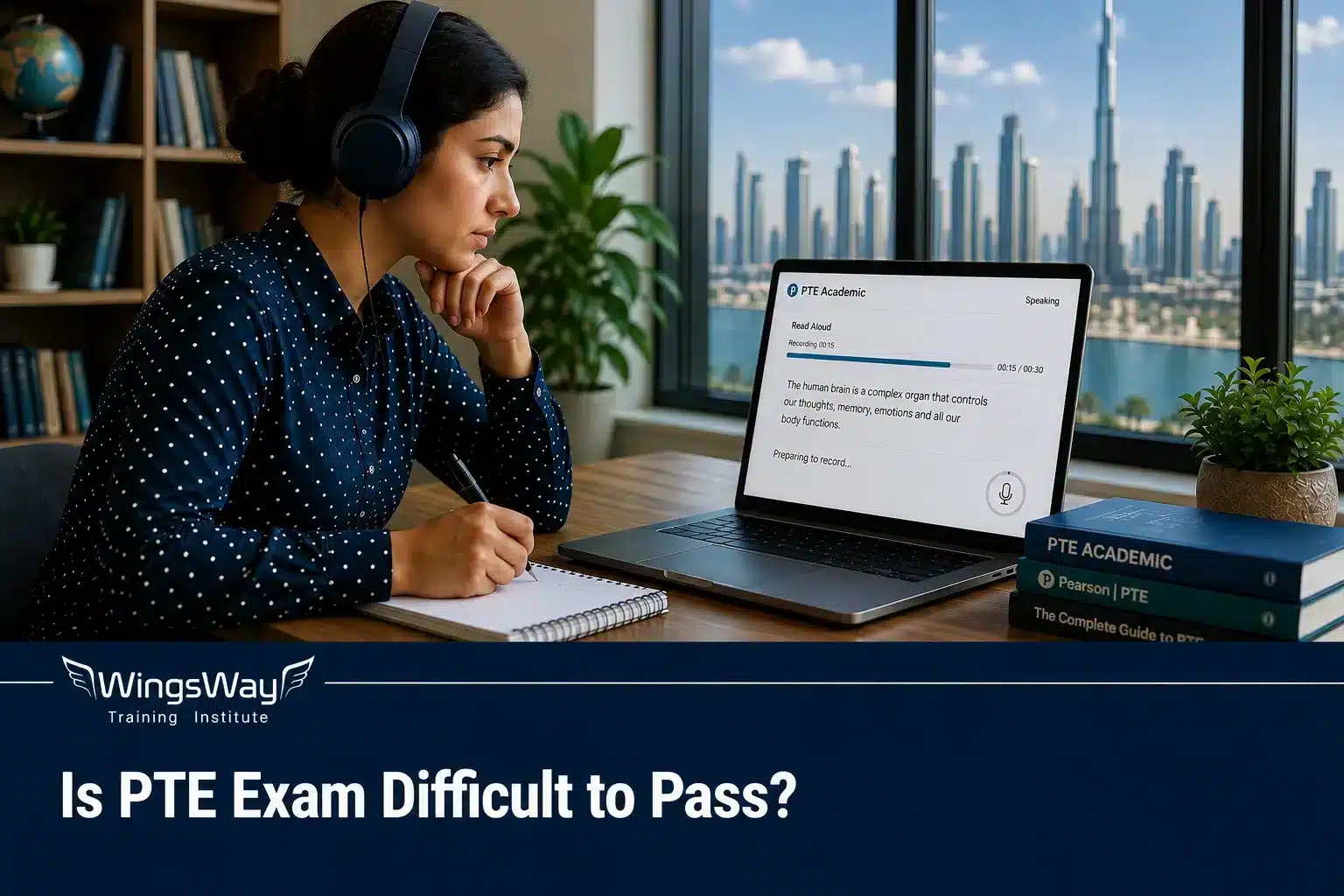
The PTE Exam is a fully computer-delivered test that evaluates Speaking, Writing, Reading, and Listening in a single sitting lasting approximately two hours. Because responses are scored by an AI system, the exam rewards clarity, correct grammar, natural pacing, and direct answers rather than subjective interpretation. This is different from human-marked exams, where tone, personality, or writing style can sometimes influence scoring. For candidates unfamiliar with speaking into a microphone under time pressure, or typing responses within strict word limits, the format itself can feel more demanding than the English content it tests.
Detailed Breakdown of PTE Exam Sections
Speaking and Writing Section
This is the longest section, typically taking between 54 and 67 minutes and covering several task types, including Read Aloud, Repeat Sentence, Describe Image, Retell Lecture, Summarize Written Text, and Essay Writing. Because Speaking and Writing responses are recorded and evaluated together in the same block, candidates often find this section the most demanding due to sustained concentration requirements.
Reading Section
The Reading section tests grammar, vocabulary in context, and comprehension through tasks such as Fill in the Blanks, Multiple Choice, and Re-order Paragraphs. Candidates who struggle here typically lack exposure to academic-style texts rather than lacking general English ability.
Listening Section
This section includes Summarize Spoken Text, Highlight Correct Summary, Fill in the Blanks, and Write from Dictation. Because several Listening tasks also contribute to the Writing score, accuracy in this section has a disproportionate effect on the overall result.
Scoring Scale and What It Means
Scores range from 10 to 90, and each skill is reported individually as well as combined into an overall score. Universities, employers, and immigration authorities set their own minimum score requirements, which means the exam is not “difficult” or “easy” in absolute terms — difficulty is always relative to the score a candidate needs to reach.
Common Reasons Candidates Find PTE Challenging
- Unfamiliarity with speaking continuously into a microphone without natural pauses
- Strict word count and time limits on Writing tasks
- Limited exposure to the specific question types before test day
- Underestimating how much Listening accuracy affects the Writing score
- Insufficient timed practice under real exam conditions
Career and Academic Outcomes
A recognized PTE score opens pathways to university admission, skilled migration visas, and certain professional licensing processes in countries that accept Pearson’s test. For job seekers in the UAE and GCC, a strong English proficiency score can also support applications for roles requiring international communication, particularly in aviation, logistics, and corporate training sectors where clear spoken and written English is a baseline requirement.
How to Start Preparing for the PTE Exam
- Assess your current level: Take a diagnostic or mock test to identify strengths and weaknesses across all four skills before starting formal PTE Exam Preparation.
- Study the exact task types: Familiarity with each of the roughly 20 question formats reduces surprises on test day.
- Practise under timed conditions: Simulating the real two-hour format builds stamina and pacing.
- Focus on high-weight tasks: Tasks like Read Aloud and Write from Dictation influence multiple skill scores, so prioritising them can improve overall results efficiently.
- Review official scoring criteria: Understanding how the AI evaluates fluency, pronunciation, and content helps candidates adjust their delivery accordingly.
Frequently Asked Questions
Q1: Is the PTE Exam harder than IELTS?
Neither test is objectively harder; they assess English differently. The PTE Exam is fully computer-based and AI-scored, while IELTS includes a face-to-face speaking component. Candidates comfortable with typing and speaking into a microphone often find PTE more predictable, while those who prefer human interaction may lean toward IELTS preparation instead.
Q2: What score is considered a pass in the PTE Exam?
There is no universal pass score. The PTE Exam is reported on a 10 to 90 scale, and the required score depends entirely on the university, employer, or visa category the candidate is applying to.
Q3: How long does it take to prepare for the PTE Exam?
Most candidates with an intermediate English level need between 4 and 8 weeks of structured PTE Exam Preparation, depending on their target score and starting proficiency.
Q4: Can beginners pass the PTE Exam without prior English training?
Beginners can take the PTE Exam, but reaching competitive scores usually requires foundational English development first, followed by exam-specific strategy training.
Q5: Is PTE accepted for UAE-based university applications?
Many international universities with UAE campuses accept PTE scores alongside IELTS, though requirements vary by institution, so candidates should confirm directly with their target university.
Q6: How is the PTE Exam scored?
The PTE Exam uses AI-based scoring supported by human quality checks, assessing content accuracy, pronunciation, fluency, and grammar objectively across all sections.
Q7: Do PTE and IELTS test the same skills?
Both exams assess Speaking, Writing, Reading, and Listening, but the question formats, delivery method, and scoring systems differ significantly between the two.
Trust and Credibility Considerations
When evaluating training providers for the PTE Exam or related language and academic preparation courses, candidates should look for institutional accountability rather than marketing promises alone. In Dubai, KHDA approval indicates that a training provider operates under recognized regulatory oversight. Accreditation from bodies such as the CPD (UK) Standards Office adds an additional layer of external quality verification for course content and delivery standards. These credentials do not determine exam difficulty, but they do help candidates identify preparation providers that meet independently assessed quality benchmarks.
Why Choose WingsWay Training Institute for PTE Exam Preparation
- Regulatory oversight: WingsWay Training Institute is a KHDA-approved provider in Dubai, placing its programs under recognized regulatory oversight rather than operating independently of any quality framework.
- Cross-industry accreditation: The institute holds accreditation from CIPS, CILT International, IATA, and CPD (UK) — credentials earned across its wider course portfolio, not specific to PTE alone.
- Institutional standard: These accreditations signal a consistent standard for how WingsWay designs, delivers, and reviews its training programs.
Exam-specific preparation approach: PTE sessions are structured around the exam’s actual AI-scoring logic, not treated as general English coaching. - Scoring-aligned practice: Preparation includes timed task drills, pronunciation and fluency calibration, and writing exercises measured against the same criteria Pearson’s scoring system applies.
- Comparison advantage: Candidates weighing PTE against IELTS Training in Dubai often find this exam-specific method — rather than a one-size-fits-all English course — more effective for producing a predictable score.
Conclusion
The PTE Exam is not difficult in the traditional pass-or-fail sense, since it uses a 10 to 90 scoring scale rather than a fixed threshold. Its perceived difficulty comes mainly from its AI-scored, fully computer-based format, which rewards precision, timing, and familiarity with specific task types over memorisation. Candidates who understand the exam structure, practise under realistic timed conditions, and target the sections with the highest scoring weight generally find the test manageable regardless of their starting English level. As demand for both PTE and IELTS continues to grow across the UAE and GCC, informed preparation remains the most reliable factor in exam outcomes — not the exam’s inherent difficulty.
Author & Review Information
- Written by: WingsWay Content Research Team
- Reviewed by: Senior Training Instructor, WingsWay Training Institute
Course content, scoring frameworks, and instructional material referenced in this article are developed and periodically reviewed by WingsWay’s subject-matter instrors to maintain factual accuracy and alignment with current exam standards.
Need More Details About This Course?
Connect with our team directly on WhatsApp for course details, fees, schedules, and guidance.
Tag:English proficiency test UAE, language exam preparation UAE, PTE Academic UAE, PTE AI scoring, PTE course in UAE, PTE Exam, PTE exam difficulty, PTE Exam Preparation, PTE exam tips, PTE mock test, PTE preparation for beginners, PTE scoring system, PTE test format, PTE training Dubai, PTE vs IELTS